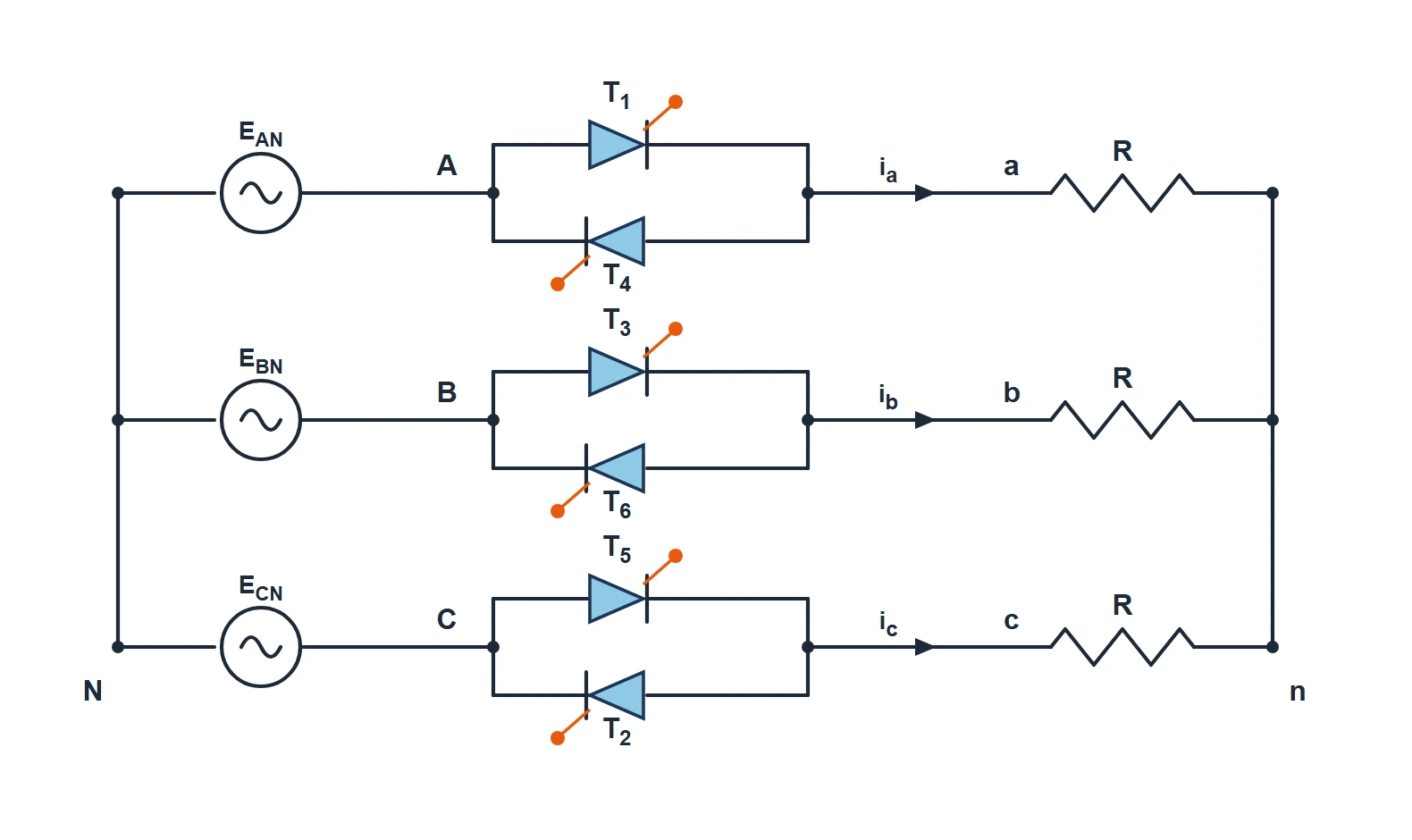
What is a three-phase AC voltage controller?
A three-phase AC voltage controller (AC regulator) varies the RMS voltage delivered to a three-phase load at constant frequency. It uses six thyristors — three anti-parallel pairs, one in each line (T1/T4, T3/T6, T5/T2). Each is fired with a delay α measured from its phase-voltage zero crossing, so only part of each half-cycle reaches the load. It is the standard controller for three-phase heaters and lighting and for induction-motor soft starters.
RMS output voltage (balanced resistive load)
For a balanced load connected so each phase is controlled independently (a star load with neutral, or a delta load where each branch is its own controller), each phase behaves exactly like a single-phase controller. The per-phase RMS output is:
where Vs is the phase (line-to-neutral) RMS. This simulator integrates the actual thyristor circuit for all three phases, so the measured per-phase RMS matches this formula to numerical precision. The three-phase load power is P = 3·Vo(rms)²/R.
Neutral current & triplen harmonics — topic-specific
Phase-angle control chops each line current, so it contains odd harmonics. The fundamental and the non-triplen harmonics (5th, 7th, 11th…) are balanced three-phase sets and sum to zero — but the triplen harmonics (3rd, 9th, 15th…) are identical (co-phasal) in all three phases and add together in the neutral wire. So a 4-wire controller can carry a substantial neutral current made almost entirely of 3rd harmonic, even though the load is perfectly balanced. Using a 3-wire star or a delta load removes the neutral path and eliminates this current (at the cost of a more complex three-mode conduction pattern).
Three-mode conduction (3-wire star)
In a 3-wire star with no neutral, current must always flow through two lines at once, so the behaviour splits into three regions of firing angle:
| Mode | Firing angle α | Devices conducting |
|---|---|---|
| I | 0° – 60° | 3 or 2 thyristors |
| II | 60° – 90° | always 2 thyristors |
| III | 90° – 150° | 2 or 0 thyristors |
Beyond α = 150° the output is zero. This simulator models the independently-controlled (4-wire / delta) case, whose per-phase output has the exact closed form above.
Applications
Three-phase heater and furnace control, lighting, and induction-motor soft starters (ramp α down from a large value to limit starting inrush). See also the single-phase AC voltage controller.
Frequently asked questions
What is a three-phase AC voltage controller?
An AC-to-AC converter using six thyristors (three anti-parallel pairs) that varies the RMS load voltage at constant frequency by phase-angle control.
What is the per-phase RMS output?
For an independently-controlled balanced load, Vo(rms) = Vs·√(1 − α/π + sin(2α)/(2π)) per phase, full at α = 0.
Why is there a neutral current with a balanced load?
The triplen harmonics (3rd, 9th…) produced by phase control are co-phasal in all three phases and add in the neutral instead of cancelling, so a 4-wire controller carries a 3rd-harmonic-dominated neutral current.
How is it used as a soft starter?
Start with a large α (reduced voltage, limited inrush) and ramp α down to zero over a few seconds to apply full voltage smoothly.