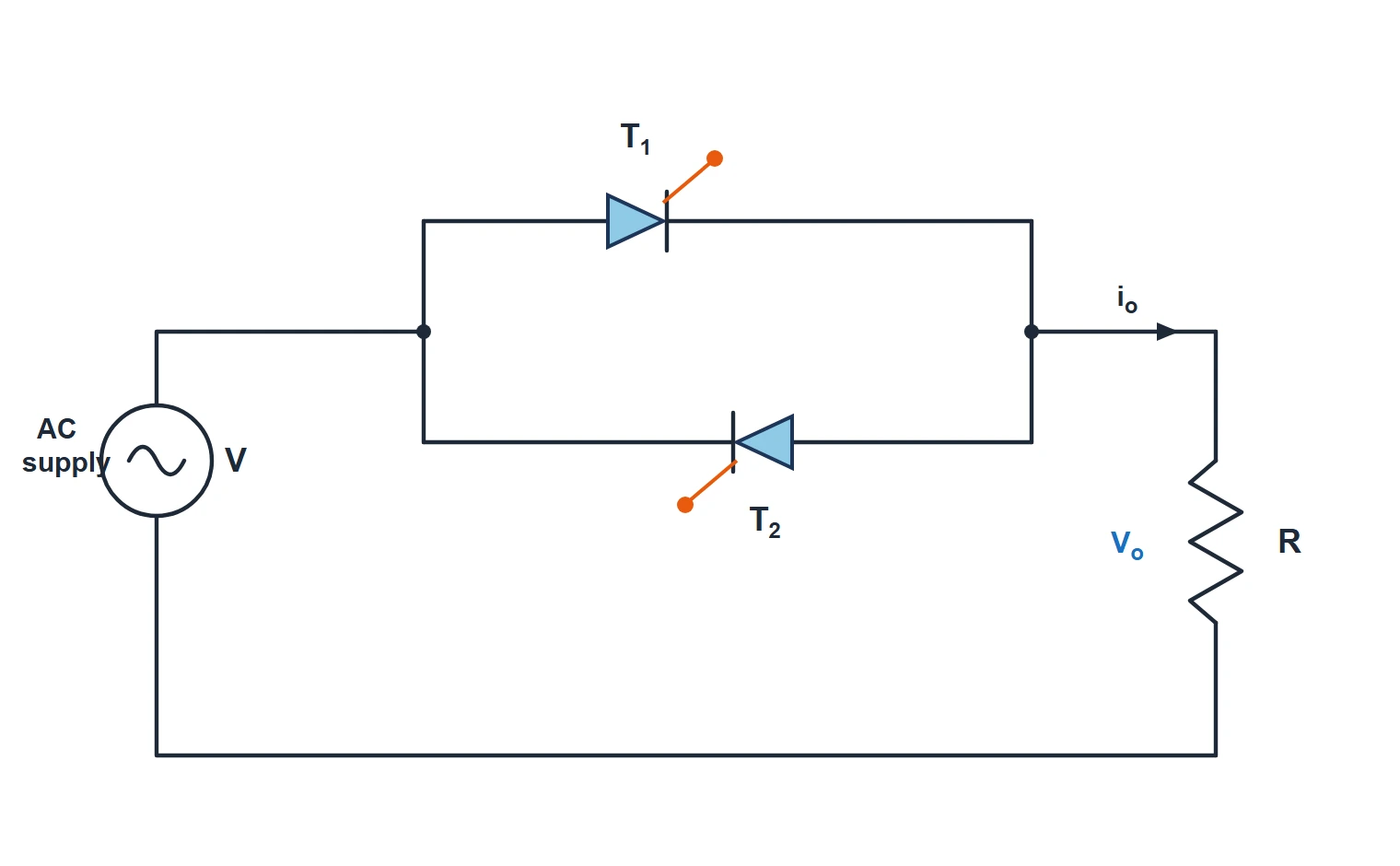
What is a single-phase AC voltage controller?
A single-phase AC voltage controller (also called an AC regulator, AC chopper or dimmer) varies the RMS voltage delivered to an AC load without changing the frequency. Two anti-parallel thyristors — or a single TRIAC — are placed in series with the load. Each half-cycle the device is fired after a delay called the firing angle α, so only the part of the sine wave from α onward reaches the load. Increasing α reduces the output; this is phase-angle control.
RMS output voltage (resistive load)
For a purely resistive load the current stops at the voltage zero crossing, so each thyristor conducts from α to 180°. The RMS output voltage is:
At α = 0 the full supply Vs appears; the output falls to zero at α = 180°. The load power is P = Vo(rms)²/R. This simulator integrates the actual thyristor circuit, so the measured RMS matches this formula to numerical precision.
Extinction & conduction angle (R-L load) — topic-specific
With an inductive (R-L) load the current lags the voltage and cannot stop at the zero crossing; it keeps flowing until it naturally returns to zero at the extinction angle β, found from:
The conduction angle is γ = β − α. A crucial result: if α ≤ φ, conduction becomes continuous and phase control has no effect — the output equals the full supply. Effective control only happens for φ < α < 180°. The analyzer above computes φ, β and γ live and tells you which region you are in.
Applications & limitations
| Use | Load | Notes |
|---|---|---|
| Light dimmer | Resistive (lamp) | Simple TRIAC dimmer |
| Fan / heater control | R or R-L | Speed / temperature control |
| Induction-motor soft starter | R-L | Ramp α down to limit inrush |
The drawback is a poor input power factor and high harmonic distortion (odd harmonics), because the current is chopped and delayed. Where harmonics matter, integral-cycle (burst-fire) control or a PWM AC chopper is used instead.
See also the three-phase AC voltage controller and the phase-controlled single-phase rectifiers.
Frequently asked questions
What is an AC voltage controller?
An AC-to-AC converter that varies the RMS load voltage at constant frequency using anti-parallel thyristors (or a TRIAC) fired at a delay angle α.
What is the RMS output for a resistive load?
Vo(rms) = Vs·√(1 − α/π + sin(2α)/(2π)); full at α = 0, zero at α = 180°.
What is the extinction angle?
With an inductive load the current continues past the zero crossing to the extinction angle β; conduction angle γ = β − α. Control is only effective when α > the load angle φ.
Why is the power factor poor?
Chopping and delaying the current lowers the displacement and distortion factors and injects odd harmonics, so the input power factor drops well below unity as α increases.