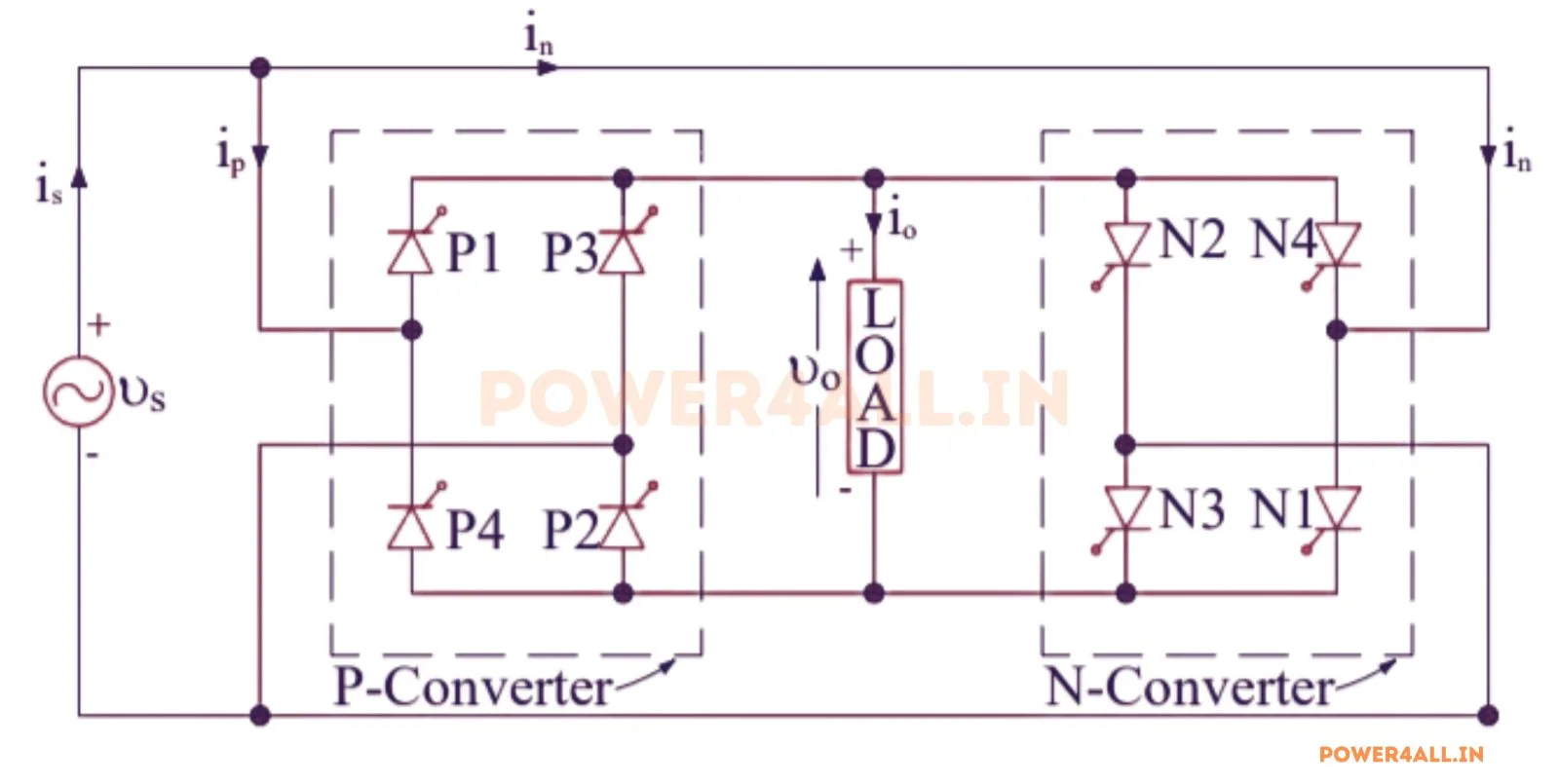
What is a single-phase to single-phase cycloconverter?
It is the simplest cycloconverter: a direct AC-to-AC frequency changer that turns a single-phase supply into a single-phase output at a lower frequency, with no intermediate DC link. Two single-phase phase-controlled converters are connected in anti-parallel across the load — a positive group (P) for positive load current and a negative group (N) for negative load current. Each group can be a mid-point (2-pulse) or bridge converter.
Cosine-wave firing modulation
The firing angle is modulated as cos α(t) = r·sin(ωot), so the local average of the output follows Vd0·r·sin(ωot). Each half-cycle of the input supply contributes one controllable segment, so there are 2·fi/fo segments per output cycle.
Fundamental output voltage
where Vm is the peak supply voltage and Vd0 = 2Vm/π is the maximum mean output of a single-phase full-wave (2-pulse) converter — the same value that appears in a single-phase full-wave controlled rectifier. This simulator builds the output with the real cosine-crossing firing and checks the fundamental against r·Vd0.
Output frequency & waveform quality — topic-specific
A cycloconverter can only step frequency down: the output frequency is a fraction of the input, typically fo = fi/n. With only 2 pulses per input cycle the output is coarse, so a single-phase cycloconverter is usually kept to fo ≤ fi/3 and is mostly used to teach the principle before moving to 3-pulse and 6-pulse three-phase versions.
Applications
Small single-phase low-frequency supplies and, above all, a teaching model for direct frequency conversion. For practical drives see the three-phase to single-phase half-wave cycloconverter, the three-phase to single-phase full-bridge cycloconverter, the three-phase to three-phase half-wave cycloconverter and the three-phase to three-phase full-wave cycloconverter.
Frequently asked questions
What is a single-phase to single-phase cycloconverter?
The simplest direct AC-to-AC frequency changer: it turns a single-phase supply into a lower-frequency single-phase output using two anti-parallel single-phase converter groups (positive and negative) with cosine-modulated firing — no DC link.
What is the fundamental output voltage?
Vo1(peak) = r·Vd0 with Vd0 = 2·Vm/π ≈ 0.637·Vm, so Vo1(rms) = r·Vd0/√2. r is the modulation ratio (0–1).
Can a cycloconverter increase the frequency?
No. A cycloconverter is a step-down frequency changer — the output frequency is always a fraction of the input frequency (fo = fi/n). Raising the output above the input is not possible.
Why is the single-phase cycloconverter mainly a teaching example?
With only two pulses per input cycle its output is coarse and distorted, so real drives use 3-pulse or 6-pulse three-phase cycloconverters. The single-phase version is the clearest way to learn the cosine-modulation principle.