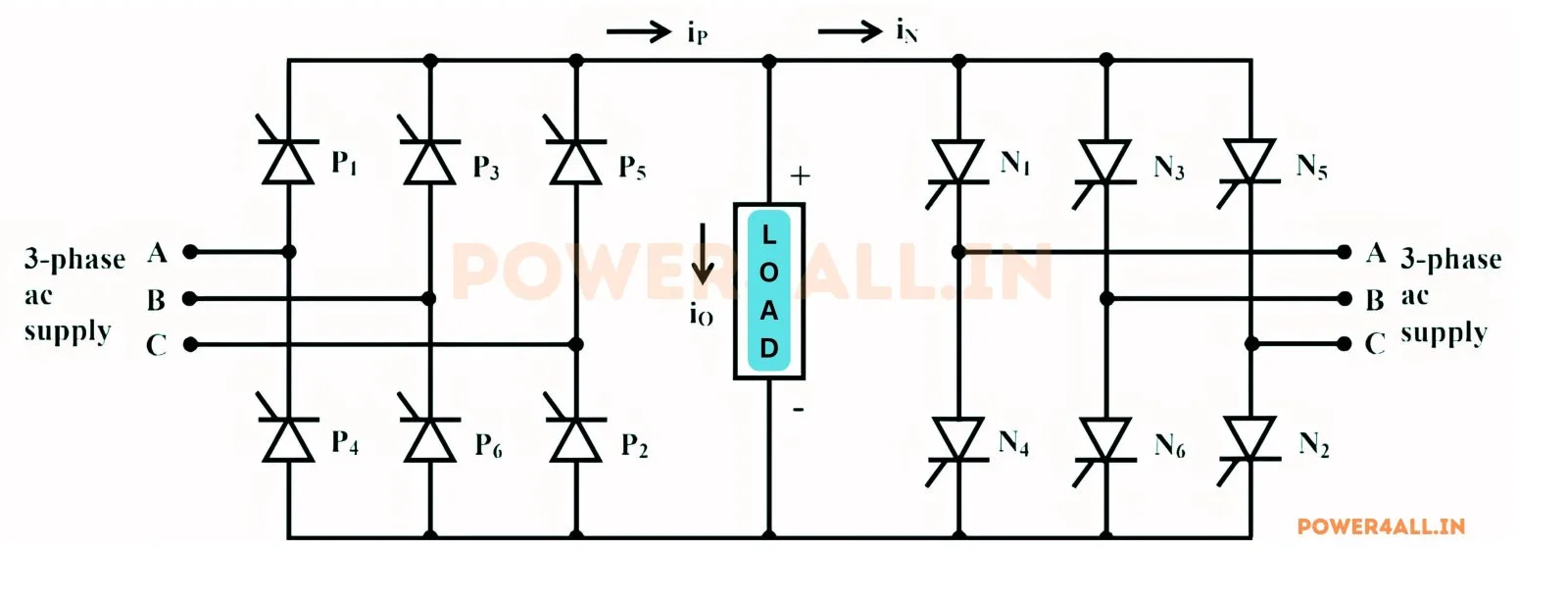
What is a three-phase to single-phase full-bridge cycloconverter?
A full-bridge cycloconverter is a direct AC-to-AC frequency changer in which each converter group is a full three-phase bridge (6-pulse) rather than a simple 3-pulse group. Two such bridges are connected in anti-parallel across one single-phase load — a positive group (P) and a negative group (N) — and their firing angles are modulated by the cosine-wave scheme so the combined output follows a low-frequency reference sine.
Cosine-wave firing modulation
Each bridge is fired so that cos α(t) = r·sin(ωot). Because a 6-pulse bridge has a mean output of Vd0·cos α, the local average of the synthesized output follows Vd0·r·sin(ωot) — a smooth low-frequency sine, assembled from six input segments per input cycle.
Fundamental output voltage
where Vm is the peak phase voltage. Vd0 is the maximum mean output of a three-phase full-wave (6-pulse) bridge — the same value that appears in a three-phase full-wave controlled rectifier. Because a 6-pulse bridge uses six segments per input cycle instead of three, its output is far smoother than the half-wave cycloconverter and it can run at a higher output frequency.
Output frequency limit & waveform quality — topic-specific
The output is assembled from p·fi/fo segments per output cycle, with p = 6 here. The extra segments mean a 6-pulse cycloconverter keeps low distortion up to roughly fo ≤ fi/2 — better than the 3-pulse half-wave version (fi/3). Push fo/fi higher and the harmonic content still grows and the fundamental droops below r·Vd0.
Applications
The 6-pulse cycloconverter is the workhorse for large low-speed AC drives — rolling mills, cement kilns, mine hoists — where its low output distortion matters. Compare it with the three-phase to single-phase half-wave cycloconverter, the three-phase to three-phase half-wave cycloconverter and three-phase to three-phase full-wave cycloconverter, and the single-phase to single-phase cycloconverter.
Frequently asked questions
What is a three-phase to single-phase full-bridge cycloconverter?
A direct AC-to-AC frequency changer that turns a three-phase supply into a lower-frequency single-phase output using two anti-parallel three-phase full-bridge (6-pulse) groups with cosine-modulated firing — no DC link.
What is the fundamental output voltage?
Vo1(peak) = r·Vd0 with Vd0 = (3√3/π)·Vm ≈ 1.654·Vm, so Vo1(rms) = r·Vd0/√2. r is the modulation ratio (0–1).
Why is a 6-pulse cycloconverter better than a 3-pulse one?
It uses six input segments per cycle instead of three, so the output is smoother, the THD is lower, and it can run up to about fo = fi/2 instead of fi/3.
What are full-bridge cycloconverters used for?
Large low-speed drives such as rolling mills, cement kilns and mine hoists, where low output distortion and four-quadrant operation without a DC link are important.