DC-AC · Impedance-Source Inverter · Virtual Lab

Three-Phase Z-Source Inverter Simulator

An advanced, physics-accurate simulator of the three-phase Z-source inverter (ZSI) — a single-stage buck-boost three-phase inverter whose X-shaped impedance network uses a shoot-through state to raise the DC-link above the input. Sweep the shoot-through duty D0, modulation index M, the L-C network and the load, and watch the true Z-network waveforms — shoot-through, boosted DC-link, inductor current and capacitor voltage — plus all three phase voltages, the line voltages and the three-phase currents. Validated live against the boost factor B = 1/(1−2·D0), peak DC-link B·Vdc and the three-phase output Vph1 = M·B·Vdc/2.

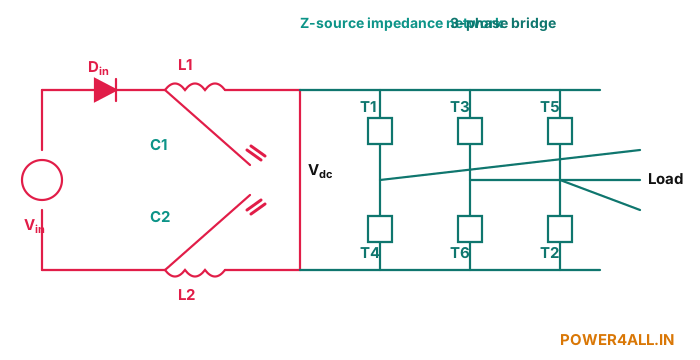
Three-phase Z-source inverter circuit diagram: DC source Vin, input diode Din, the X-shaped Z-source impedance network of inductors L1, L2 and capacitors C1, C2, and a six-switch three-phase bridge (T1-T6) feeding a three-phase load, allowing a shoot-through state to boost the DC-link
Three-phase Z-source inverter — the X-connected L1/L2/C1/C2 network lets a shoot-through state boost the DC-link to B·Vdc before the three-phase bridge (T1–T6) inverts it.

Shoot-through & modulation

Boost factor B = 1/(1−2·D0). D0→0.5 ⇒ B→∞.
Must satisfy M + D0 ≤ 1.
V

Z-network & load

Sampling & display

Presets

Waveforms to display

Z-network waveforms — switching-period scale

shoot-through DC-link v_dc i_L1 V_c1
LIVE

Shoot-through boost analyzer (topic-specific)

Boost factor B
Capacitor Vc
Peak DC-link B·Vdc
Line VLL1 (√3/2)MB·Vdc
The shoot-through state charges L1/L2; when it ends, the boosted DC-link B·Vdc feeds the three-phase bridge. Increase D0 to boost more — but keep M + D0 ≤ 1.

Three-phase output — all waveforms, one fundamental period

VaoVbo VcoVab line fundamental

Harmonic spectrum & measurements

Line-voltage THD (relative to fundamental)

Live accuracy check — simulation vs closed-form theory

Boost / capacitor  
Three-phase output  

What is a three-phase Z-source inverter?

A three-phase Z-source inverter (ZSI) combines the standard six-switch three-phase bridge with the distinctive X-shaped Z-source impedance network (two inductors L1, L2 and two capacitors C1, C2) between it and the DC source. This makes it a single-stage buck-boost inverter: a deliberate shoot-through state — impossible in a normal inverter — charges the inductors and boosts the DC-link, so the three-phase AC output can exceed the DC input without a separate boost converter, with inherent immunity to shoot-through faults.

The shoot-through boost (topic-specific)

B = 1/(1 − 2·D0) · Vc = (1 − D0)/(1 − 2·D0)·Vdc · peak DC-link v̂ = B·Vdc
phase peak Vph1 = M·v̂/2 = M·B·Vdc/2 · line peak VLL1 = (√3/2)·M·B·Vdc · M + D0 ≤ 1

Applying inductor volt-second balance to the Z-network gives the boost factor B and capacitor voltage above. This simulator integrates the real Z-network through the shoot-through and active states to steady state, so the boosted DC-link, inductor current and capacitor voltage are exact, and it then applies three-phase sinusoidal PWM on that boosted link to produce all three phase voltages, the line voltages and the load currents.

Z-source vs conventional three-phase VSI

FeatureConventional VSIZ-source inverter
Voltage capabilityBuck onlyBuck & boost
Shoot-throughDestructive faultUsed to boost — safe
StagesBoost + inverterSingle stage
Dead-timeRequiredNot needed

See the single-phase Z-source inverter and the conventional three-phase 180° and 120° inverters.

Applications

Photovoltaic and fuel-cell grid-tie inverters, electric-vehicle traction and industrial motor drives — anywhere a single-stage three-phase buck-boost with a wide DC-input range and high reliability is needed.

Frequently asked questions

What is the boost factor?

B = 1/(1−2·D0); the boosted DC-link is B·Vdc and the capacitor voltage is (1−D0)/(1−2·D0)·Vdc.

What is the three-phase output voltage?

Phase peak M·B·Vdc/2, line-to-line peak (√3/2)·M·B·Vdc, with M + D0 ≤ 1.

Why is shoot-through safe?

The Z-network inductance is in series with the bridge, so a shoot-through charges the inductors instead of shorting the source — and it boosts the DC-link.

Where is it used?

PV and fuel-cell grid-tie inverters and EV/motor drives, where the DC input varies and single-stage buck-boost is valuable.

Power4All · Three-Phase Z-Source Inverter interactive simulator. All waveforms are produced by numerical integration of the actual switching circuit and validated against closed-form theory.