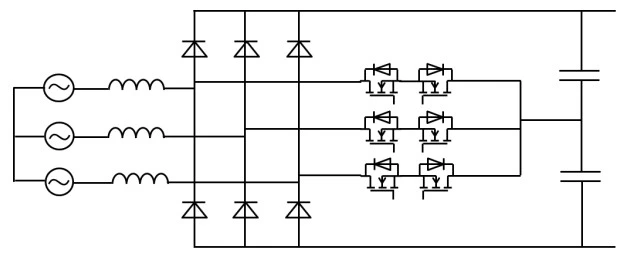
What is a Vienna rectifier?
The Vienna rectifier is a three-phase, three-level, unity-power-factor boost rectifier. Each phase has a boost inductor and a bidirectional switch tied to the mid-point (neutral) of a split DC bus (two series capacitors), together with rectifier diodes. With only three controlled switches it shapes sinusoidal input currents in phase with the voltages and produces a regulated DC output with very low harmonic distortion — the classic front end for high-power three-phase supplies.
Three-level operation
Because each phase terminal can be connected to the positive rail, the neutral mid-point, or the negative rail, the converter phase voltage takes three levels: +Vo/2, 0, −Vo/2. The smaller voltage steps (half those of a two-level converter) produce much smaller inductor-current ripple and lower THD, so the input filter can be smaller and the switches see only half the DC-bus voltage.
Unity power factor and boost operation
The current controller forces each line current to be a sinusoid in phase with its phase voltage, so the power factor is close to 1 and the THD is very low. As a boost rectifier the DC bus must sit above the line-to-line peak √3·Vm (about 560 V for a 400 V line, so a 700–800 V bus is typical).
No low-frequency ripple — the three-phase advantage
For a balanced three-phase set the instantaneous input power is constant:
So, unlike the single-phase boost PFC, there is no 100/120 Hz output ripple — only high-frequency switching ripple. The simulator verifies that p(t) is flat in real time.
Applications
Telecom and data-centre rectifiers, EV fast chargers, wind-turbine and aircraft converters — anywhere high power, unity power factor and low THD are needed. Compare the two-level PWM / active-front-end rectifier and the single-phase boost PFC.
Frequently asked questions
What is a Vienna rectifier?
A three-phase, three-level, unity-power-factor boost rectifier that draws sinusoidal input currents with only three controlled switches and produces a regulated DC output with low THD.
Why is it called three-level?
Each phase terminal can connect to the positive rail, the neutral mid-point or the negative rail, so the converter phase voltage takes three levels (+Vo/2, 0, −Vo/2), giving small steps and low harmonics.
Does it have twice-line-frequency output ripple?
No. Balanced three-phase input power is constant, so there is no 100/120 Hz output ripple — only high-frequency switching ripple.
How high must the DC bus be?
Above the line-to-line peak √3·Vm. For a 400 V line that is about 560 V, so a 700–800 V bus is typical.