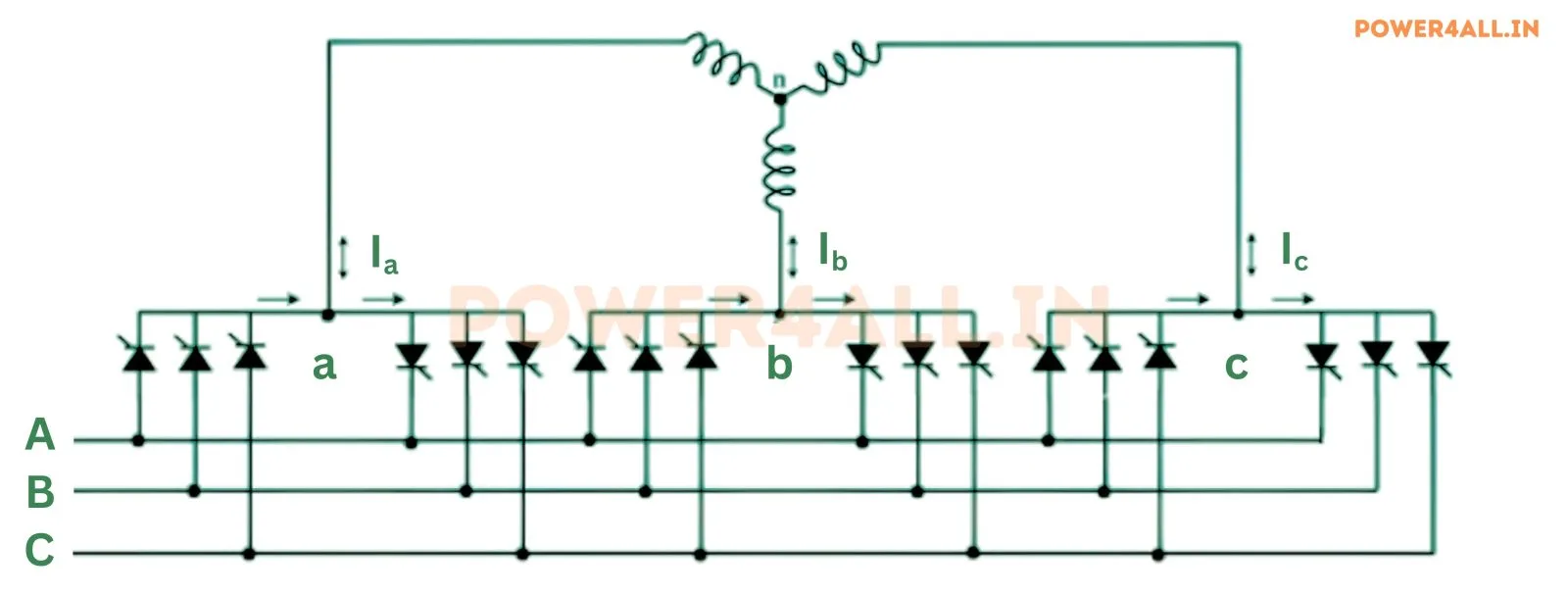
What is a three-phase to three-phase half-wave cycloconverter?
It is a direct AC-to-AC frequency changer that converts a three-phase supply into a balanced three-phase output at a lower frequency, with no intermediate DC link. It is made of three single-phase-output cycloconverters — one per output phase — each using a positive and a negative 3-pulse converter group. That is 18 thyristors in total (3 phases × 2 groups × 3 devices).
Balanced three-phase output by cosine modulation
Each output phase is fired with the cosine-wave law cos α(t) = r·sin(ωot + φ), where the reference phase φ is 0°, −120° and −240° for the three phases. This makes the three local averages follow a balanced set of low-frequency sines: Vd0·r·sin(ωot), …sin(ωot−120°) and …sin(ωot−240°).
Fundamental output voltage (per phase)
where Vm is the peak phase voltage. The three output-phase fundamentals are equal in magnitude and 120° apart, so the output is a balanced three-phase set. This simulator synthesizes all three phases by the real cosine-crossing firing scheme and checks the phase-A fundamental against r·Vd0 to numerical precision.
Output frequency limit & waveform quality — topic-specific
As with any 3-pulse cycloconverter, each output phase is assembled from 3·fi/fo segments per output cycle. Keeping fo ≤ fi/3 gives a clean balanced 3φ output; higher ratios raise distortion and droop the fundamental.
Applications
Three-phase cycloconverters drive large low-speed three-phase machines directly — synchronous and induction motors in mills, kilns and hoists rated up to many MW. Compare with the three-phase to three-phase full-wave cycloconverter (6-pulse, lower distortion), the three-phase to single-phase half-wave cycloconverter, the three-phase to single-phase full-bridge cycloconverter and the single-phase to single-phase cycloconverter.
Frequently asked questions
What is a three-phase to three-phase half-wave cycloconverter?
A direct AC-to-AC frequency changer that produces a balanced three-phase output at a lower frequency using three single-phase cycloconverters (one per phase), each with positive and negative 3-pulse groups — 18 thyristors, no DC link.
How many thyristors does it use?
Eighteen: three output phases, each with a positive and a negative 3-pulse group of three thyristors (3 × 2 × 3 = 18).
What is the per-phase fundamental output voltage?
Vo1(peak) = r·Vd0 with Vd0 = (3√3/2π)·Vm ≈ 0.827·Vm; the three phases are equal and 120° apart.
Why keep fo below fi/3?
Each phase is made of 3·fi/fo input segments per output cycle; too few segments (high fo/fi) raise distortion and droop the fundamental. fo ≤ fi/3 keeps the balanced output clean.