What is an indirect matrix converter?
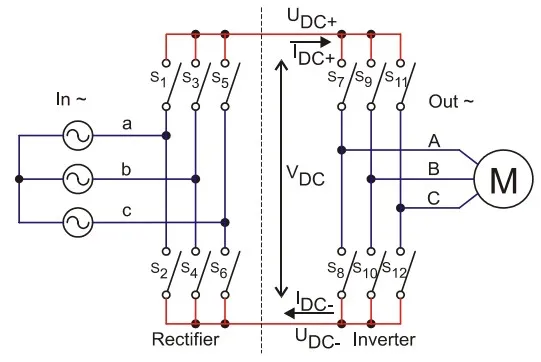
An indirect matrix converter (IMC) is a direct AC-to-AC converter that reaches the same result as the direct matrix converter but is drawn as two stages sharing a virtual DC link that holds no capacitor. A current-source rectifier (six bidirectional switches, S1–S6) forms the DC link from the input; a voltage-source inverter (six switches, S7–S12) then builds the three-phase output.
The virtual DC link
The rectifier stage always connects the DC-link rails to the most positive and most negative input phases, so the virtual DC-link voltage vpn is always positive and ripples with six humps per input cycle. Because the rectifier switches only when the DC-link current is zero (the inverter is in a freewheeling state), commutation is far simpler than the direct converter's four-step method.
Output voltage and the 0.866 limit
The inverter uses space-vector modulation, referenced to the instantaneous DC link, to make each output phase track q·Vim·sin(ωot). As with any matrix converter the linear ceiling is 0.866·Vim; this simulator confirms Vo = q·Vim by FFT of the real switched waveform.
Why the indirect form? — topic-specific
The indirect topology keeps the matrix converter's virtues — no DC-link capacitor, sinusoidal input currents, near-unity input power factor and four-quadrant operation — while making commutation and protection much easier because switching is done at zero DC-link current. It is also the natural stepping stone to the reduced-switch sparse matrix converter.
Applications
The same compact, capacitor-free drives as the direct converter — aerospace, marine and wind systems — where simple commutation and protection are valued. Compare the direct matrix converter and the sparse matrix converter.
Frequently asked questions
What is an indirect matrix converter?
A direct AC-to-AC converter drawn as a current-source rectifier and a voltage-source inverter sharing a virtual DC link with no capacitor. It gives the same output as a direct matrix converter but commutates at zero DC-link current.
What is the maximum voltage transfer ratio?
Vo = q·Vim with a linear-range maximum of q = √3/2 ≈ 0.866, the same as the direct matrix converter. Above it the output over-modulates.
What is the virtual DC link?
A pair of DC rails formed by the rectifier from the most positive and most negative input phases. It holds no capacitor, is always positive, and ripples with six humps per input cycle.
How is it better than the direct matrix converter?
It commutates while the DC-link current is zero, so it avoids the direct converter's complex four-step commutation and is easier to protect — with the same 0.866 voltage ceiling and sinusoidal input currents.