What is Conductance?
The complete, advanced guide to how easily current flows — the exact opposite of resistance. From the siemens and G = 1/R = I/V to conductivity, combining conductances, admittance in AC circuits, measurement and real-world uses.
Complete Learning Path — Electrical Conductance
From the siemens and G = 1/R to conductivity, combining conductances, admittance, measurement and applications
What is Conductance?
Electrical conductance measures how easily electric current flows through a component. It is the exact mirror image of resistance: where resistance counts the opposition, conductance counts the freedom. The higher the conductance, the more current flows for a given voltage.
Conductance is given the symbol G and is measured in siemens (S) — a unit that used to be called the mho (“ohm” spelled backwards, symbol ℧). By definition it is simply the reciprocal of resistance.
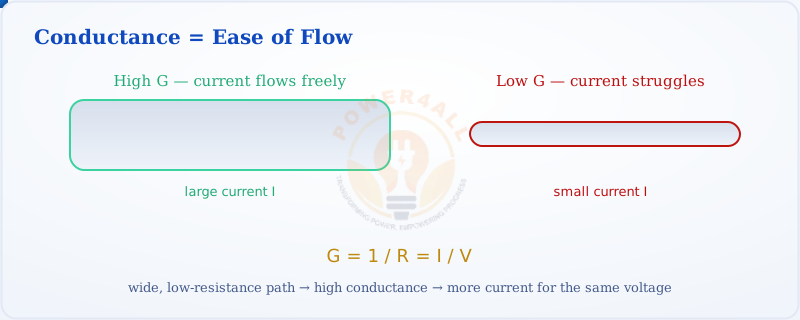
G = 1 / R = I / V
Conductance (siemens) = 1 ÷ Resistance (ohms) = Current (amperes) ÷ Voltage (volts)
The water-pipe analogy
If voltage is water pressure and current is the flow, conductance is how wide and smooth the pipe is. A fat, short, polished pipe lets water gush through — high conductance. A thin, long, rough pipe barely trickles — low conductance.
Conductance & Resistance: Two Views of One Thing
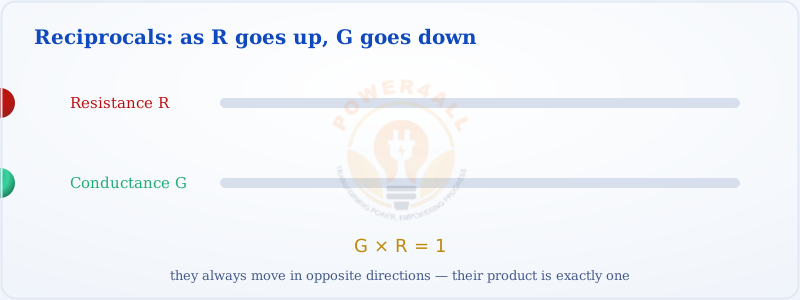
Conductance and resistance describe the same physical reality from opposite ends. Neither is “more correct” — engineers pick whichever makes the maths simpler.
Because G = 1/R, every fact about resistance flips cleanly into a fact about conductance. A good conductor like copper has a low resistance and therefore a high conductance. An insulator like glass has enormous resistance and essentially zero conductance.
High conductance
- Low resistance — silver, copper, aluminium
- Current flows easily for little voltage
- Ideal for wires, busbars and contacts
Low conductance
- High resistance — nichrome, carbon
- Current is choked for a given voltage
- Used in heaters and current-limiting
Near-zero conductance
- Insulators — glass, rubber, air
- G practically zero; blocks current
- Used for insulation and safety
Why bother with conductance at all?
In a parallel circuit, conductances simply add — far easier than the reciprocal sum you need for parallel resistances. That is why nodal analysis and current-divider maths are written in conductances.
Conductance Formulas: G = 1/R, I/V and σA/L
Three formulas cover conductance: from resistance, from Ohm’s law, and from the material’s geometry. They are the reciprocals of the resistance formulas you already know.
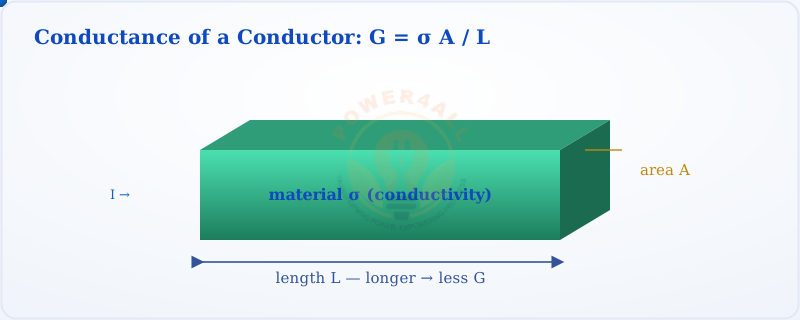
G = σ × (A / L)
Conductance = conductivity (σ, S/m) × cross-sectional area (A, m²) ÷ length (L, m)
Notice how this is the perfect inverse of the resistance formula R = ρL/A: area and length swap roles, and resistivity ρ becomes conductivity σ.
Worked example 1 — conductance from resistance
A resistor measures R = 25 Ω. Its conductance is:
G = 1 / R = 1 / 25 = 0.04 S = 40 mS
So this resistor lets 0.04 amperes flow per volt applied.
Worked example 2 — conductance from Ohm’s law
A component carries 2 A when 8 V is applied across it. Its conductance is:
G = I / V = 2 / 8 = 0.25 S
Check: its resistance is R = 1/G = 4 Ω, and indeed V/I = 8/2 = 4 Ω.
Conductivity & Materials
Conductivity (σ) is a property of the material itself, independent of size or shape — the reciprocal of resistivity (ρ). It tells you how good a material is at carrying current, per metre.
σ = 1 / ρ
Conductivity (σ, siemens per metre) is the reciprocal of resistivity (ρ, ohm-metre)
| Material | Conductivity σ (S/m, approx.) | Verdict |
|---|---|---|
| Silver | 6.3 × 10⁷ | Best conductor of all |
| Copper | 5.96 × 10⁷ | Wiring, windings, PCB tracks |
| Aluminium | 3.5 × 10⁷ | Power lines, busbars |
| Nichrome | ~ 9.1 × 10⁵ | Poor conductor (heating elements) |
| Silicon | ~ 1.6 × 10⁻³ | Semiconductor (tunable by doping) |
| Glass / Rubber | 10⁻¹⁵ – 10⁻₁₀ | Insulator — effectively zero |
Conductance vs conductivity — don’t mix them up
Conductivity (σ) is intrinsic to the material and measured in S/m. Conductance (G) belongs to one specific object of a given size, measured in siemens. Link them with G = σA/L.
Conductance in Series & Parallel
Here conductance really earns its keep. Because it is the reciprocal of resistance, the series and parallel rules swap over — and the parallel case becomes beautifully simple.
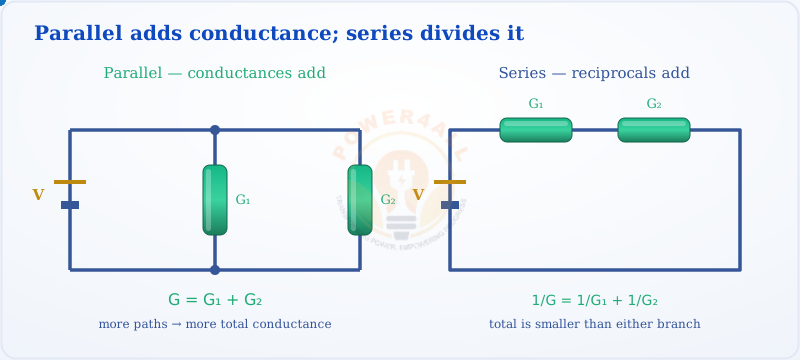
Parallel (the easy one)
G = G₁ + G₂ + G₃
Same voltage across each branch; conductances add directly — the total is always larger.
Series
1/G = 1/G₁ + 1/G₂
Same current everywhere; the reciprocals add, so the total conductance falls.
Worked example 3 — parallel conductances add
Three branches of 0.2 S, 0.3 S and 0.5 S sit in parallel. The total conductance is simply:
G = 0.2 + 0.3 + 0.5 = 1.0 S → R = 1/G = 1 Ω
Adding parallel resistances the long way would have meant 1/R = 1/5 + 1/3.33 + 1/2 — conductance makes it a one-line sum.
Splitting current between parallel branches? The Current Divider Calculator works directly in conductances, and the Delta-Wye Transformation Calculator reduces messy networks.
Conductance in AC: Admittance & Susceptance
In direct-current circuits, conductance is the whole story. In AC circuits, current is also opposed by capacitance and inductance, so conductance becomes just one part of a bigger quantity: admittance.
Admittance Y is the reciprocal of impedance (Z), and it splits into two pieces: the conductance G (the real, energy-dissipating part) and the susceptance B (the reactive part from capacitors and inductors).
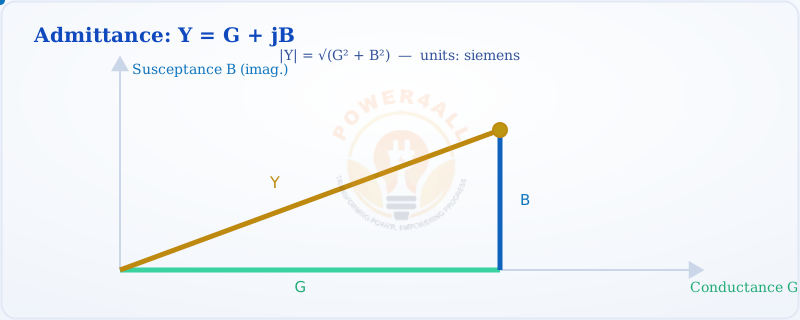
Y = G + jB |Y| = √(G² + B²)
Admittance (Y) = conductance (G) + j × susceptance (B), all measured in siemens
Conductance G
The real part — the part of admittance that actually turns electrical energy into heat or useful work.
Susceptance B
The imaginary part — energy stored and returned each cycle by capacitors (+B) and inductors (−B).
Admittance Y
The AC counterpart of conductance; Y = 1/Z. Parallel admittances add, just like DC conductances.
Measuring Conductance
Most meters read resistance directly, so conductance is usually found by measurement and a quick reciprocal — but dedicated conductance instruments exist where it matters.
Multimeter + reciprocal
Measure resistance on the Ω range (power off), then compute G = 1/R. A 50 Ω reading is 0.02 S.
Conductivity meter
Used for liquids and water quality — reads conductivity in S/m or µS/cm to gauge dissolved ions and purity.
LCR / admittance meter
At AC, an LCR meter reports admittance, splitting it into conductance G and susceptance B directly.
Watch the prefixes
Conductances are often small numbers: a 1 kΩ resistor is only 0.001 S = 1 mS. Keep track of milli- (mS) and micro-siemens (µS) to avoid factor-of-1000 mistakes.
Where Conductance Is Used
Conductance is more than a textbook flip of resistance — it is the natural language of parallel circuits, semiconductors and analysis.
Nodal analysis
Kirchhoff’s current equations are written with a conductance matrix — the backbone of every circuit simulator (SPICE).
Transconductance
Transistors are rated by gm — how much output current a change in input voltage produces, measured in siemens.
Water & soil testing
Electrical conductivity reveals dissolved salts and ions — a standard measure of water purity and soil quality.
Power systems
Line and insulation performance are often quoted as conductance per unit length (leakage conductance) in transmission models.
Working with real circuits? Pair this with the Current Divider Calculator, size wires with the AWG to mm² Calculator, and cost your losses with the Energy Cost Calculator.
Key Terms at a Glance
The essential conductance vocabulary students and engineers search for.
Conductance (G)
Ease of current flow, in siemens (S). G = 1/R = I/V.
Siemens (S)
SI unit of conductance, 1 S = 1 A/V = 1/Ω. Old name: mho.
Conductivity (σ)
Material property, in S/m. σ = 1/ρ, and G = σA/L.
Admittance (Y)
AC conductance, Y = 1/Z = G + jB, in siemens.
Susceptance (B)
Reactive part of admittance from L and C, in siemens.
Transconductance (gm)
Output current per input voltage of an active device, in S.
Frequently Asked Questions
Quick, expert answers to the questions people ask most about electrical conductance.
What exactly is electrical conductance?
Conductance measures how easily electric current flows through a component — the exact opposite of resistance. High conductance means current flows freely for little voltage. It is defined by G = 1/R = I/V and measured in siemens.
What is the unit of conductance?
The siemens (symbol S). 1 S = 1 ampere per volt = 1/Ω. Its old name is the mho (ohm spelled backwards, symbol ℧). Common submultiples are the millisiemens (mS) and microsiemens (µS).
What is the formula for conductance?
Conductance is the reciprocal of resistance, G = 1/R, and from Ohm’s law G = I/V. For a material, G = σA/L, where σ is conductivity, A is area and L is length.
What is the difference between conductance and conductivity?
Conductance (G, in siemens) belongs to a specific object of a given size and shape. Conductivity (σ, in S/m) is a property of the material alone. They are linked by G = σA/L, and σ is the reciprocal of resistivity ρ.
How do conductances combine in series and parallel?
The rules are the reverse of resistance. In parallel, conductances add: G = G₁ + G₂ + …. In series, the reciprocals add: 1/G = 1/G₁ + 1/G₂, giving a smaller total.
Is conductance the reciprocal of resistance?
Yes, exactly. G = 1/R and R = 1/G. A 10 Ω resistor has a conductance of 0.1 S; a 4 S element has a resistance of 0.25 Ω. Their product is always 1.
What is admittance and how is it related?
In AC circuits, admittance Y = 1/Z describes how easily alternating current flows. It has two parts, Y = G + jB: conductance G (real) and susceptance B (reactive, from capacitance and inductance).
Why use conductance instead of resistance?
Because parallel circuits become trivial — conductances simply add. It is the natural quantity for nodal analysis, current dividers and semiconductor equations, where transconductance describes how a device responds to input voltage.
Conclusion & Key Takeaways
Conductance is resistance turned inside out — the measure of how freely current flows. Master it and parallel circuits, semiconductors and AC analysis all become easier.
Ease of current flow
Measured in siemens (S); G = 1/R = I/V.
Reciprocal of resistance
G × R = 1 — two views of one thing.
G = σA/L
Thicker → more; longer → less; material sets σ.
Parallel adds, series divides
The mirror image of the resistance rules.
Admittance in AC
Y = G + jB extends conductance to AC.
The analyst’s tool
Nodal analysis and transconductance live in siemens.