What is Resistance?
The complete, advanced guide to the opposition that limits electric current — from the ohm and Ohm’s law R = V/I to resistivity, the factors that change resistance, temperature effects, series & parallel, measurement and real-world uses.
Complete Learning Path — Electrical Resistance
From the ohm and Ohm’s law to resistivity, factors, temperature, series/parallel, measurement and applications
What is Resistance?
Electrical resistance is the opposition a material offers to the flow of electric current. It is what makes electrons work hard to move — the electrical equivalent of friction. The higher the resistance, the smaller the current for a given voltage.
Resistance is given the symbol R and is measured in ohms (Ω). It is defined by Ohm’s law: the resistance equals the voltage across a component divided by the current through it.
R = V / I
Resistance (ohms) = Voltage (volts) ÷ Current (amperes) — Ohm’s law
The water-pipe analogy
If voltage is water pressure and current is the flow, resistance is a narrow, rough pipe. A thinner or longer pipe fights the flow more — exactly like a thinner or longer wire.
Why Resistance Happens
Resistance is not magic — it is the natural result of how electrons move through matter. Understanding the mechanism explains every rule that follows.
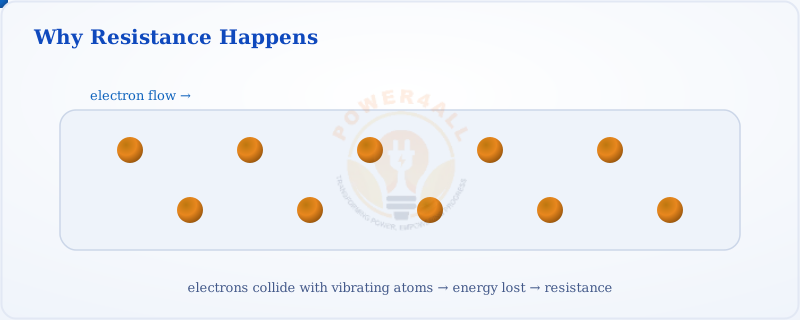
Inside a conductor, free electrons drift when a voltage is applied. But they cannot travel in a straight line: they constantly collide with the atoms of the material, which are always vibrating. Each collision robs the electron of a little energy, which appears as heat. That built-in obstacle course is resistance.
More collisions = more resistance
- Longer path → more collisions
- Hotter atoms vibrate more → more collisions
- Some materials pack atoms that scatter electrons more
Resistance makes heat
- Lost energy becomes heat:
P = I²R - Used on purpose in heaters and lamps
- Wasted (as loss) in wires and connectors
Conductance: the opposite view
- Conductance
G = 1/R, in siemens (S) - High G means current flows easily
- Just a different way to state the same thing
Resistance Formulas: R = V/I and R = ρL/A
There are two key formulas: one from the circuit’s point of view (Ohm’s law) and one from the material’s point of view (resistivity).
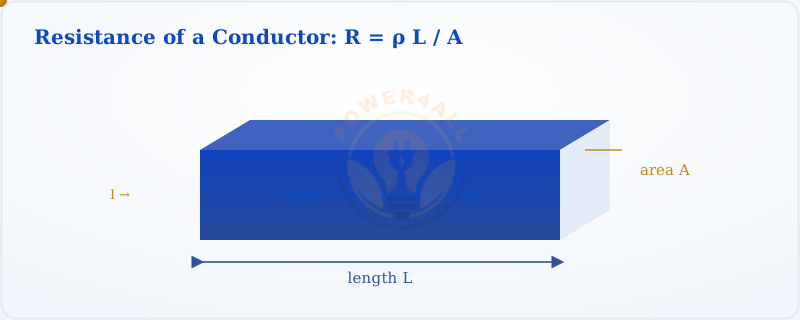
R = ρ × (L / A)
Resistance = resistivity (ρ, Ω·m) × length (L, m) ÷ cross-sectional area (A, m²)
Worked example — resistance from Ohm’s law
A device drops 12 V and draws 0.5 A. Its resistance is:
R = V / I = 12 / 0.5 = 24 Ω
Double the resistance and, at the same 12 V, the current halves to 0.25 A.
Factors Affecting Resistance
Four things decide how much resistance a wire or component has. Change any one and the resistance changes in a predictable way.
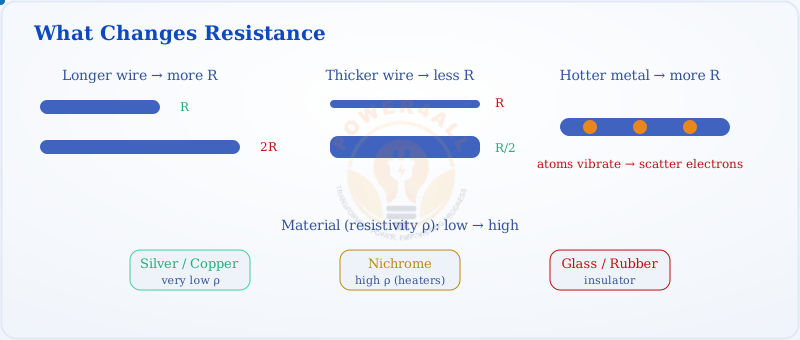
1. Length (L)
Resistance is directly proportional to length. Double the wire length, double the resistance.
2. Cross-Section (A)
Resistance is inversely proportional to area. A thicker wire has lower resistance.
3. Material (ρ)
Each material has its own resistivity. Copper conducts well; nichrome resists a lot.
4. Temperature
For most metals, resistance rises with temperature. Semiconductors do the opposite.
Resistivity & Conductivity
Resistivity (ρ) is a property of the material itself, independent of its shape or size — unlike resistance, which depends on the specific object. Its reciprocal is conductivity (σ).
| Material | Resistivity ρ (Ω·m, approx.) | Typical use |
|---|---|---|
| Silver | 1.6 × 10⁻⁸ | Best conductor, contacts |
| Copper | 1.7 × 10⁻⁸ | Wiring, windings, PCB tracks |
| Aluminium | 2.8 × 10⁻⁸ | Power lines, busbars |
| Nichrome | 1.1 × 10⁻⁶ | Heating elements |
| Silicon | ~ 6.4 × 10² | Semiconductors (varies with doping) |
| Glass / Rubber | 10¹² – 10¹⁶ | Insulators |
σ = 1 / ρ
Conductivity (σ) is the reciprocal of resistivity (ρ)
Resistance in Series & Parallel
When resistors are combined, the total (equivalent) resistance follows two simple rules — and they give opposite results.
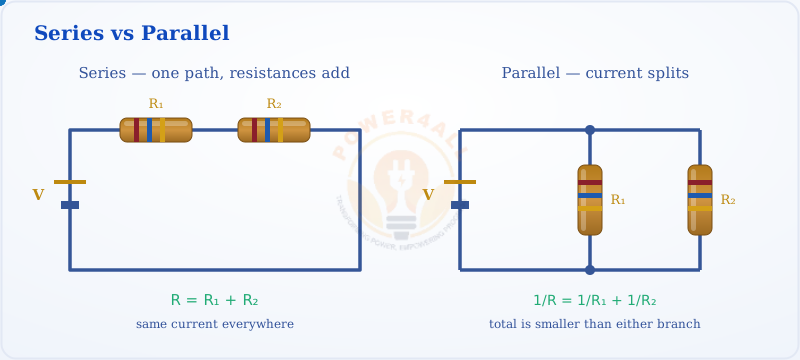
Series
R = R₁ + R₂ + R₃
Same current everywhere; total resistance is the sum — always larger.
Parallel
1/R = 1/R₁ + 1/R₂
Same voltage across each; total resistance is smaller than the smallest branch.
Reducing complex networks? The Delta-Wye Transformation Calculator and Current Divider Calculator help.
Resistance & Temperature
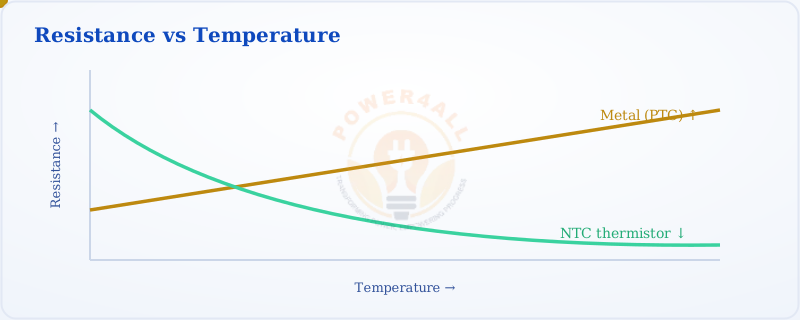
Resistance is not fixed — it drifts with temperature. This is used deliberately in sensors, and must be designed around in precision circuits.
R = R₀ (1 + α ΔT)
Resistance at temperature = reference resistance R₀ × (1 + temperature coefficient α × temperature change)
PTC (metals)
Positive temperature coefficient — resistance rises with heat (copper, tungsten filaments).
NTC (thermistors)
Negative temperature coefficient — resistance falls with heat; used as temperature sensors.
Superconductors
Below a critical temperature, resistance drops to exactly zero — no loss at all.
Measuring Resistance
Resistance is measured with an ohmmeter — always on a circuit with the power off, because the meter supplies its own tiny test current.
Multimeter / Ohmmeter
Select the Ω range, touch the probes across the component (power off), and read the ohms directly.
4-Wire (Kelvin)
For very low resistances, four wires cancel out the resistance of the leads for an accurate reading.
Resistor Colour Code
Fixed resistors print their value as coloured bands — decode them with the Resistor Code Calculator.
Always measure with the power off
An ohmmeter injects its own current. Measuring a live circuit gives wrong readings and can damage the meter. Isolate the component first.
Where Resistance Is Used (and Fought)
Resistance is both a tool we design with and a loss we fight against.
Heating
Heaters, toasters, kettles and incandescent lamps turn I²R into useful heat and light.
Current Limiting
Series resistors protect LEDs and set bias points; they cap the current a device sees.
Sensing
Thermistors, strain gauges and LDRs work by changing their resistance with temperature, force or light.
Unwanted Loss
Wire and contact resistance waste power as heat (I²R) — why we size cables and use thick, clean joints.
Sizing wires to keep resistance low? See the AWG to mm² Wire Size Calculator and the Line Loss Calculator.
Key Terms at a Glance
The essential resistance vocabulary students and engineers search for.
Resistance (R)
Opposition to current, in ohms (Ω). R = V/I.
Resistivity (ρ)
Material property, in Ω·m. R = ρL/A. Also called specific resistance.
Conductance (G)
Ease of flow, G = 1/R, in siemens (S).
Conductivity (σ)
Material’s ease of conduction, σ = 1/ρ.
Ohm (Ω)
SI unit of resistance, 1 Ω = 1 V/A.
Temp. coefficient (α)
How much resistance changes per degree, in /°C.
Frequently Asked Questions
Quick, expert answers to the questions people ask most about electrical resistance.
What exactly is electrical resistance?
Resistance is the opposition a material offers to electric current. As electrons drift they collide with the material’s atoms and lose energy as heat, which limits the current. It is measured in ohms and defined by Ohm’s law, R = V / I.
What is the unit of resistance?
The ohm (symbol Ω), named after Georg Ohm. 1 Ω = 1 volt per ampere. Larger units are the kilo-ohm (kΩ) and mega-ohm (MΩ).
What is the formula for resistance?
From Ohm’s law, R = V / I. For a wire, R = ρ × L / A, where ρ is resistivity, L is length and A is cross-sectional area.
What are the factors affecting resistance?
Length (longer = more), cross-sectional area (thicker = less), material/resistivity, and temperature (metals rise with heat). All four are captured by R = ρL/A plus the temperature relation.
What is the difference between resistance and resistivity?
Resistance (ohms) depends on the object’s size and shape; resistivity (Ω·m) is a property of the material alone. They are linked by R = ρL/A.
How do I find total resistance in series and parallel?
Series: R = R₁ + R₂ + …. Parallel: 1/R = 1/R₁ + 1/R₂ + …, giving a total smaller than the smallest branch.
Does resistance change with temperature?
Yes. Most metals gain resistance as they heat up (R = R₀(1 + αΔT)), while semiconductors and NTC thermistors lose resistance as temperature rises.
How is resistance measured?
With an ohmmeter or a multimeter’s Ω range, on an unpowered circuit. For very small resistances, a four-wire (Kelvin) method removes lead-resistance error.
Conclusion & Key Takeaways
Resistance is the property that turns a simple wire into a controllable circuit. Master it and Ohm’s law, power and heat all make sense.
Opposition to current
Measured in ohms (Ω); R = V / I.
It is electrical friction
Electrons collide with atoms and lose energy as heat.
R = ρL/A
Longer → more; thicker → less; material sets ρ.
Temperature matters
Metals rise, NTC thermistors fall, superconductors hit zero.
Series adds, parallel divides
Combine resistors with the two simple rules.
Tool and enemy
Used for heating and sensing; fought as I²R loss.