What is Norton's Theorem?
A powerful shortcut for circuit analysis: any linear two-terminal network of sources and resistors can be replaced by one current source IN in parallel with one resistance RN. Learn how to find IN and RN, the step-by-step method, its link to Thévenin’s theorem, and a worked example.
Complete Learning Path — Norton's Theorem
From the statement and the Norton equivalent, to finding IN & RN, the steps, source transformation, load current and a worked example
What is Norton's Theorem?
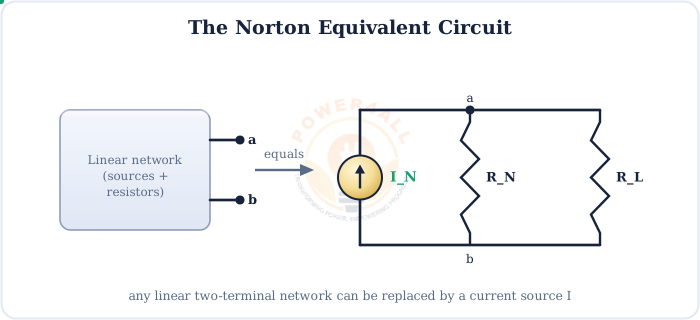
Norton's theorem says that any linear two-terminal network — no matter how many sources and resistors it contains — behaves, as seen from its two output terminals, exactly like a single current source IN in parallel with a single resistance RN.
It is the current-source twin of Thévenin’s theorem (which uses a voltage source in series with a resistance). Both let you replace a messy circuit with a tiny, easy-to-analyse equivalent.
Only for linear circuits
Norton's theorem applies to linear networks (resistors and independent/dependent linear sources). The load can be anything — the equivalent stays the same as you swap loads.
The Norton Equivalent Circuit
The Norton equivalent has just two parts: the source IN and the parallel resistance RN. Connect any load RL across it and it delivers exactly the same voltage and current as the original network.
Norton equivalent = IN ∥ RN
A current source IN in parallel with a resistance RN, presented at terminals a-b
Why it saves time
Once you have IN and RN, finding the current for dozens of different loads is a one-line current-divider calculation each time — no need to re-solve the whole network.
Finding the Norton Current IN
The Norton current is the short-circuit current: remove the load, place a wire (short) across the output terminals a-b, and find the current through that short.
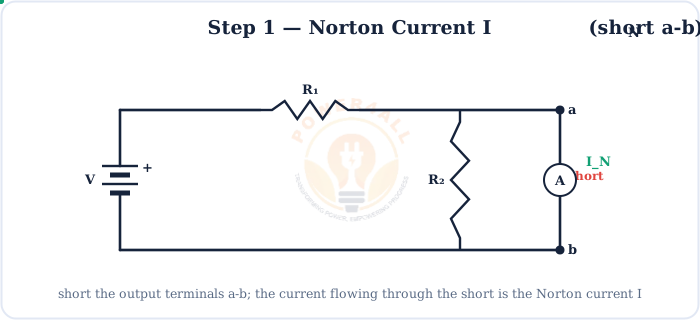
IN = Ishort-circuit (through a-b)
Use Ohm's law, mesh or nodal analysis to compute the current in the shorting wire
Finding the Norton Resistance RN
Deactivate every independent source, then look back into the terminals. Voltage sources become shorts; current sources become opens. The resistance you see is RN — identical to the Thévenin resistance.
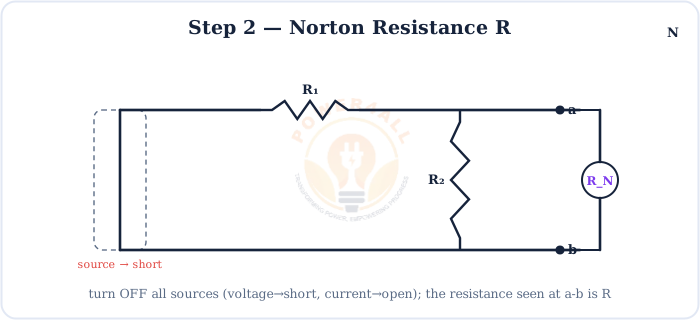
Deactivating sources correctly
Replace an ideal voltage source with a short (0 V → a wire) and an ideal current source with an open (0 A → a gap). Leave resistors in place, then simplify series/parallel combinations.
Step-by-Step Method
Four steps turn any linear network into its Norton equivalent and give you the load current.
Remove the load
Take out RL and mark terminals a-b.
Short a-b → IN
Find the short-circuit current.
Sources off → RN
Resistance at a-b with sources deactivated.
Rebuild & solve
Draw IN∥RN, reconnect RL, use the current divider.
Norton vs Thévenin (Source Transformation)
Norton and Thévenin equivalents describe the same network and convert directly into each other by source transformation.
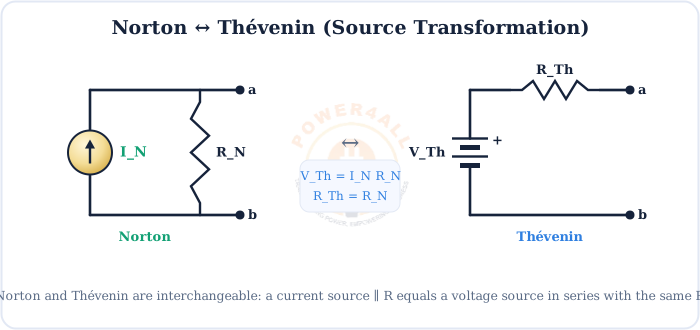
VTh = IN × RN · RTh = RN · IN = VTh / RTh
Convert between the two equivalents; the resistance is identical, and the sources relate by Ohm's law
Load Current from the Norton Model
With the Norton equivalent built, the current into any load RL follows straight from the current-divider rule.
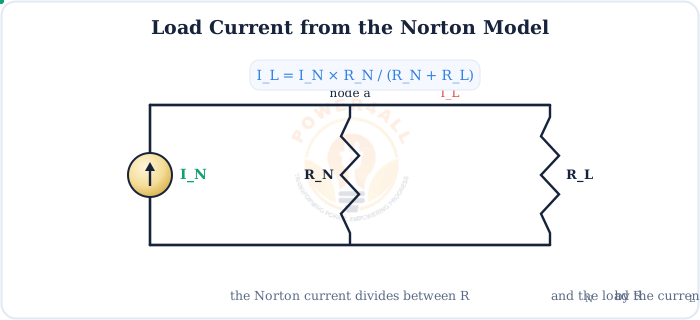
IL = IN × RN / (RN + RL)
Current-divider rule: the load takes the share set by the parallel resistances
Worked Example
A 12 V source with R1 = 4 Ω in series and R2 = 4 Ω across the output. Find the Norton equivalent.
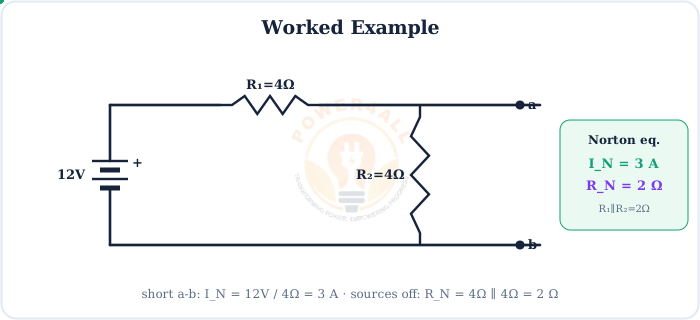
Norton current
Short a-b → R2 is bypassed, so IN = 12 V / R1 = 12 / 4 = 3 A.
Norton resistance
Short the source → R1 and R2 are in parallel: RN = 4 ∥ 4 = 2 Ω.
Check via Thévenin
VTh = IN × RN = 3 × 2 = 6 V — consistent with the Thévenin equivalent.
Where Norton's Theorem is Used
Any time you must analyse one part of a big circuit — especially for many load values — Norton (or Thévenin) is the tool.
Variable loads
Find load current quickly as RL changes — one divider per value.
Circuit design
Model a supply or amplifier output as IN ∥ RN.
Power transfer
Maximum power to the load when RL = RN.
AC networks
Works with impedances: IN ∥ ZN.
Key Terms at a Glance
The essential Norton vocabulary students search for.
Norton current (IN)
Short-circuit current at a-b.
Norton resistance (RN)
Resistance at a-b, sources off.
Norton equivalent
IN in parallel with RN.
Source transformation
Norton ↔ Thévenin.
Current divider
Splits IN between RN & RL.
Linear network
Resistors + linear sources only.
Frequently Asked Questions
Quick, expert answers to the questions people ask most about Norton's theorem.
What is Norton's theorem in simple words?
It says any linear circuit with two output terminals can be replaced by a single current source (IN) with a resistor (RN) in parallel — a simple model that behaves exactly like the original from the load's point of view.
How do you find the Norton current?
Short-circuit the two output terminals and find the current through the short. That is IN, the short-circuit current.
How do you find the Norton resistance?
Turn off all independent sources (voltage → short, current → open) and find the resistance looking into the terminals. That is RN, equal to the Thévenin resistance.
What is the relationship between Norton and Thévenin?
They are interchangeable: RN = RTh and VTh = IN × RN. Converting one to the other is called source transformation.
What are the steps of Norton's theorem?
Remove the load; short the terminals to get IN; deactivate sources to get RN; draw IN∥RN, reconnect the load and use the current divider.
How do you find the load current?
Apply the current divider: IL = IN × RN / (RN + RL).
Does Norton's theorem work for AC?
Yes — use impedances instead of resistances. The network reduces to a Norton current phasor IN in parallel with a Norton impedance ZN.
When should I use Norton instead of Thévenin?
Use whichever is more convenient — they give the same answer. Norton (a current source in parallel) is handy for parallel circuits and current-divider problems; Thévenin suits series/voltage problems.
Conclusion & Key Takeaways
Norton's theorem shrinks any linear two-terminal network to a current source and a parallel resistance — fast, reusable and exact.
IN ∥ RN
The Norton equivalent.
IN = short-circuit I
Short a-b to find it.
RN = RTh
Sources off, look in.
↔ Thévenin
VTh = INRN.
Current divider
Gives the load current.
Linear only
Great for variable loads.