What is Alternating Current (AC)?
The complete, advanced guide to alternating current — electricity that reverses direction many times a second. From the sine wave and AC vs DC to how AC is generated, peak and RMS values, frequency, single & three phase, the key formulas and where AC powers the world.
Complete Learning Path — Alternating Current
From what AC is and how it differs from DC, to generation, waveform values, RMS, frequency, phases, measurement and applications
What is Alternating Current (AC)?
Alternating current (AC) is electric current that periodically reverses direction. Instead of flowing one way like direct current, it swings back and forth — usually as a smooth sine wave — rising to a peak one way, falling through zero, then peaking the other way.
On the mains this happens 50 or 60 times every second. The current has the symbol I and is measured in amperes (A); the “alternating” label describes the constant reversal of direction and polarity.
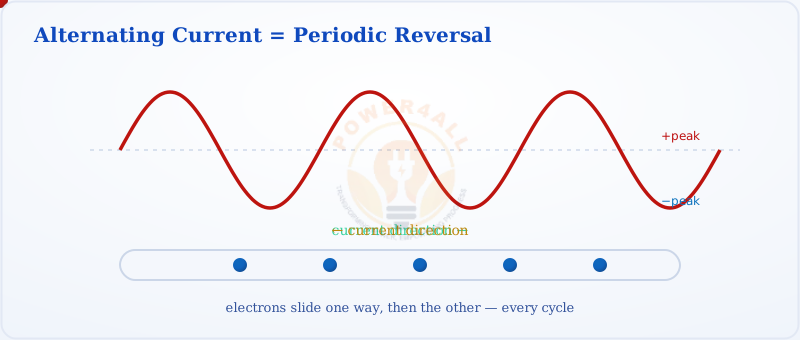
Why a sine wave?
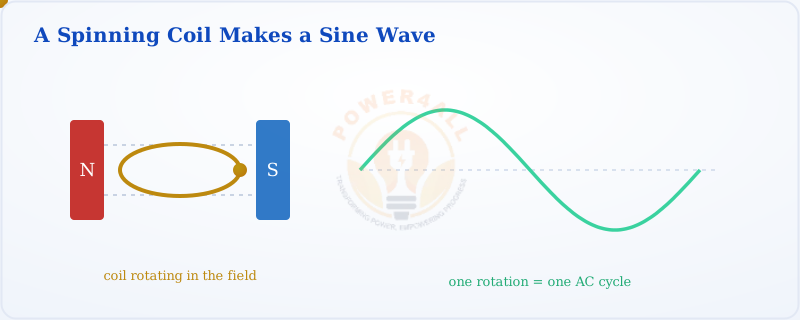
AC is sinusoidal because it is generated by something rotating — a coil spinning in a magnetic field. Steady rotation naturally traces out a sine, which is also the only waveform that keeps its shape through transformers and inductors.
AC vs DC: The Key Differences
The two forms of electricity are alternating current (AC) and direct current (DC). AC reverses direction on a sine wave; DC flows steadily one way. Each wins in its own domain.
| Property | Alternating Current (AC) | Direct Current (DC) |
|---|---|---|
| Direction of flow | Reverses periodically | One direction only |
| Waveform | Sine wave | Flat, steady line |
| Frequency | 50 Hz / 60 Hz | 0 Hz |
| Typical source | Generator / alternator, grid | Battery, solar cell, rectifier |
| Change voltage | Easy — transformers | Hard (needs converters) |
| Transmission | Standard for the grid | HVDC (special cases) |
| Used by | Homes, motors, industry | Electronics, batteries, EVs |
They work together
The grid delivers AC; your charger rectifies it to DC for the electronics inside. Read the companion guide on Direct Current (DC) for the other half of the story.
How Alternating Current is Generated
AC is produced by a generator (alternator): a coil spinning in a magnetic field. By Faraday’s law of electromagnetic induction, the changing magnetic flux through the coil induces a voltage that rises and falls as a sine — one full cycle per rotation.
e = −N · (dΦ/dt)
Faraday’s law: induced EMF = − number of turns × rate of change of magnetic flux
Dig deeper into the physics behind this in Transformers (which rely on the same induction) and the Inductor topic.
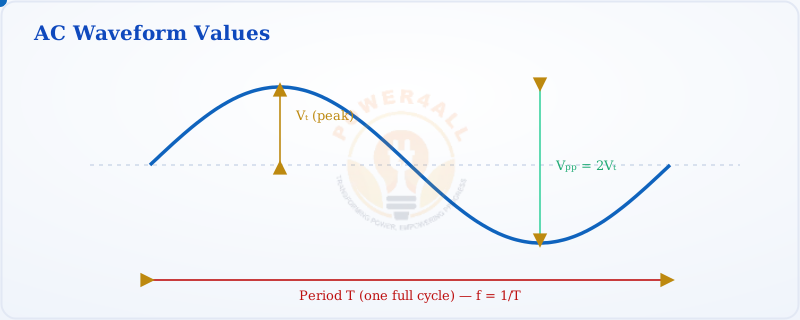
Peak, Peak-to-Peak, Period & Amplitude
A sine wave is described by a few key measurements. Get these straight and every AC calculation follows.
RMS & Average Value
Because AC constantly changes, we need one number that captures its “effective” strength. That is the RMS (root-mean-square) value — the DC value that would deliver the same heating power.
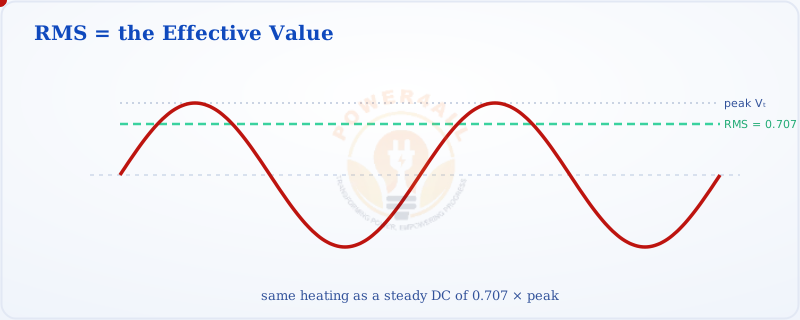
0.707 × peak. The familiar 230 V mains figure is an RMS value — its peak is actually about 325 V.Vrms = Vm / √2 ≈ 0.707 Vm
RMS value of a sine wave = peak ÷ square root of 2
Worked example — peak of the 230 V mains
Mains is quoted as Vrms = 230 V. Its peak is:
Vm = Vrms × √2 = 230 × 1.414 ≈ 325 V
So insulation must withstand ~325 V even though the meter reads 230 V. The average value over a full cycle is 0 — which is why RMS is used instead.
Average of AC is zero
Over a complete cycle the positive and negative halves cancel, so the true average is zero. The “average value” quoted in textbooks (0.637 Vm) is the average of one half-cycle only.
Alternating Current Formulas
The maths of AC starts from the sine and the angular frequency ω = 2πf.
v(t) = Vm sin(ωt)
Instantaneous voltage — peak Vm, angular frequency ω = 2πf
Vrms = Vm/√2 · Vpp = 2Vm
RMS value and peak-to-peak value of a sine wave
P = Vrms × Irms × cosφ
Real AC power — cosφ is the power factor (unlike DC, phase matters)
Single-Phase & Three-Phase AC
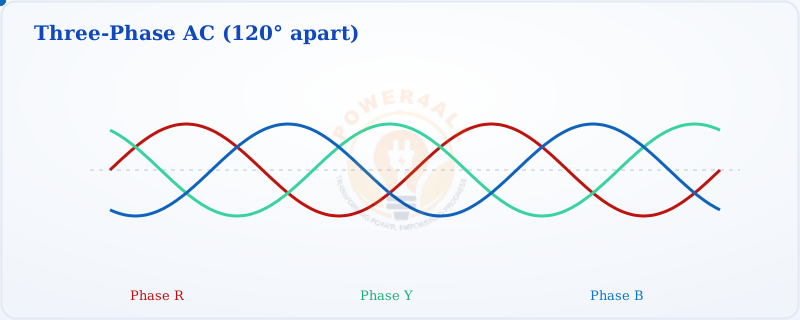
Homes usually get single-phase AC — one sine wave. Generation, transmission and industry use three-phase AC: three waves offset by 120° for smoother, more efficient power.
Single-phase
One live and one neutral; simple wiring for lighting, sockets and small appliances at home.
Three-phase
Three lives 120° apart; smoother power, smaller conductors for the same power, and self-starting motors.
Why industry loves it
Constant total power and rotating magnetic fields make three-phase perfect for large transformers and motors.
Measuring Alternating Current
AC meters read the RMS value by default, and polarity does not matter because the current reverses anyway.
Multimeter (AC mode)
Select the V~ / A~ (wavy line) range. For distorted waveforms, use a “true-RMS” meter for an accurate reading.
Clamp meter
Reads AC current by sensing the magnetic field around a conductor — no need to break the circuit.
Oscilloscope
Shows the actual sine on screen so you can read peak, peak-to-peak, period and f = 1/T directly.
Read the value you expect
A multimeter shows RMS (e.g. 230 V), while a scope shows the peak (~325 V). They describe the same AC — just different measures.
Where Alternating Current is Used
AC powers the world outside the socket — anywhere electricity must travel far or turn a motor.
Homes & buildings
Lighting, sockets and appliances all run on mains AC at 230 V/50 Hz or 120 V/60 Hz.
Power transmission
Transformers step AC up to hundreds of kV for low-loss transmission, then back down for use.
Motors & industry
Three-phase AC induction motors drive pumps, fans, machines and traction across industry.
Generation
Power stations, wind and hydro all generate AC with rotating alternators.
See how AC is shaped and converted in the Power Electronics Guide, and how it is turned into DC on the Direct Current page.
Key Terms at a Glance
The essential alternating-current vocabulary students and engineers search for.
Alternating current (AC)
Current that periodically reverses direction (sine wave).
Peak value (Vm)
Maximum value from zero; the amplitude.
RMS value
Effective value; Vrms = Vm/√2.
Frequency (f)
Cycles per second, in Hz. 50/60 Hz mains.
Phase
Position within a cycle; three-phase = 120° apart.
Power factor (cosφ)
How well voltage and current line up in AC.
Frequently Asked Questions
Quick, expert answers to the questions people ask most about alternating current.
What is alternating current (AC) in simple words?
Alternating current is electricity that keeps changing direction. It flows one way, slows, stops, then flows the opposite way, over and over as a sine wave — 50 or 60 times a second on the mains. The socket in your wall supplies AC.
What is the difference between AC and DC?
AC reverses direction periodically (a sine wave); DC flows steadily one way. AC is easy to transform to high voltage, so the grid uses it; DC suits batteries, solar and electronics.
Why does the grid use AC instead of DC?
Because transformers can step AC up to very high voltage for transmission and back down for use. High voltage means low current and far less energy lost as heat in the wires — something that is much harder with DC.
What is the RMS value of AC?
The RMS (root-mean-square) value is the effective value — the DC that would give the same heating. For a sine, Vrms = Vm/√2 ≈ 0.707 Vm. The 230 V mains figure is RMS; its peak is about 325 V.
What is the formula for AC?
The instantaneous value is v = Vm sin(ωt), where ω = 2πf. The RMS is Vm/√2, peak-to-peak is 2Vm, and the average over a full cycle is zero.
How is alternating current generated?
By spinning a coil in a magnetic field. Faraday’s law says the changing flux induces a voltage that rises and falls sinusoidally — one full cycle per rotation. The machine is an alternator, used in every power station.
What is the frequency of AC mains?
It is 50 Hz in India, Europe, Africa and most of Asia, and 60 Hz in North America and parts of South America — that many full cycles of reversal every second.
What is the difference between single-phase and three-phase?
Single-phase uses one AC waveform (typical at home); three-phase uses three waveforms 120° apart, giving smoother, more efficient power for motors and industry. Most generation and transmission is three-phase.
Is mains electricity AC or DC?
Mains is AC — 230 V 50 Hz or 120 V 60 Hz. Devices needing DC, such as phones and laptops, use a rectifier in the charger to convert it. See Direct Current for that process.
Why is AC a sine wave?
Because it is made by steady rotation. A coil turning at constant speed in a magnetic field produces a voltage proportional to the sine of the angle — so uniform rotation naturally gives a sine wave.
Conclusion & Key Takeaways
Alternating current is the back-and-forth flow that lights our homes and powers industry. Master the sine, RMS and phases, and the whole grid makes sense.
Reverses direction
A sine wave, 50/60 times a second.
Made by rotation
A coil spinning in a magnetic field.
RMS = 0.707 × peak
The effective value; 230 V is RMS.
v = Vm sin(ωt)
The instantaneous value.
Easy to transform
Why the grid is AC.
Single & three phase
Three-phase powers industry.