What is Frequency?
The complete, advanced guide to how fast a signal repeats — from the hertz and f = 1/T to angular frequency, the wave equation v = fλ, the full frequency spectrum, resonance and how frequency is measured.
Complete Learning Path — Frequency
From the hertz and f = 1/T to angular frequency, the wave equation, the spectrum, resonance, measurement and applications
What is Frequency?
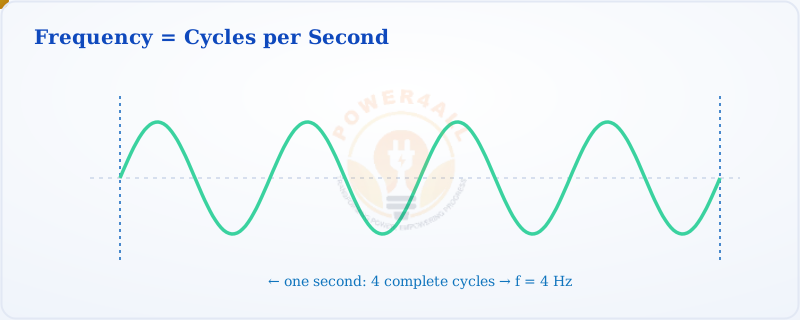
Frequency is how often a repeating event happens — the number of complete cycles that occur in one second. For an alternating current, a swinging pendulum or a sound wave, the faster it repeats, the higher its frequency.
Frequency is given the symbol f and is measured in hertz (Hz), named after Heinrich Hertz. One hertz is exactly one cycle per second. It is defined as the reciprocal of the period — the time one cycle takes.
f = 1 / T
Frequency (hertz) = 1 ÷ Period (seconds) — cycles per second
Everyday frequencies
A heartbeat is around 1–2 Hz, mains power is 50 or 60 Hz, the musical note A is 440 Hz, FM radio is around 100 MHz, and Wi-Fi runs at 2.4 GHz — the same idea across a huge range.
Frequency & Period: Two Sides of a Cycle
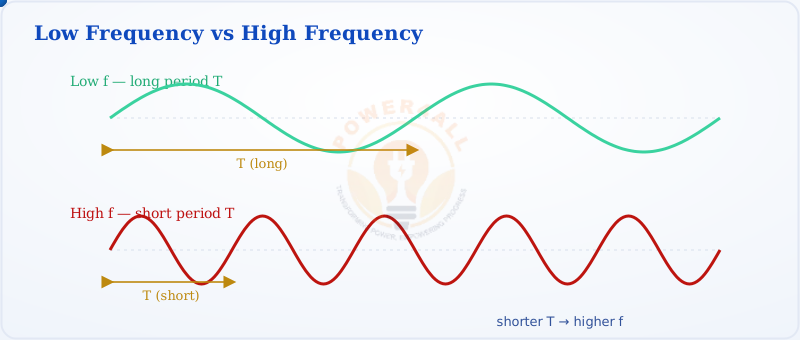
Frequency and period describe the same repetition from opposite angles. The period T is how long one cycle takes; the frequency f is how many cycles fit into a second. They are exact reciprocals.
Worked example 1 — period of mains power
Indian mains runs at f = 50 Hz. The time for one cycle is:
T = 1 / f = 1 / 50 = 0.02 s = 20 ms
So the AC voltage completes a full up-and-down swing every 20 milliseconds.
Quick conversions
1 kHz = 1000 Hz (T = 1 ms) · 1 MHz = 10⁶ Hz (T = 1 µs) · 1 GHz = 10⁹ Hz (T = 1 ns). Convert quickly with the Frequency Units Converter.
Angular Frequency: ω = 2πf
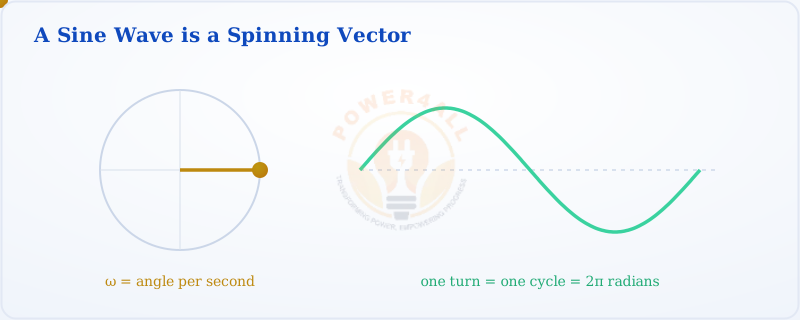
A sine wave is really a rotating vector seen edge-on. That is why every AC formula uses angular frequency ω — the rate the phase spins, in radians per second. Because one full turn is 2π radians, ω = 2πf.
ω = 2πf = 2π / T
Angular frequency (radians/second) = 2π × frequency = 2π ÷ period
Worked example 2 — angular frequency of mains
For f = 50 Hz:
ω = 2πf = 2 × 3.1416 × 50 ≈ 314 rad/s
This 314 rad/s is the number that appears in reactance formulas like XL = ωL.
Frequency, Speed & Wavelength: v = fλ
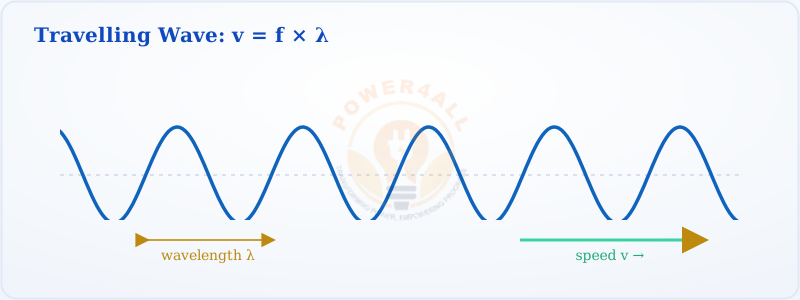
For any travelling wave — sound, light or radio — frequency, wavelength and speed are tied together. Multiply how many cycles pass per second by the length of each cycle and you get the wave’s speed.
v = f × λ
Wave speed (m/s) = frequency (Hz) × wavelength (m)
Worked example 3 — wavelength of FM radio
An FM station at f = 100 MHz sends radio waves at the speed of light, v = 3 × 10⁸ m/s:
λ = v / f = (3 × 10⁸) / (100 × 10⁶) = 3 m
That 3-metre wavelength is why FM antennas are about a metre or so long.
The Frequency Spectrum
The same quantity, frequency, spans an astonishing range — from the slow swing of the power grid to the blur of visible light, each band put to a different use.
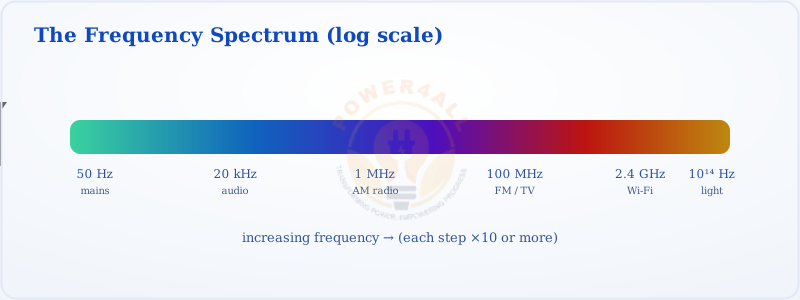
| Band | Typical frequency | Everyday example |
|---|---|---|
| Power / mains | 50 – 60 Hz | Household AC supply |
| Audio | 20 Hz – 20 kHz | Sound humans can hear |
| AM radio | 0.5 – 1.7 MHz | Long-range broadcast |
| FM / VHF | 88 – 108 MHz | FM stations, TV |
| Microwave | 1 – 6 GHz | Wi-Fi, phones, radar |
| Visible light | ~ 4 – 8 × 10¹⁴ Hz | Colours we see |
Frequency, Reactance & Resonance
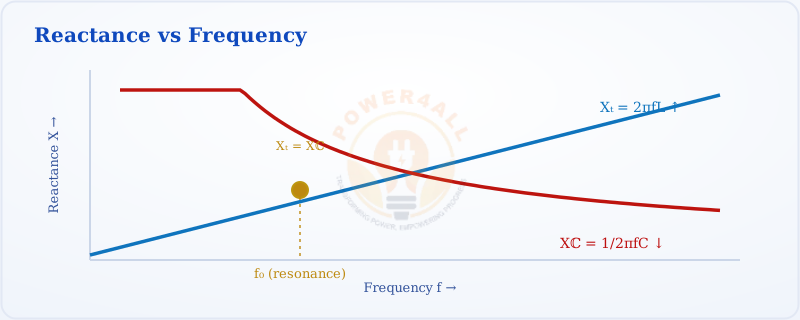
In AC circuits, frequency decides how much capacitors and inductors oppose the current. That opposition is called reactance, and it depends directly on frequency.
Inductive reactance
XL = 2πfL
Rises with frequency — an inductor blocks fast signals and passes slow ones.
Capacitive reactance
XC = 1/2πfC
Falls with frequency — a capacitor passes fast signals and blocks DC.
Resonance
f₀ = 1/2π√(LC)
Where XL = XC. The circuit favours one frequency — how radios tune.
Compute these directly with the Reactance Calculator and the RLC Resonant Frequency Calculator, or design filters with the RC Filter Calculator.
Measuring Frequency
Frequency is one of the most precisely measurable quantities in all of science — atomic clocks pin it to parts in 10¹⁵. In the workshop, a few tools cover almost everything.
Frequency counter
Counts the number of cycles that arrive during a precise time gate (often exactly one second) and displays the result in Hz.
Oscilloscope
Shows the waveform on screen; measure one period T from the time axis and compute f = 1/T.
Multimeter Hz range
Many DMMs read the frequency of mains and logic signals directly — handy for a quick 50/60 Hz check.
Watch out for aliasing
Any sampled instrument (a scope or sound card) must sample at more than twice the signal frequency — the Nyquist rule. Sample too slowly and a high frequency masquerades as a false low one.
Where Frequency Matters
Frequency is the hidden dial behind power, communication, music and computing.
Power grids
Grid frequency (50/60 Hz) must stay rock-steady; it drifts if generation and load fall out of balance.
Radio & wireless
Each station and Wi-Fi channel is assigned its own carrier frequency so signals do not collide.
Sound & music
Pitch is frequency — 440 Hz is concert A, and doubling the frequency raises the note one octave.
Clocks & CPUs
A processor’s clock frequency (GHz) sets how many operations it can attempt each second.
Working with timing circuits? Try the 555 Timer Calculator and the Frequency Calculator.
Key Terms at a Glance
The essential frequency vocabulary students and engineers search for.
Frequency (f)
Cycles per second, in hertz (Hz). f = 1/T.
Period (T)
Time for one cycle, in seconds. T = 1/f.
Hertz (Hz)
SI unit of frequency; 1 Hz = 1 cycle/s.
Angular frequency (ω)
Phase rate, in rad/s. ω = 2πf.
Wavelength (λ)
Length of one cycle in space. v = fλ.
Resonant frequency (f₀)
Where XL = XC. f₀ = 1/2π√(LC).
Frequently Asked Questions
Quick, expert answers to the questions people ask most about frequency.
What exactly is frequency?
Frequency is the number of complete cycles of a repeating wave or signal that occur in one second. A higher frequency means faster repetition. It has the symbol f and is measured in hertz, where 1 Hz = 1 cycle per second.
What is the unit of frequency?
The hertz (Hz), named after Heinrich Hertz. Multiples are the kilohertz (1 kHz = 1000 Hz), megahertz (1 MHz = 10⁶ Hz) and gigahertz (1 GHz = 10⁹ Hz).
What is the formula for frequency?
Frequency is the reciprocal of the period, f = 1/T. For a travelling wave, v = fλ, and the angular frequency is ω = 2πf.
What is the difference between frequency and period?
The period T is the time for one cycle (seconds); the frequency f is how many cycles occur per second (hertz). They are reciprocals: f = 1/T. A 50 Hz signal has a period of 20 ms.
What is the frequency of mains electricity?
It is 50 Hz in India, Europe, Africa and most of Asia, and 60 Hz in North America and parts of South America. That is how many full AC voltage cycles occur every second.
What is angular frequency?
Angular frequency ω is how fast the phase of a wave advances, in radians per second. Since one cycle is 2π radians, ω = 2πf. It appears in reactance formulas like XL = ωL.
How does frequency affect reactance and resonance?
Inductive reactance rises with frequency (XL = 2πfL) while capacitive reactance falls (XC = 1/2πfC). They are equal at the resonant frequency f₀ = 1/2π√(LC), which is how tuners select a station.
How is frequency measured?
With a frequency counter (which counts cycles over a precise gate), an oscilloscope (measure the period, then f = 1/T), or a multimeter’s Hz range for mains and logic signals.
Conclusion & Key Takeaways
Frequency is the rhythm of electronics — how fast a signal repeats. Master it and AC power, waves, radio and resonance all fall into place.
Cycles per second
Measured in hertz (Hz); f = 1/T.
Reciprocal of period
Shorter period → higher frequency.
ω = 2πf
Angular frequency drives every AC formula.
v = fλ
Frequency, wavelength and speed are linked.
Sets reactance
XL rises, XC falls; they meet at resonance.
Spans the spectrum
From 50 Hz mains to 10¹⁴ Hz light.