What is Electric Power?
The complete, advanced guide to the rate at which electricity does work — from the watt and P = V × I to AC power, the power triangle and power factor, energy and kWh cost, efficiency and why the grid runs at high voltage.
Complete Learning Path — Electric Power
From the watt and the power formulas to AC power, power factor, energy cost and efficiency
What is Electric Power?
Electric power is the rate at which electrical energy is delivered or converted in a circuit — how fast work is done by, or on, the electricity. If voltage is the push and current is the flow, power is the actual work being done: the brightness of a lamp, the heat of an element, the torque of a motor.
It is defined as voltage multiplied by current, and is measured in watts (W). One watt means one joule of energy is being converted every second.
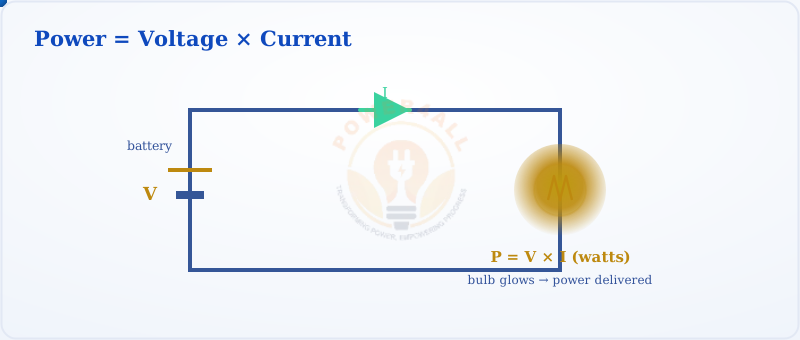
P = V × I
Power (watts) = Voltage (volts) × Current (amperes)
Power is a rate, not an amount
Power tells you how fast energy is used, like speed tells you how fast you travel. The total energy used depends on power and how long it runs: Energy = Power × Time.
Power vs Energy & the Watt
The single most common confusion in electricity is mixing up power and energy. Getting this straight makes everything else — bills, ratings, efficiency — fall into place.
Power (the rate)
Unit: watt (W)
- How fast energy is converted, right now
- A 2000 W heater draws energy twice as fast as a 1000 W one
- Like the flow rate from a tap
Energy (the amount)
Unit: joule (J) or kilowatt-hour (kWh)
- The total consumed over a period of time
E = P × t- Like the total water collected in a bucket
The Watt
Named after: James Watt
1 W = 1 J/s- 1 kW = 1000 W, 1 MW = 10⁶ W
- 746 W ≈ 1 horsepower (HP)
P = W / t → 1 watt = 1 joule / second
Power is energy (work, W) divided by the time taken (t)
Worked example — power of a phone charger
A charger delivers 5 V at 2 A. Its power is:
P = V × I = 5 × 2 = 10 W
If it runs for 1 hour it delivers 10 W × 1 h = 10 Wh = 0.01 kWh of energy.
The Power Formulas (P = VI, I²R, V²/R)
By combining Ohm’s law (V = IR) with P = VI, we get three equivalent power formulas. Pick whichever matches the quantities you already know.
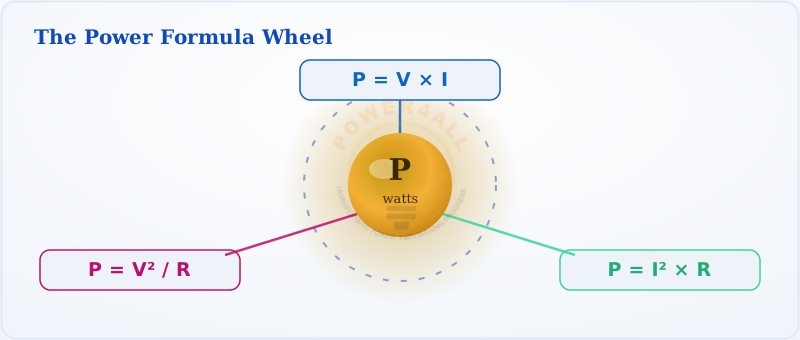
P = V × I
Use when you know voltage and current. The most fundamental form.
P = I² × R
Use when you know current and resistance. Governs heating and I²R losses.
P = V² / R
Use when you know voltage and resistance. Handy for resistive loads on a fixed supply.
Worked example — a resistive heater
A heating element of R = 24 Ω runs on V = 240 V. Its power is:
P = V² / R = 240² / 24 = 57600 / 24 = 2400 W = 2.4 kW
Cross-check the current: I = V/R = 10 A, so P = V×I = 240×10 = 2400 W. ✓
DC Power vs AC Power
In a DC circuit power is steady. In an AC circuit, voltage and current rise and fall every cycle — so power pulses too, and we describe it with average values.
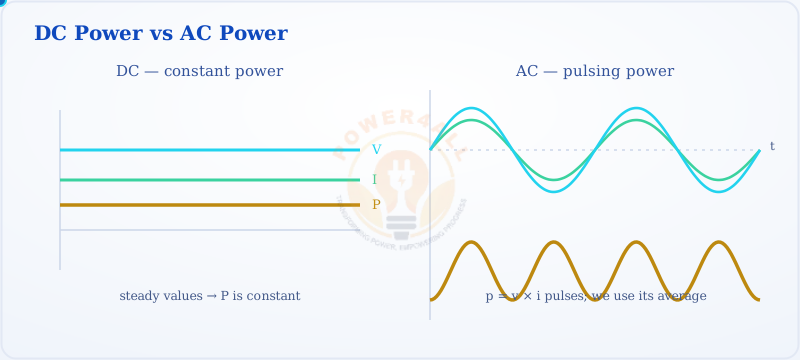
RMS: How We Rate AC
Because AC swings between peaks, we use the RMS (root-mean-square) values of voltage and current. RMS values are the ones that deliver the same average power as an equivalent DC source, which is why a "230 V" AC supply is a 230 V RMS value.
Pavg = Vrms × Irms × cosφ
Average AC power uses RMS values and the power factor cosφ (see next section)
Real, Reactive & Apparent Power
In AC systems with motors, transformers or capacitors, not all the power flowing does useful work. Engineers split it into three quantities that form the power triangle.
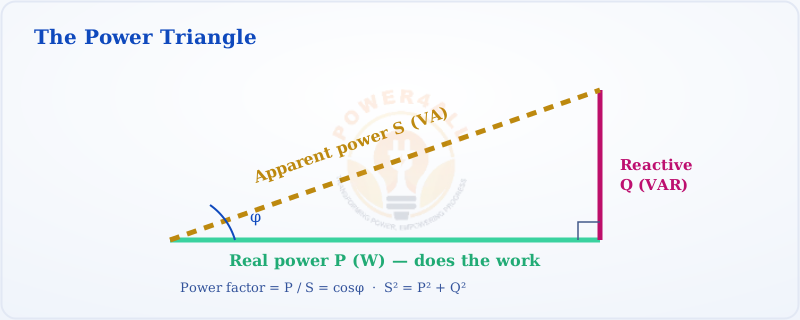
Real Power (P)
Unit: watt (W)
- Actually does useful work / produces heat
- What your meter mostly bills
Reactive Power (Q)
Unit: volt-ampere reactive (VAR)
- Sloshes in and out of inductors/capacitors
- Does no net work but loads the wires
Apparent Power (S)
Unit: volt-ampere (VA)
- The total the supply must deliver
S = Vrms × Irms
Why power factor matters
A low power factor means the utility must push extra current for the same useful watts, causing higher I²R losses and bigger cables. Industry corrects it with capacitor banks to bring cosφ close to 1.
Measuring Power & Energy
Power is measured instantly in watts; energy is measured over time in kilowatt-hours. Different instruments do each job.
Wattmeter
Reads real power (W) directly by sensing both voltage and current and their phase.
Energy Meter (kWh)
The utility meter on your wall; totals energy used in kilowatt-hours for billing.
Power Analyzer / Clamp Meter
Measures real/reactive/apparent power, power factor and harmonics; clamp meters read current without breaking the circuit.
Electrical Energy, kWh & Cost
Your bill is for energy, not power. The unit is the kilowatt-hour (kWh) — the energy used by a 1 kW load running for 1 hour.
Energy (kWh) = Power (kW) × Time (h) · Cost = kWh × tariff
Multiply power by hours to get energy, then by the per-unit tariff for cost
Worked example — monthly cost of an air conditioner
A 1.5 kW AC runs 8 hours/day at a tariff of ₹8 / kWh:
Energy/day = 1.5 × 8 = 12 kWh → Month = 12 × 30 = 360 kWh
Cost = 360 × 8 = ₹2,880 / month. Halving the run-time halves the bill.
Need the numbers fast? Try the Power4All Energy Cost Calculator and Energy & Efficiency Calculator.
Efficiency & Power Loss
No device converts 100% of its input power into useful output — some is always lost, mostly as heat. Efficiency measures how much makes it through.
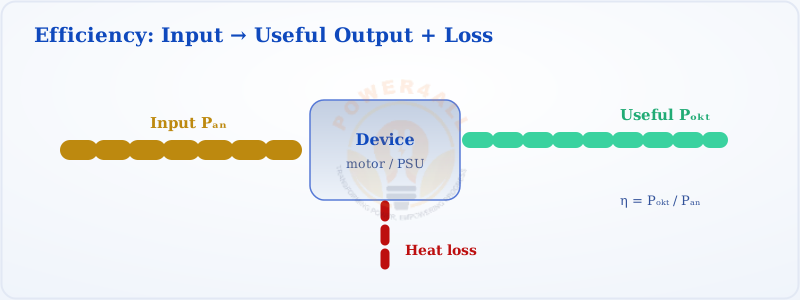
η = (Pout / Pin) × 100%
Efficiency = useful output power ÷ input power
- Resistive loss: the
I²Rheating in every wire, winding and contact. - Switching & core loss: in converters, transformers and motors.
- Why it matters: lost power costs money and must be removed as heat — see the Converter Efficiency Calculator.
Power Transmission: Why High Voltage?
The grid moves power at hundreds of thousands of volts for one reason: to keep the current — and therefore the I²R losses — as low as possible.
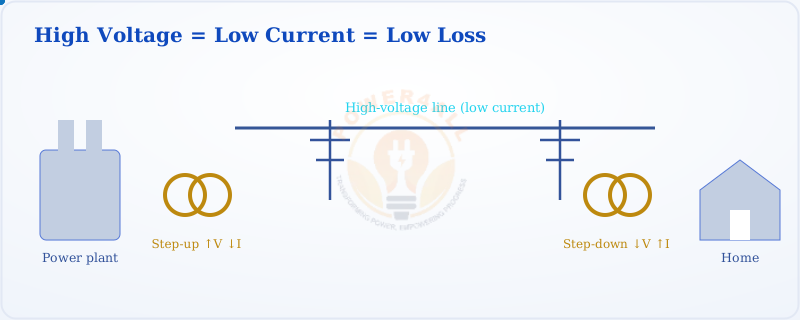
Ploss = I² × Rline
Line loss depends on current squared — halving the current cuts the loss to a quarter
Frequently Asked Questions
Quick, expert answers to the questions people ask most about electric power.
What exactly is electric power?
Electric power is the rate at which electrical energy is transferred or converted. It equals voltage times current, P = V × I, and is measured in watts (W), where 1 watt = 1 joule per second.
What is the unit of electric power?
The watt (W), named after James Watt. 1 W = 1 J/s. Bigger units: kilowatt (1 kW = 1000 W) and megawatt (1 MW = 10⁶ W). About 746 W equals one horsepower.
What are the three power formulas?
P = V × I, P = I² × R, and P = V² / R. They come from combining P = VI with Ohm’s law V = IR, and all give watts.
What is the difference between power and energy?
Power is the rate of using energy (watts); energy is the total used over time (joules or kWh). Energy = Power × Time. Your bill charges for energy (kWh), not power.
What is power factor?
Power factor is the ratio of real power to apparent power, cosφ = P / S. A value near 1 is efficient; a low value means extra current flows without doing useful work.
How do I calculate my electricity bill?
Multiply each appliance’s power (kW) by the hours it runs to get energy in kWh, then multiply by your tariff. Example: a 1 kW heater for 5 h = 5 kWh; at ₹8/kWh that’s ₹40.
Why is power transmitted at high voltage?
Because line loss is I²R. For the same power, a higher voltage means lower current, and lower current dramatically reduces the heating loss in the wires — so high voltage is far more efficient over distance.
Conclusion & Key Takeaways
Electric power is where voltage and current combine to do real work. Master P = VI and its cousins, and you can size, cost and troubleshoot almost any electrical system.
Power is a rate
Watts measure how fast energy is used: 1 W = 1 J/s.
P = V × I
Also I²R and V²/R — the same law via Ohm’s law.
Energy ≠ power
Energy = Power × Time; bills are in kWh.
AC needs RMS & PF
P = Vrms Irms cosφ; watch the power factor.
Nothing is 100%
Efficiency η = Pout/Pin; losses become heat.
High V, low loss
Transmission uses high voltage to cut I²R losses.