What is Electric Charge?
The complete, advanced guide to the property behind every electrical phenomenon — from the atom and the coulomb to Coulomb’s law, electric fields, and how charge powers capacitors, batteries and semiconductors.
Complete Learning Path — Electric Charge
From the definition and the atom to Coulomb’s law, fields, and real power-electronics applications
What is Electric Charge?
Electric charge is a fundamental property of matter that decides how strongly — and in which direction — an object responds to electricity and magnetism. Every spark, battery, motor and microchip ultimately works because charge exists and moves. It is as basic to electrical engineering as mass is to mechanics.
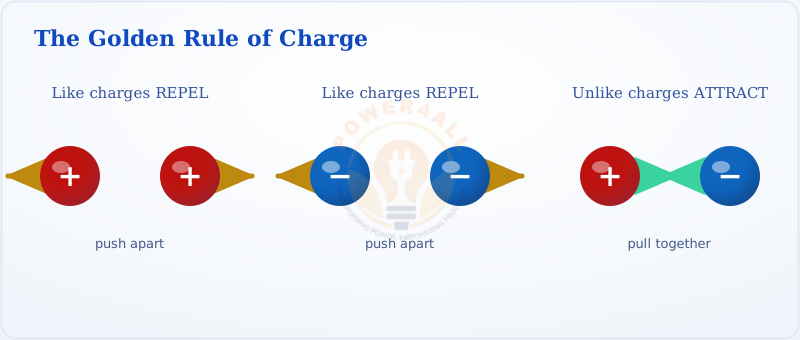
Charge comes in exactly two kinds, labelled positive (+) and negative (−). Objects with the same kind of charge push each other away, and objects with opposite kinds pull together. When charge sits still we call the study of it electrostatics; when it flows in an orderly stream we call that flow electric current.
Q = n × e
Total charge (Q) = number of extra/missing electrons (n) × the elementary charge (e)
Definition, Symbol and Unit
In equations, electric charge is written with the symbol Q (or q for a small/point charge). Its SI unit is the coulomb (C), named after the French physicist Charles-Augustin de Coulomb. One coulomb is a very large amount of charge in everyday terms — it is the charge carried past a point when a steady current of one ampere flows for one second.
Q = I × t
Charge (coulombs) = Current (amperes) × Time (seconds) — the practical definition of the coulomb
Charge vs. current — don’t confuse them
Charge (Q) is the amount of electricity; current (I) is the rate at which that charge flows. Think of charge as litres of water and current as litres-per-second. They are linked by I = Q / t.
Charge Fundamentals & the Atom
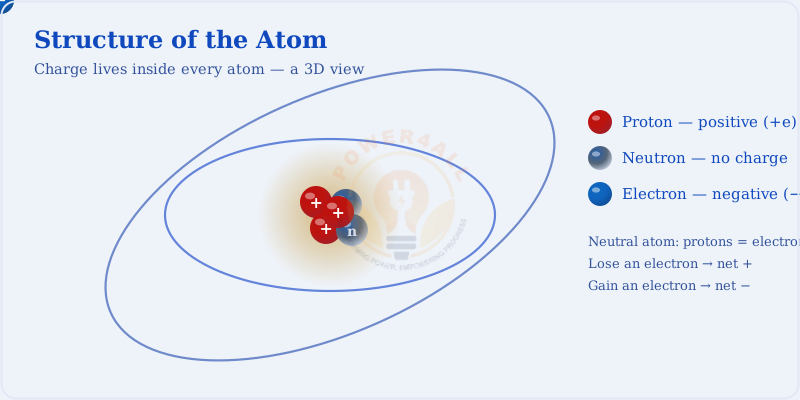
To really understand charge, look inside the atom. Charge is not something added to matter from outside — it is built into the particles matter is made of.
The Three Building Blocks
Proton
Charge: +e (positive)
- Lives in the nucleus
- Relatively heavy and fixed in place
- Its count defines the element
Electron
Charge: −e (negative)
- Orbits the nucleus
- Light and mobile — it is what actually moves
- Transfer of electrons is what charges objects
Neutron
Charge: 0 (neutral)
- Also in the nucleus
- Adds mass but no charge
- Keeps the nucleus stable
The Elementary Charge and Quantization
The proton and electron carry charges that are equal in size but opposite in sign. That size is the elementary charge, e = 1.602 × 10⁻¹⁹ C. Crucially, you can never find a free charge smaller than e: every measurable charge is a whole-number multiple of it. This principle is called the quantization of charge.
Worked example — how many electrons make −1 nC?
A small object carries a charge of Q = −1 nC = −1 × 10⁻⁹ C. Using n = Q / e:
n = (1 × 10⁻⁹) / (1.602 × 10⁻¹⁹) ≈ 6.24 × 10⁹
So the object has about 6.24 billion extra electrons — a reminder that even a “tiny” charge involves enormous numbers of particles.
Why a Neutral Object Is Not “Charge-Free”
An ordinary object looks electrically neutral because it contains equal numbers of protons and electrons, so their charges cancel. It is packed full of charge — the positives and negatives are simply balanced. Upset that balance by adding or removing electrons and the object shows a net charge.
Types of Charge & How They Interact
There are only two types of charge, and one simple rule governs how they behave: like charges repel, unlike charges attract.
Conventions You Must Know
- Positive charge: a shortage of electrons (or excess of protons). By convention, conventional current flows in the direction a positive charge would move.
- Negative charge: an excess of electrons. In metals, it is these electrons that physically drift.
- The force is mutual: both charges feel an equal and opposite force (Newton’s third law), no matter how different their sizes.
Common misconception
A “positive” object usually has not gained anything — it has lost electrons. Since electrons are the mobile particles, almost all everyday charging is about electrons leaving or arriving, not protons moving.
How Objects Get Charged
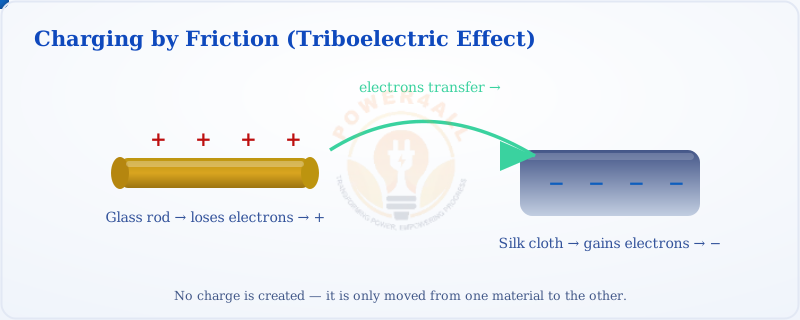
Charging simply means creating an imbalance of electrons. There are three classic ways to do it — friction, conduction and induction.
1. Friction (Rubbing)
Two different materials rubbed together swap electrons.
- One gains electrons (−), the other loses them (+)
- Both end up with equal and opposite charge
- Example: a comb through hair, a balloon on a jumper
2. Conduction (Contact)
A charged object touches a neutral conductor and shares its charge.
- Both objects end up with the same sign
- Charge spreads until potentials equalise
- Basis of how charge redistributes in wires
3. Induction (No Contact)
A nearby charge rearranges charge in a conductor without touching it.
- Produces the opposite sign on the near face
- Combine with grounding for a permanent charge
- Used in sensors, touchscreens and ESD design
The Triboelectric Series (Simplified)
The triboelectric series ranks materials by how readily they give up electrons. Rub any two together and the one higher in the “gives electrons” list becomes positive; the other becomes negative.
Coulomb’s Law: The Force Between Charges
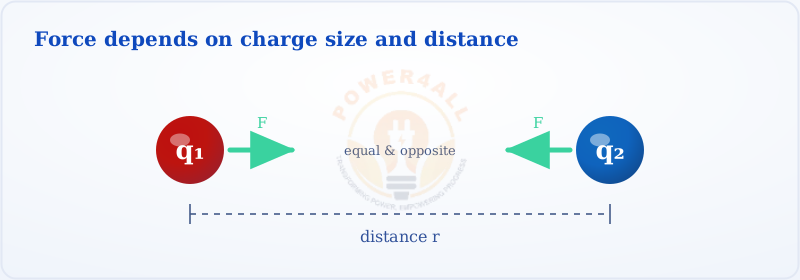
Coulomb’s law puts a precise number on the attraction or repulsion between two charges. It is the electrostatic equivalent of Newton’s law of gravity.
F = k · (q₁ · q₂) / r²
Force = Coulomb constant × product of charges ÷ distance squared (k ≈ 8.99 × 10⁹ N·m²/C²)
What the Formula Tells You
- Bigger charges, bigger force: double either charge and the force doubles.
- Inverse-square with distance: double the separation and the force drops to a quarter.
- Sign sets direction: a positive product means repulsion, a negative product means attraction.
- Medium matters: in a material other than vacuum, the force is reduced by the medium’s permittivity.
Worked example — force between two charges
Two charges, q₁ = +2 µC and q₂ = +3 µC, sit r = 0.10 m apart in air.
F = (8.99×10⁹)(2×10⁻⁶ × 3×10⁻⁶) / (0.10)²
F = (8.99×10⁹)(6×10⁻¹²) / 0.01 ≈ 5.4 N, directed apart (repulsion).
Move them to 0.20 m and the force falls to about 1.35 N — a quarter, exactly as the inverse-square rule predicts.
Electric Field & Potential from Charge
A charge does not need to touch another charge to affect it. It fills the space around itself with an electric field — the mechanism through which the force is delivered.
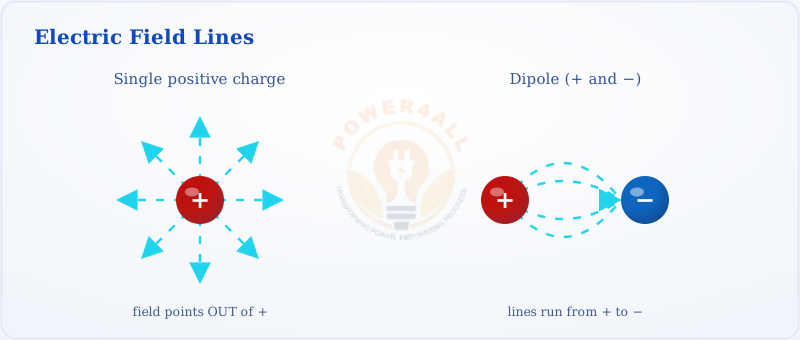
From Field to Force to Voltage
E = F / q = k · Q / r²
Electric field (E) is the force per unit charge; near a point charge it also follows an inverse-square law
Charge, field and voltage are three views of the same story. Moving a charge through an electric field takes energy, and the energy per unit charge is exactly what we call potential difference (voltage):
W = Q × V
Energy to move charge Q through a potential difference V (joules)
Charge in Conductors & Insulators
Whether charge can move freely depends on the material. This single difference explains wires, insulation, static cling and grounding.
Conductors
Materials with loosely-bound “free” electrons.
- Charge moves easily throughout the material
- Excess charge spreads to the outer surface
- Examples: copper, aluminium, silver, salt water
- Used for wires, busbars and contacts
Insulators (Dielectrics)
Materials that hold their electrons tightly.
- Charge stays where it is placed
- Can be polarised — charge shifts slightly
- Examples: rubber, glass, plastic, dry air
- Used for cable insulation and capacitor dielectrics
Semiconductors
In-between materials whose conductivity we control.
- Charge carriers: electrons and “holes”
- Doping sets the number of carriers
- Examples: silicon, germanium, SiC, GaN
- Foundation of every diode and transistor
Grounding: Giving Charge Somewhere to Go
Connecting a charged conductor to the earth provides a huge reservoir that absorbs or supplies electrons, neutralising the object. Grounding is a safety cornerstone in wiring and the working principle behind lightning protection and ESD wrist straps.
Why static shocks happen
Walking across carpet charges you by friction. Because your shoes and the air are insulators, the charge cannot leak away — until you touch a conductive doorknob, and thousands of volts’ worth of built-up charge equalises in a single quick spark.
Measuring & Detecting Charge
Charge is rarely measured directly in the field; more often we detect its presence or calculate it from current, voltage or capacitance.
Units and Practical Multiples
Because one coulomb is so large, engineers work in submultiples every day:
Gold-Leaf Electroscope
The classic charge detector.
- Two thin leaves spread apart when charged
- Shows the presence and relative size of charge
- Can identify the sign by a known test charge
Coulomb Meter / Electrometer
Instruments that read charge directly.
- Measure very small charges and currents
- Extremely high input impedance
- Used in labs, calibration and physics research
Calculate It Instead
Most engineering charge values are derived.
- From current & time:
Q = I × t - From a capacitor:
Q = C × V - From battery rating:
Ah → coulombs
Electric Charge in Power Electronics & Real Life
Charge is not just a physics-class idea — managing where charge goes and how fast it moves is the daily work of power electronics.
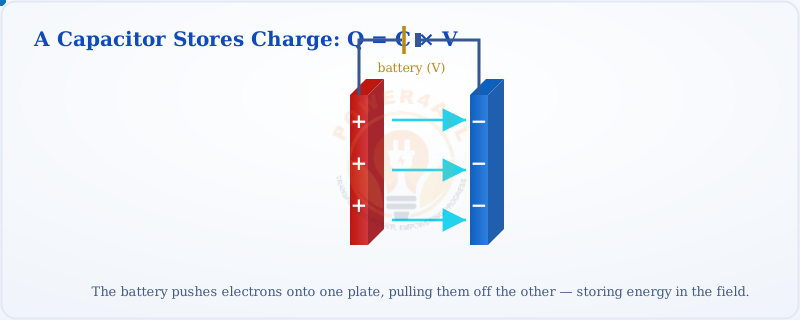
Capacitors
Store charge on demand: Q = C × V.
- Smooth ripple in power supplies
- Set timing in oscillators
- Buffer energy for fast loads
Batteries
Capacity is charge: an amp-hour is charge over time.
1 Ah = 3600 C- Total charge delivered =
I × t - State-of-charge tracks remaining coulombs
Semiconductors & Gates
Switching means moving gate charge fast.
- MOSFET gate charge sets switching speed
- Charge carriers form the current in chips
- Less gate charge = faster, cooler switching
ESD Protection
Stray static charge destroys electronics.
- Wrist straps and mats drain charge safely
- TVS diodes clamp charge surges
- Grounding prevents damaging sparks
Worked example — charge in a battery
A power bank is rated 10,000 mAh at its cell voltage. How much charge can it deliver?
Q = 10 Ah × 3600 s/h = 36,000 C
If a device draws 0.5 A, run-time ≈ Q / I = 36,000 / 0.5 = 72,000 s ≈ 20 hours (before conversion losses).
Conservation & Key Laws of Charge
Three principles about charge hold everywhere in physics and engineering — memorise them and most charge problems become straightforward.
1. Conservation of Charge
The total electric charge of an isolated system is constant. Charge is never created or destroyed — only transferred. When you charge a balloon by rubbing, the balloon’s negative charge is matched exactly by the positive charge left on the cloth, so the pair’s total is still zero.
ΣQbefore = ΣQafter
The algebraic sum of charge stays the same
2. Quantization of Charge
Charge exists only in whole-number multiples of the elementary charge e. You can have 1e, 2e or a trillion e, but never 1.5e of free charge. In everyday circuits the numbers of electrons are so vast that charge looks continuous — but at heart it is granular.
Q = n × e (n = ±1, ±2, ±3 …)
Charge is always an integer multiple of e
3. Additivity of Charge
The net charge of a body is simply the algebraic sum of all the charges it contains, treating positive as (+) and negative as (−). Charge is a scalar — it has size and sign but no direction — so charges add like ordinary signed numbers.
Frequently Asked Questions
Quick, expert answers to the questions students and engineers ask most about electric charge.
What exactly is electric charge?
Electric charge is a fundamental property of matter that makes it feel a force in an electric or magnetic field. It comes in two kinds — positive (carried by protons) and negative (carried by electrons) — and is measured in coulombs (C).
What is the SI unit of charge, and how big is it?
The unit is the coulomb (C). One coulomb is the charge moved by a 1-ampere current in 1 second (Q = I × t). It is huge on an atomic scale — about 6.242 × 10¹⁸ electrons make one coulomb — which is why engineers usually work in µC, nC or pC.
What is the smallest amount of charge that can exist?
The elementary charge, e = 1.602 × 10⁻¹⁹ C, carried by a single electron or proton. All free charge is a whole-number multiple of it — this is the quantization of charge.
Why do like charges repel and unlike charges attract?
Each charge sets up an electric field. Same-sign fields oppose each other and produce a repulsive force; opposite-sign fields reinforce and pull together. The exact strength follows Coulomb’s law, F = k q₁q₂ / r².
How is charge related to voltage and capacitors?
A capacitor stores charge according to Q = C × V. Moving a charge through a voltage takes energy W = Q × V. So charge, voltage and stored energy are tightly linked.
Is electric charge the same as electricity or current?
No. Charge is the quantity of electricity; current is the flow of that charge per second. “Electricity” is the general phenomenon that includes charge, current, voltage and fields together.
What is 1 coulomb of charge?
One coulomb (1 C) is the charge moved when a 1-ampere current flows for 1 second. It equals about 6.242 × 10¹⁸ elementary charges — a huge amount, which is why practical values use µC, nC or pC.
Is electric charge a scalar or a vector quantity?
Charge is a scalar — it has magnitude and a sign (+ or −) but no direction, so charges add algebraically. The force between charges (Coulomb’s law) is a vector, but the charge itself is not.
How do you calculate the charge stored in a capacitor?
Use Q = C × V. For example, a 100 µF capacitor charged to 12 V stores Q = 100×10⁻⁶ × 12 = 1.2 mC. See capacitors for more.
What is the difference between static charge and current electricity?
Static charge is charge at rest that builds up on a surface (as in the triboelectric effect). Current electricity is charge in motion — a continuous flow measured in amperes. Same charge; the difference is whether it is stationary or flowing.
Conclusion & Key Takeaways
Electric charge is the single most fundamental idea in electrical engineering. Once you understand what charge is and how it behaves, voltage, current, fields and every device fall neatly into place.
Two kinds, one rule
Charge is positive or negative; like charges repel and unlike attract.
Measured in coulombs
Q = I × t, and the smallest free unit is the elementary charge e.
Coulomb’s law
Force grows with charge and falls off with the square of distance.
Conserved & quantized
Charge is never created or destroyed and always comes in multiples of e.
It powers everything
Capacitors, batteries and chips are all about storing and moving charge.
Links to voltage & current
W = Q × V and I = Q / t tie charge to the rest of electricity.