What is a Parallel Circuit?
The complete guide to parallel circuits — components on separate branches across the same two nodes. Learn why the voltage is the same across every branch, how the current divides (I = I1+I2+I3), why total resistance is less than the smallest, the current divider, and why your home is wired this way.
Complete Learning Path — Parallel Circuits
From the many-branch idea and the three rules, to Ohm's law, the current divider, parallel vs series and real uses
What is a Parallel Circuit?
A parallel circuit is a circuit in which the components are connected across the same two points, so each sits on its own separate branch. Current arriving at the node splits, flows through the branches, and recombines — there are many paths, not one.
Think of a wide river splitting into several channels around islands and rejoining downstream: the water divides between the channels, but every channel spans the same drop. This is the opposite of a series circuit, and it leads to the three rules of parallel circuits covered below.
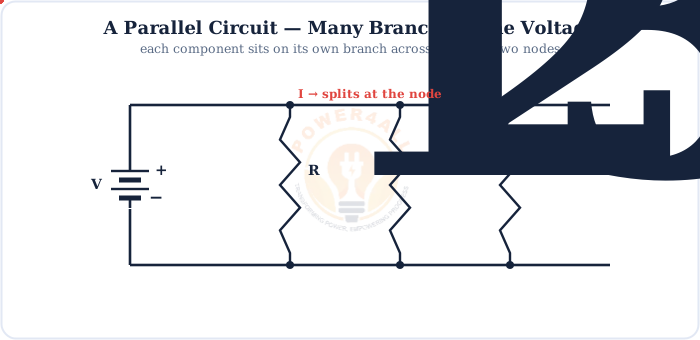
The three rules in one glance
Voltage: same across all — V = V1 = V2 = V3. Current: divides — I = I1 + I2 + I3. Resistance: reciprocals — 1/Rtotal = 1/R1 + 1/R2 + 1/R3.
Rule 1: The Voltage Is the Same Across Every Branch
Because both ends of every branch connect to the same two nodes, each branch has the full supply voltage across it. Put a voltmeter across any branch and it reads the same value.
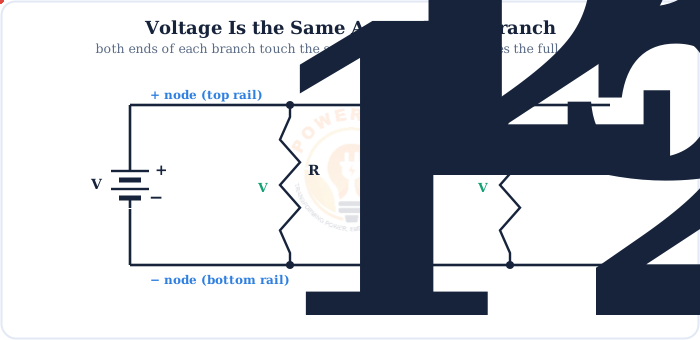
V = V1 = V2 = V3 = … = Vn
The same voltage appears across every branch of a parallel circuit
Why appliances are wired in parallel
Every socket in your home is a branch across the same live and neutral, so each appliance gets the full mains voltage and runs independently — exactly what parallel connection guarantees.
Rule 2: The Current Divides (Kirchhoff's Current Law)
The total current from the source splits between the branches, and the branch currents add back up to the total. This is Kirchhoff's Current Law (KCL).
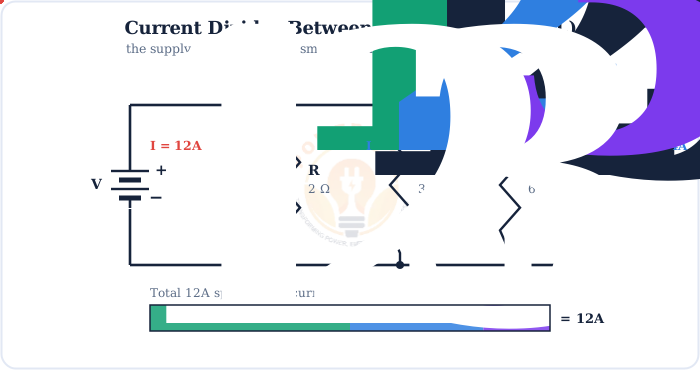
Itotal = I1 + I2 + I3 + … · Ix = V / Rx
The total current equals the sum of the branch currents; each branch current follows Ohm's law
Smaller resistor, bigger current
Since the voltage is shared equally, the current I = V/R is inversely proportional to each branch's resistance. The 2 Ω branch carries three times the current of the 6 Ω one.
Rule 3: Total Resistance Follows the Reciprocal Rule
Adding parallel branches gives the current more ways through, so the total resistance drops — it is always less than the smallest single branch.
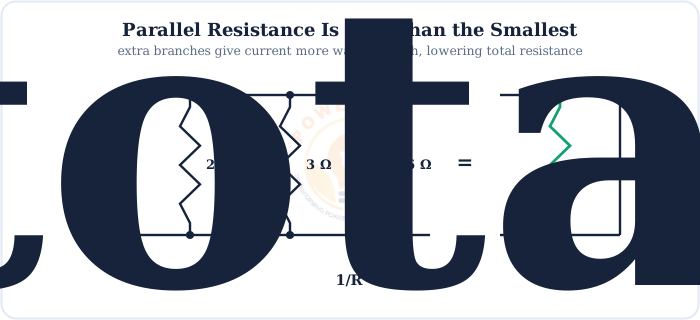
1/Rtotal = 1/R1 + 1/R2 + … · (two: Rtotal = R1R2 / (R1+R2))
Reciprocals add; for two resistors use the product-over-sum shortcut
Conductance simply adds
In terms of conductance (G = 1/R) the rule is beautifully simple: Gtotal = G1 + G2 + … — conductances in parallel add just like resistances in series. Capacitors in parallel also add: Ctotal = C1 + C2 + …
Putting It Together with Ohm's Law
Combine the three rules with Ohm's law to solve any parallel circuit. Here is the full worked example for the circuit above (12 V supply).
Worked example — 12 V across 2 Ω, 3 Ω, 6 Ω
1. Branch currents (each sees the full 12 V): I1 = 12/2 = 6 A, I2 = 12/3 = 4 A, I3 = 12/6 = 2 A
2. Total current: I = 6 + 4 + 2 = 12 A
3. Total resistance: Rtotal = V/I = 12/12 = 1 Ω (check: 1/2+1/3+1/6 = 1 ✓)
Two-resistor shortcut
Just 2 Ω and 3 Ω in parallel? Use product-over-sum:
Rtotal = (2×3)/(2+3) = 6/5 = 1.2 Ω — again below the smaller (2 Ω).
The Parallel Current Divider
Just as series circuits give the voltage divider, parallel circuits give the current divider — two branches that split an incoming current in a fixed ratio.
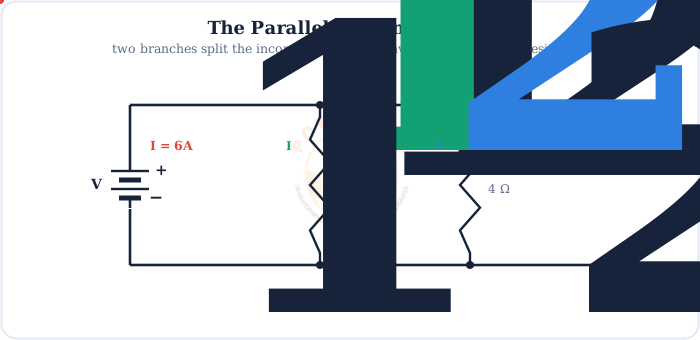
I1 = Itotal × R2 / (R1 + R2)
Branch current for a two-resistor divider — note the opposite resistor is on top
Current dividers appear in ammeter shunts (a small resistor diverts most of the current around the meter), current sharing between paralleled devices, and sensor front-ends. The opposite-resistor-on-top rule is the mirror image of the series voltage divider.
Parallel vs Series Circuits
Parallel and series are the two fundamental ways to connect components — and they behave as near-opposites. Here is the side-by-side comparison.
| Property | Parallel circuit | Series circuit |
|---|---|---|
| Paths | Multiple branches | One single path |
| Voltage | Same across each branch | Divides across components |
| Current | Divides between branches | Same everywhere |
| Total resistance | 1/R1+1/R2+… (smaller) | R1+R2+… (larger) |
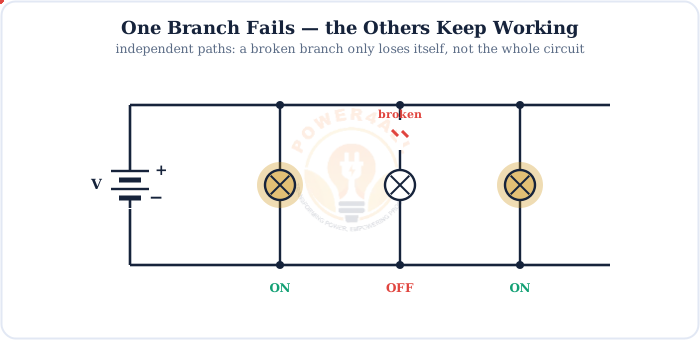
| If one fails (open) | Other branches keep working | Whole circuit stops |
| Typical use | Mains outlets, home wiring | Switches, fuses, LED strings |
Real circuits are often both
Most practical circuits mix the two into series-parallel networks, solved by repeatedly collapsing parallel and series groups into single equivalent resistances.
Uses & the Big Advantage
Parallel connection costs more wire, but it buys the property that matters most in real systems: independence — one branch failing does not stop the rest.
Home & mains wiring
Every socket and light is a branch on the same supply, each at full voltage.
Lighting
Modern light strings are parallel — one bulb out, the rest stay on.
Batteries in parallel
Same voltage but more capacity and current capability.
Paralleled devices
MOSFETs in parallel share current to handle more power.
Advantages
Each device full voltage; independent; one failure doesn't stop others.
Disadvantages
More wiring; draws more total current; a short on one branch loads the source.
Key Terms at a Glance
The essential parallel-circuit vocabulary students and engineers search for.
Parallel circuit
Branches across the same two nodes.
Branch
One independent current path.
Node
A junction where branches meet.
KCL
Branch currents sum to the total.
Reciprocal rule
1/Rtotal = Σ(1/R)
Current divider
Two branches split the current.
Frequently Asked Questions
Quick, expert answers to the questions people ask most about parallel circuits.
What is a parallel circuit?
A parallel circuit is a circuit in which the components are connected across the same two points, so each one sits on its own branch. Because every branch spans the same two nodes, the same voltage appears across each component, and the total current splits between the branches.
What are the three rules of a parallel circuit?
First, the voltage is the same across every branch: V = V1 = V2 = V3. Second, the branch currents add up to the total: I = I1 + I2 + I3. Third, the resistances combine by reciprocals: 1/Rtotal = 1/R1 + 1/R2 + 1/R3.
Is the voltage the same in a parallel circuit?
Yes. Every branch connects to the same two nodes, so each branch has the full supply voltage across it. A voltmeter across any branch reads the same value, so V = V1 = V2 = V3.
How does current divide in a parallel circuit?
The total current splits between the branches in inverse proportion to their resistance, and the branch currents add back up to the total. This is Kirchhoff's current law: I = I1 + I2 + I3. A smaller resistance carries a larger share of the current.
How do you calculate total resistance in a parallel circuit?
Add the reciprocals of the branch resistances and take the reciprocal of the result: 1/Rtotal = 1/R1 + 1/R2 + 1/R3. For two resistors this simplifies to Rtotal = (R1×R2)/(R1+R2).
Why is the total resistance in parallel less than the smallest resistor?
Every extra branch gives the current another path to flow through, so more current flows for the same voltage. More current for the same voltage means less resistance, so the total is always smaller than the smallest single branch.
What happens if one branch fails in a parallel circuit?
If one branch fails open, only that branch stops. The other branches still connect to the same two nodes and keep working normally. This independence is the main advantage of parallel wiring over series.
What is the difference between parallel and series circuits?
In a parallel circuit there are multiple branches, the voltage is the same across each, the current divides, and the total resistance is less than the smallest branch. In a series circuit there is one path, the current is the same everywhere, the voltage divides, and the resistances add.
Why is house wiring done in parallel?
So every socket and light gets the same full mains voltage and works independently. You can switch one appliance off without affecting the others, and if one device fails the rest keep running, which a series arrangement could not provide.
What is a current divider?
A current divider is two parallel branches that split an incoming current. For two resistors, the current in one branch is I1 = I × R2/(R1 + R2) — note the opposite resistor appears on top, because the smaller resistance takes the larger current.
Conclusion & Key Takeaways
A parallel circuit gives every component its own path — same voltage for all, shared current, and the independence that makes it the choice for real-world wiring.
Many branches
Across the same two nodes.
V is constant
Same voltage on each branch.
I divides
I = I1+I2+I3 (KCL).
R gets smaller
1/Rtotal = Σ(1/R).
Current divider
Opposite resistor on top.
Independent branches
One fails, others work.