Joule’s Law of Heating
The complete guide to the heating effect of electric current — why a wire warms up when current flows through it. From the formula H = I²Rt, its statement and derivation, to the forms H = VIt and H = V²t/R, heat in joules and calories, worked examples, and everyday uses from heaters to the humble fuse.
Complete Learning Path — Joule’s Law of Heating
From what the law says, to its formula, derivation, units, applications and losses
What is Joule’s Law of Heating?
Joule’s law of heating tells us how much heat an electric current produces as it flows through a resistance. When current pushes through a resistor, the moving electrons collide with the atoms of the conductor, lose energy, and that energy appears as heat. This is called the heating effect of electric current.
Named after the English physicist James Prescott Joule, the law puts an exact number on this everyday phenomenon: the heat produced is H = I²Rt. It is the reason an electric heater glows, a bulb lights up, a fuse melts to save your wiring — and also why cables and motors get warm and waste energy.
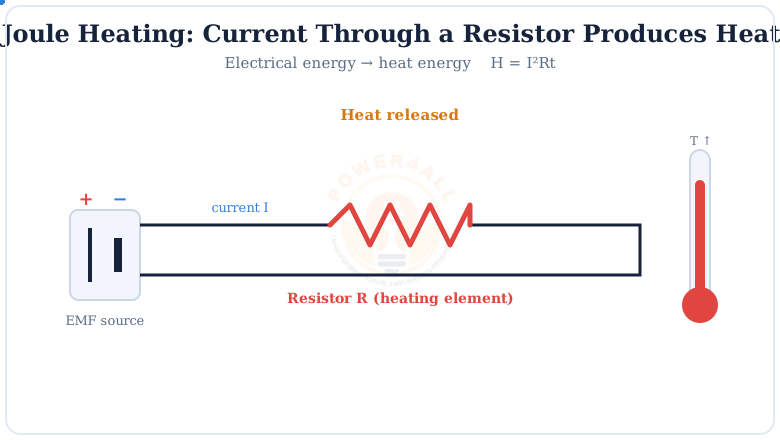
Heating effect of current
Whenever current flows through any resistance, heat is produced — there is no way to avoid it. Joule’s law simply tells us how much. Engineers use it deliberately in heaters and fuses, and fight it as wasted I²R losses elsewhere.
Statement of Joule’s Law & the Three Factors
Joule’s law of heating is really three simple laws combined into one. Each says the heat produced (H) is proportional to one quantity while the others are held constant.
| Law | Held constant | Relationship | Meaning |
|---|---|---|---|
| 1. Current law | R, t constant | H ∝ I² | Double the current → four times the heat |
| 2. Resistance law | I, t constant | H ∝ R | Double the resistance → double the heat |
| 3. Time law | I, R constant | H ∝ t | Double the time → double the heat |
Put together, these give the single equation H = I²Rt. In words: “the heat produced in a conductor is directly proportional to the square of the current, to the resistance of the conductor, and to the time for which the current flows.”
The star factor is I²
Current matters most because it appears squared. That single fact — heat rising with the square of current — explains fuses, transmission at high voltage, and why overloaded wires overheat so fast.
The Formula: H = I²Rt
The heart of Joule’s law is one compact formula. Every factor has a clear role and a clear unit.
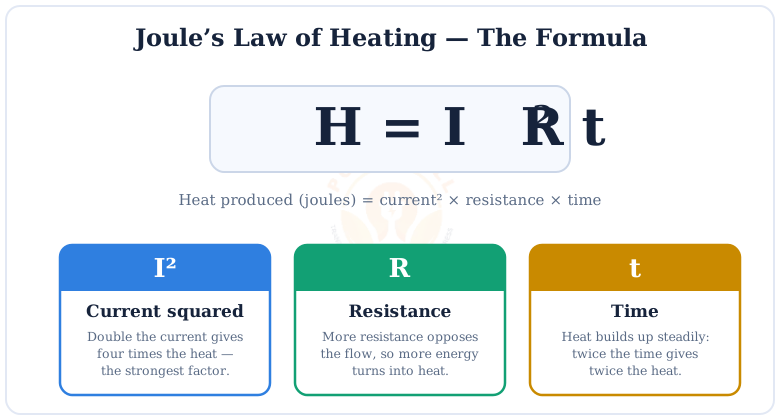
H = I² R t (joules)
H = heat (J) · I = current (A) · R = resistance (Ω) · t = time (s)
Worked example 1 — basic H = I²Rt
A current of 5 A flows through a 10 Ω resistor for 2 minutes (120 s). How much heat is produced?
H = I²Rt = 5² × 10 × 120 = 25 × 10 × 120 = 30 000 J = 30 kJ. Check the working with the Power Dissipation Calculator.
Worked example 2 — using voltage (H = V²t/R)
A 220 V electric heater has an element of resistance 48.4 Ω. Heat produced in 1 hour (3600 s)?
H = V²t/R = (220² × 3600) / 48.4 = (48 400 × 3600) / 48.4 = 3.6 × 10⁶ J = 3.6 MJ — that is exactly 1 kWh of energy. Estimate the cost with the Energy Cost Calculator.
Why Current Matters Most: the I² Effect
Because current is squared in H = I²Rt, a small rise in current causes a big rise in heat. This is the single most important idea in the whole topic.
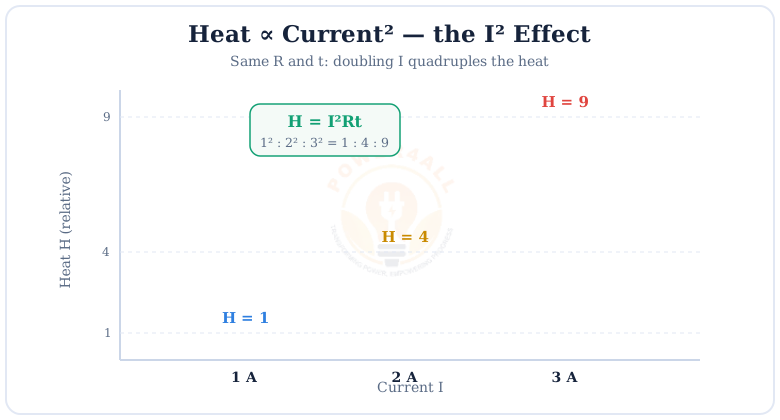
This is why an overloaded wire heats so dangerously, why fuses act fast on a fault, and why power companies transmit electricity at high voltage and low current — halving the current cuts the line heating losses to a quarter.
Remember
Heat scales with the square of current but only linearly with resistance and time. If a load draws 20% more current, the heat rises by about 44% (1.2² = 1.44), not 20%.
Derivation & the Three Equivalent Forms
Joule’s formula comes straight from the definition of electrical energy. Heat is simply the electrical energy delivered to the resistor.
The work done to move charge Q through a potential difference V is W = VQ. Since charge Q = It and, by Ohm’s law, V = IR, the electrical energy converted to heat is:
H = W = V × Q = V × I × t = (IR) × I × t = I²Rt
Starting from H = VIt and substituting V = IR gives H = I²Rt
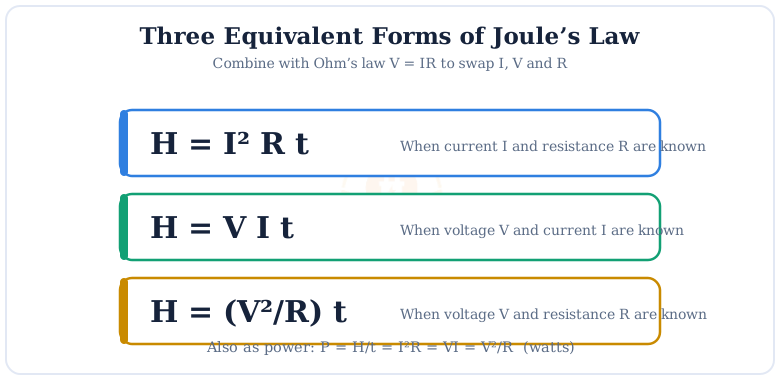
H = I²Rt
Use when you know the current and resistance (e.g. a fixed heating element).
H = VIt
Use when you know the voltage and current directly across the load.
H = V²t/R
Use for an appliance on a fixed supply voltage such as 230 V mains.
Link to power
Heat is just power × time. Since P = I²R = VI = V²/R, dividing any heat form by t gives the power dissipated in watts: H = P × t.
Units: Joules, Calories & kWh
Because heat is a form of energy, its SI unit is the joule (J). In heat and chemistry problems the calorie is also common, and electricity bills use the kilowatt-hour (kWh).
| Unit | Equivalent | Where used |
|---|---|---|
| Joule (J) | 1 J = 1 W·s | SI unit; the H in H = I²Rt |
| Calorie (cal) | 1 cal = 4.184 J | Heat & thermal problems |
| Kilowatt-hour (kWh) | 1 kWh = 3.6 × 10⁶ J | Energy bills / meter reading |
To get heat in calories, first find H = I²Rt in joules, then divide by 4.184:
H (calories) = I²Rt / 4.184 ≈ 0.24 I²Rt
The factor 0.24 (cal/J) converts Joule heating from joules into calories
Worked example 3 — heat in calories
Find the heat, in calories, when 2 A flows through 5 Ω for 60 s.
H = I²Rt = 2² × 5 × 60 = 1200 J, so H ≈ 0.24 × 1200 ≈ 287 calories (1200 / 4.184).
Applications of the Heating Effect
Joule heating is put to work wherever we want to turn electricity into heat or light. The trick is a high-resistance element (usually nichrome) that glows without melting or oxidising.
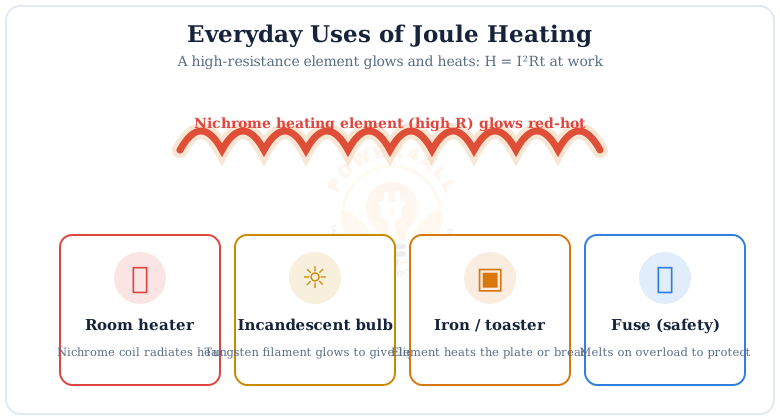
Heating appliances
Room heaters, geysers, immersion rods, kettles, irons, toasters and hair dryers all use nichrome elements.
Incandescent bulb
Current heats a thin tungsten filament to ~2500 °C so it glows white and gives light.
Electric fuse
A thin wire melts on overload, breaking the circuit — a life-saving use of Joule heating.
Soldering & welding
Soldering irons and resistance welders concentrate I²R heat to melt solder or fuse metal.
Why nichrome?
Nichrome (nickel–chromium) has a high resistivity, a high melting point (~1400 °C) and does not oxidise easily — so it produces lots of heat and survives glowing red for years.
The Electric Fuse: Safety by Joule Heating
The fuse is the most elegant use of Joule’s law: it protects a circuit by deliberately being the first thing to overheat and melt.
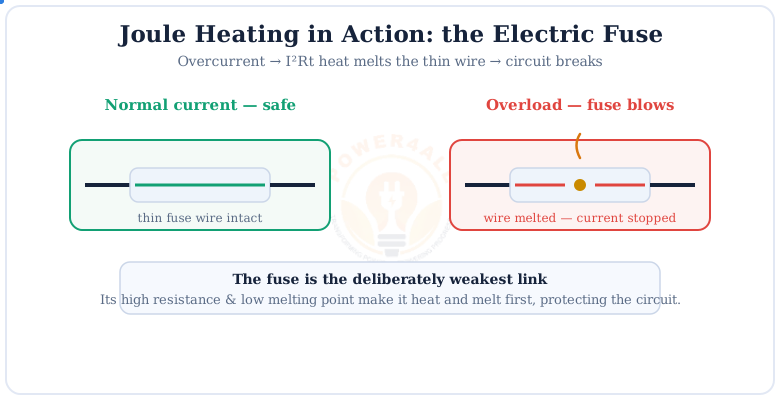
A fuse is a short length of thin wire with high resistance and a low melting point, connected in series with the load. During normal operation the heat I²Rt is small and harmless. If a fault or overload pushes the current too high, the heat rises with the square of the current, quickly melting the wire and cutting the supply. Modern homes also use MCBs (miniature circuit breakers), but the underlying protection idea — act before I²R heat damages the wiring — is the same.
Worked example 4 — fuse rating
An appliance normally draws 4 A. A 5 A fuse is fitted. If a fault makes it draw 10 A, the heating in the fuse is (10/5)² = 4× its rated heat — more than enough to melt it and disconnect the circuit almost instantly.
The Downside: I²R Losses & Drawbacks
The very same effect that powers a heater is a costly nuisance everywhere else. Unwanted Joule heating is called I²R loss (copper loss).
Transmission lines
Long cables waste energy as heat; power is sent at high voltage / low current to cut I²R loss.
Motors & transformers
Winding resistance turns useful energy into heat, lowering efficiency and needing cooling.
Electronics
Chips and MOSFETs dissipate I²R heat and need heat sinks to stay cool.
Fire & overheating
Loose joints and overloaded wires overheat — a leading cause of electrical fires.
Managing the heat
Engineers fight I²R losses with thicker conductors (less R), higher transmission voltage (less I), and cooling such as fans, oil and heat sinks. Sizing a conductor’s current rating is really a Joule-heating calculation.
Key Terms at a Glance
The essential Joule-heating vocabulary students and engineers search for.
Joule heating
Heat from current in a resistance.
H = I²Rt
Heat = current² × resistance × time.
I²R loss
Unwanted heating (copper loss).
Nichrome
High-resistance heating alloy.
Fuse
Wire that melts on overload.
Calorie
1 cal = 4.184 J of heat.
Frequently Asked Questions
Quick, exam-ready answers to the questions people ask most about Joule’s law of heating.
What is Joule’s law of heating?
Joule’s law of heating describes the heating effect of electric current. It states that when a current flows through a resistance, the heat produced is directly proportional to the square of the current, to the resistance, and to the time. In symbols, H = I²Rt, where H is heat in joules, I current in amperes, R resistance in ohms and t time in seconds. The electrical energy is converted into heat in the resistor.
What is the formula for Joule’s law of heating?
The formula is H = I²Rt. Using Ohm’s law V = IR, it can also be written as H = VIt or H = V²t/R. Here H is heat in joules, I current in amperes, V voltage in volts, R resistance in ohms and t time in seconds.
State the three laws that make up Joule’s law of heating.
First, the heat is proportional to the square of the current when R and t are constant (H ∝ I²). Second, it is proportional to the resistance when I and t are constant (H ∝ R). Third, it is proportional to the time when I and R are constant (H ∝ t). Combined, they give H = I²Rt.
What are the three factors on which the heat produced depends?
The current (as its square), the resistance of the conductor, and the time for which the current flows. Doubling the current gives four times the heat, doubling the resistance doubles the heat, and doubling the time doubles the heat.
What is the SI unit of heat produced?
The SI unit is the joule (J), the same as energy, because Joule’s law just converts electrical energy into heat. Heat is also expressed in calories, where 1 cal = 4.184 J, so H (cal) = I²Rt / 4.184 ≈ 0.24 I²Rt.
Why does the heat depend on the square of the current?
Power in a resistor is P = I²R, and heat is power × time. The voltage across the resistor is itself V = IR, so power = VI = I×IR = I²R. Because heat is P×t, it grows with the square of current — doubling I quadruples the heat.
What are the applications of Joule’s heating effect?
Electric heaters, geysers, immersion rods, irons, toasters, kettles and hair dryers (nichrome elements), the glowing filament of an incandescent bulb, and the electric fuse that melts on overload. The same effect appears as unwanted I²R losses in cables, motors and transformers.
How does a fuse work using Joule’s law?
A fuse is a thin, high-resistance wire with a low melting point in series with the circuit. Under normal current the I²Rt heat is small and the wire stays intact. If the current rises too high, the heat (which grows with the square of current) melts the wire and breaks the circuit, protecting the appliance and wiring.
How do you calculate the heat produced in calories?
Find the heat in joules with H = I²Rt, then divide by 4.184 to get calories (since 1 cal = 4.184 J), giving H (cal) ≈ 0.24 I²Rt. Example: 2 A through 5 Ω for 60 s gives 1200 J ≈ 287 calories.
Is Joule heating useful or wasteful?
Both. It is useful and deliberate in heaters, bulbs and fuses. It is wasteful as I²R losses in transmission lines, motor windings and transformers, where the heat is lost energy that forces the use of thicker conductors, higher voltages and cooling.
Conclusion & Key Takeaways
Joule’s law of heating is the bridge between electricity and heat: H = I²Rt, one formula that runs your heater, lights your bulb, and saves your wiring through the fuse.
H = I²Rt
Heat = current² × R × time.
Current squared
Double I → 4× the heat.
Three forms
I²Rt = VIt = V²t/R.
Joules & calories
H(cal) ≈ 0.24 I²Rt.
Useful heat
Heaters, bulbs, fuses.
Wasted heat
I²R losses to fight.