Real, Reactive & Apparent Power
The complete guide to the three kinds of AC power — real power P = VI cosφ (watts), reactive power Q = VI sinφ (VAR) and apparent power S = VI (VA) — tied together by the power triangle S² = P² + Q² and the power factor cosφ = P/S.
Complete Learning Path — AC Power
From the three kinds of power, to their formulas, the power triangle, power factor, units and real-world use
Three Kinds of Power in AC Circuits
In a DC circuit power is simply P = VI. In an AC circuit, voltage and current are usually out of phase because of reactance, so the power splits into three distinct quantities.
The real (active) power P is the useful power the load actually consumes. The reactive power Q sloshes back and forth without doing net work. The apparent power S is the total the source has to supply. They combine as a right-angled power triangle.
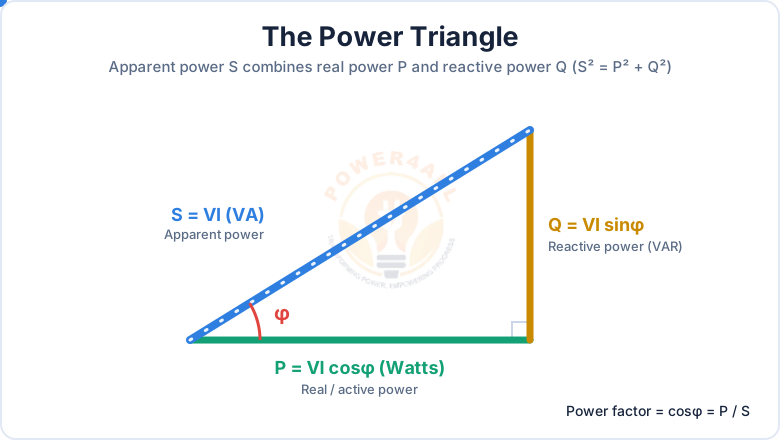
One current, three names for its power
There is only one voltage and one current. Splitting the power into P, Q and S just separates the part that does work (P) from the part that only moves energy back and forth (Q). The supply still has to carry the total, S.
Real (Active) Power: P = VI cosφ
Real power — also called active or true power — is the average power actually turned into useful work, light, motion or heat. It is what your electricity meter bills you for, measured in watts (W).
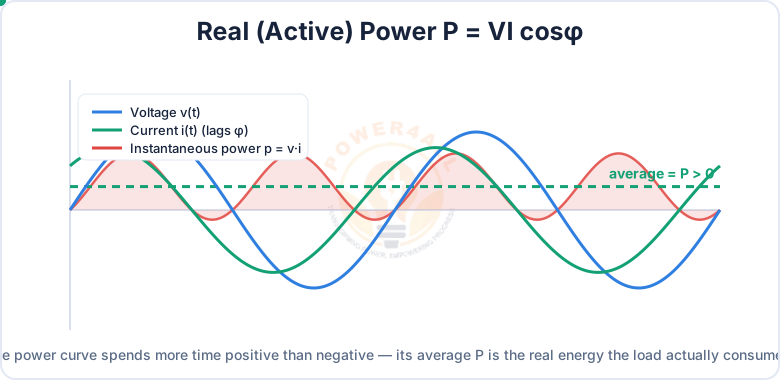
P = VI cosφ
Real (active) power in watts (W) — V and I are RMS values, φ is the phase angle
When voltage and current are in phase (φ = 0, a purely resistive load) cosφ = 1 and all the power is real: P = VI. As φ grows, cosφ shrinks and less of the supplied power does useful work.
Worked example
A 230 V supply drives 10 A into a motor with a phase angle of 37° (cosφ ≈ 0.8):
P = 230 × 10 × 0.8 = 1840 W. A 2 kW resistive heater on the same supply (cosφ = 1) draws less current for the same real power.
Reactive Power: Q = VI sinφ
Reactive power is the power that is repeatedly borrowed and returned by the magnetic fields of inductors and the electric fields of capacitors. It does no net work, yet the wires still have to carry the current that produces it. Its unit is the volt-ampere reactive (VAR).
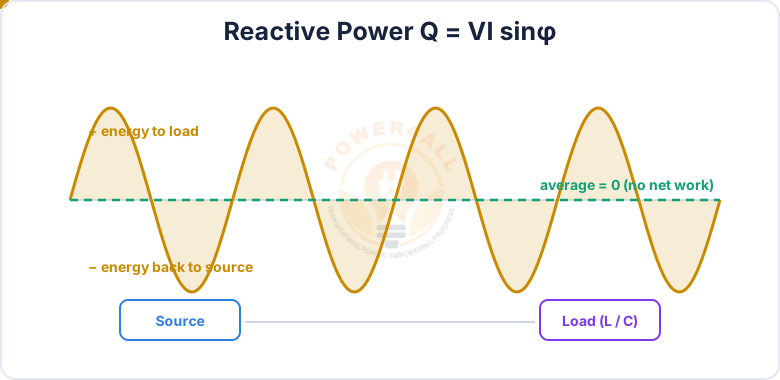
Q = VI sinφ
Reactive power in volt-amperes reactive (VAR) — positive for lagging (inductive) loads
Lagging vs leading
Inductive loads (motors, transformers) draw lagging reactive power (Q > 0, current lags voltage). Capacitive loads supply leading reactive power (Q < 0). This is why capacitor banks correct the lagging power factor of factories.
Apparent Power: S = VI
Apparent power is simply the product of the RMS voltage and RMS current, S = VI. It is the total power the utility must actually supply, measured in volt-amperes (VA). Cables, transformers and generators are rated in VA (or kVA) because they must carry the whole current, useful or not.
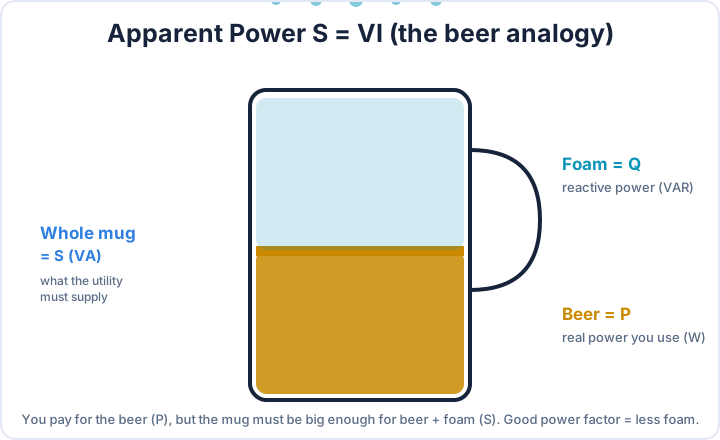
S = VI = √(P² + Q²)
Apparent power in volt-amperes (VA) — the vector sum of real and reactive power
Worked example
Same motor: 230 V, 10 A:
S = 230 × 10 = 2300 VA = 2.3 kVA. With P = 1840 W, the reactive power is Q = √(2300² − 1840²) ≈ 1380 VAR.
The Power Triangle & Complex Power
Because real and reactive power are 90° apart, they add like the two sides of a right triangle, with apparent power as the hypotenuse. This single picture ties everything together.
S² = P² + Q² · P = S cosφ · Q = S sinφ · Q = P tanφ
The power-triangle relationships — and in complex form, S = P + jQ
| Quantity | Symbol | Formula | Unit | Meaning |
|---|---|---|---|---|
| Real power | P | VI cosφ | W (kW) | Useful work / heat |
| Reactive power | Q | VI sinφ | VAR (kVAR) | Exchanged, no net work |
| Apparent power | S | VI | VA (kVA) | Total supplied |
| Complex power | S | P + jQ | VA | Phasor form |
The 3-4-5 example
If P = 4 kW and Q = 3 kVAR, then S = √(4²+3²) = 5 kVA, and the power factor is cosφ = 4/5 = 0.8. Try the Power Triangle Calculator.
Power Factor: cosφ = P / S
Power factor measures how much of the supplied (apparent) power actually does useful work. It is the ratio of real to apparent power, cosφ = P/S, and ranges from 0 to 1.
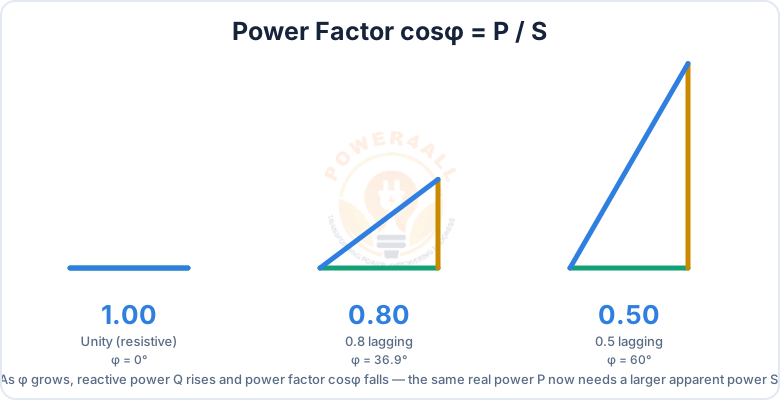
Power factor = cosφ = P / S
Dimensionless, 0 to 1 — unity means all supplied power is useful
A low power factor means a large reactive current, so wires run hotter and transformers reach their kVA limit while delivering fewer useful watts. Utilities often penalise industrial customers for poor power factor, which is corrected with capacitor banks. Check yours with the Power Factor Calculator.
Units at a Glance: Watt, VAR, VA
All three powers have the same dimensions, but different unit names make clear which kind of power is meant.
Watt (W / kW)
Unit of real power P. Measures the energy actually consumed per second. Your energy bill is in kWh.
VAR (kVAR)
Volt-ampere reactive, unit of reactive power Q. Measures the non-working power exchanged with fields.
VA (kVA)
Volt-ampere, unit of apparent power S. Transformers and generators are rated here.
Three-phase
For a balanced three-phase system: S = √3 VLIL, P = √3 VLIL cosφ and Q = √3 VLIL sinφ, where VL and IL are line values.
Why It Matters
Understanding P, Q and S is the foundation of power-system efficiency, billing and equipment sizing.
Billing & penalties
Domestic meters bill real power (kWh); industry is also charged for poor power factor and kVA demand.
Equipment rating
Generators, cables and transformers are sized in kVA (apparent power) because they carry the full current.
PF correction
Capacitor banks supply leading VAR to cancel the lagging VAR of motors, freeing up capacity.
Grid stability
Reactive power controls voltage; utilities dispatch VAR to keep the grid within limits.
Key Terms at a Glance
The essential AC-power vocabulary students and engineers search for.
Real power (P)
P = VI cosφ; useful power in watts.
Reactive power (Q)
Q = VI sinφ; exchanged power in VAR.
Apparent power (S)
S = VI; total power in VA.
Power factor
cosφ = P/S; 0 to 1.
Power triangle
S² = P² + Q².
Complex power
S = P + jQ.
Frequently Asked Questions
Quick, expert answers to the questions people ask most about real, reactive and apparent power.
What is the difference between real, reactive and apparent power?
Real power P = VI cosφ (watts) is the useful power a load consumes. Reactive power Q = VI sinφ (VAR) shuttles between source and load without doing net work. Apparent power S = VI (VA) is the total the source must supply. They are linked by S² = P² + Q².
What is real (active) power?
Real power is the average power actually converted into work, light or heat: P = VI cosφ, measured in watts (W). A purely resistive load such as a heater uses only real power (cosφ = 1).
What is reactive power and why does it matter if it does no work?
Reactive power Q = VI sinφ (VAR) is energy borrowed and returned by inductor and capacitor fields. Its average is zero, but the current that carries it still heats the wires and uses up transformer and cable capacity — so it costs money even though it does no net work.
What is apparent power?
Apparent power is S = VI, the product of RMS voltage and current, measured in volt-amperes (VA). It is the total power the utility supplies and the vector sum of P and Q: S = √(P² + Q²). Equipment is rated in kVA because it must carry the full current.
What is the power triangle?
The power triangle is a right triangle with real power P as the base, reactive power Q as the vertical side and apparent power S as the hypotenuse. So S² = P² + Q², P = S cosφ and Q = S sinφ.
What is power factor?
Power factor is cosφ = P/S, the fraction of supplied power that does useful work. It runs from 0 to 1. Unity is ideal; a low value means a lot of reactive current is wasting capacity in the system.
Why is apparent power in VA and not watts?
To keep it distinct from real power. VA equals watts only when the power factor is 1. Because cables and transformers must carry the full current regardless of power factor, their limit is set in VA/kVA, not watts.
How do I calculate P, Q and S from V, I and power factor?
Use S = VI, P = VI cosφ and Q = VI sinφ. Example: 230 V, 10 A, pf 0.8 gives S = 2300 VA, P = 1840 W and Q ≈ 1380 VAR. The Power Triangle Calculator does it instantly.
Conclusion & Key Takeaways
Real, reactive and apparent power are three views of the same AC current — the part that works, the part that only sloshes, and the total the supply must carry.
P = VI cosφ
Real power, in watts.
Q = VI sinφ
Reactive power, in VAR.
S = VI
Apparent power, in VA.
S² = P² + Q²
The power triangle.
cosφ = P/S
Power factor, 0 to 1.
Correct low PF
Capacitors free capacity.