What is a Three-Phase System?
The complete guide to three-phase power — three AC voltages spaced 120° apart that run the world’s grids, factories and motors. From the waveforms and phasors to star vs delta, the √3 line/phase rule, three-phase power and why it beats single-phase.
Complete Learning Path — Three-Phase Systems
From the 120° waveforms and phasors, to star & delta, line vs phase (√3), three-phase power, balanced loads and why three-phase wins
What is a Three-Phase System?
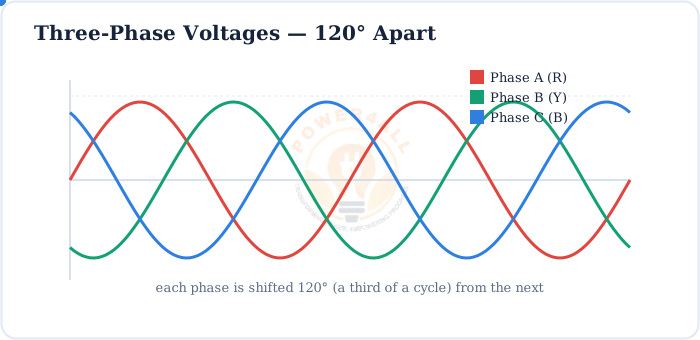
A three-phase system is an AC power system that uses three sinusoidal voltages of equal magnitude and frequency, each shifted 120° from the next. The three phases are labelled R, Y, B (red, yellow, blue) or A, B, C.
It is simply three single-phase supplies produced together by one generator, staggered by a third of a cycle. This clever arrangement delivers constant total power, uses less copper, and runs the world’s generation, transmission and heavy industry.
Single-phase vs three-phase
A single-phase supply has one live and one neutral. A three-phase supply has three live conductors (and often a neutral), carrying three voltages 120° apart — three times the power-carrying capability from a smart, compact system.
The Three-Phase Waveforms (120°)
Mathematically, the three instantaneous voltages are just one sine wave written three times, each pushed back by 120°.
vA = Vm sin(ωt)
Reference phase A
vB = Vm sin(ωt − 120°) · vC = Vm sin(ωt − 240°)
Phases B and C lag A by 120° and 240° respectively
They always add to zero
At every instant, vA + vB + vC = 0. This is why a balanced star system needs no current in the neutral — the three phases perfectly cancel.
Phase sequence
The order the phases reach their peaks — R → Y → B (positive sequence) — sets the direction a three-phase motor turns. Swap any two lines and the motor reverses.
Phasor Representation
The neatest way to picture a three-phase set is as three phasors of equal length, 120° apart, rotating together.
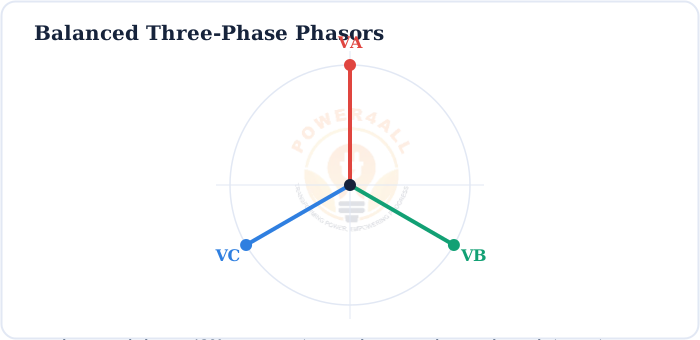
VA ∠ 0° · VB ∠ −120° · VC ∠ −240°
A balanced set in phasor (polar) form — equal magnitudes, 120° apart
New to phasors? Start with Phasors & Complex Numbers and Phase & Phase Difference.
Star (Wye) & Delta Connections
The three windings can be joined in two ways — star (Y / wye) or delta (Δ) — and the choice sets the relationship between line and phase quantities.
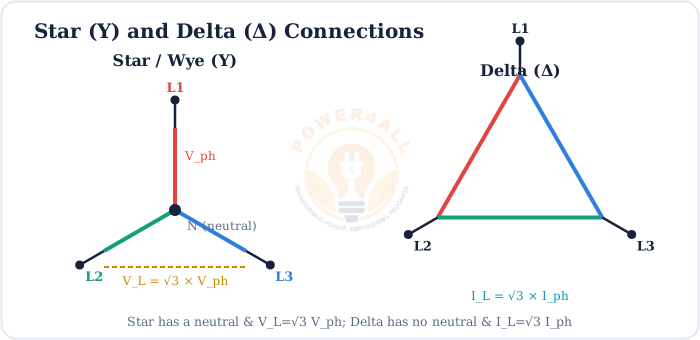
| Feature | Star (Y / Wye) | Delta (Δ) |
|---|---|---|
| Neutral wire | Yes (4-wire possible) | No (3-wire) |
| Line voltage | VL = √3 × Vph | VL = Vph |
| Line current | IL = Iph | IL = √3 × Iph |
| Two voltages? | Yes (400 V & 230 V) | One voltage |
| Typical use | Distribution, mixed loads | Motors, transformers |
Star–delta starters
Big induction motors often start in star (lower voltage per winding, less inrush) then switch to delta for full running power — the classic star–delta starter.
Line vs Phase Values — the √3 Factor
“Phase” values are measured across one winding; “line” values are measured between the supply conductors. They differ by the famous factor √3 ≈ 1.732.
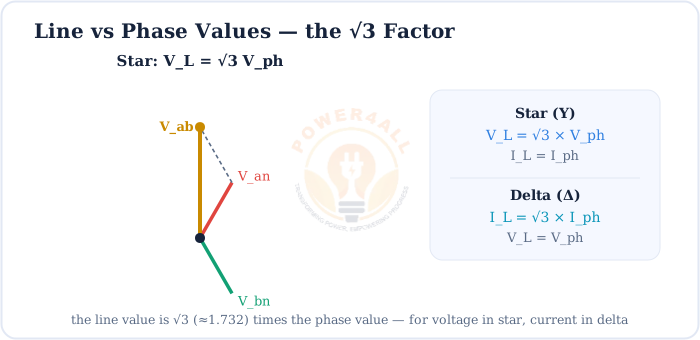
Star: VL = √3 Vph, IL = Iph
Line voltage is √3 × phase voltage; line current equals phase current
Delta: IL = √3 Iph, VL = Vph
Line current is √3 × phase current; line voltage equals phase voltage
Worked example — 400/230 V
A star supply has a phase voltage of 230 V. The line voltage is:
VL = √3 × 230 = 1.732 × 230 ≈ 400 V — exactly the standard 400/230 V system.
Three-Phase Power
One of the great advantages of three-phase is that the total instantaneous power is constant — unlike single-phase, which pulses at twice the frequency.
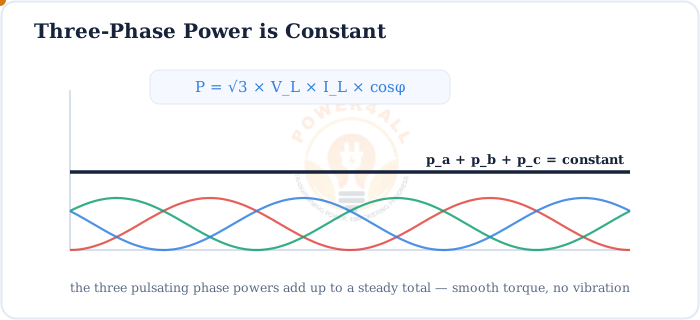
P = √3 × VL × IL × cosφ
Real (active) power in watts, using line voltage and line current — same for star and delta
Real Power
P = √3 VLILcosφ
Watts (W / kW)
Reactive Power
Q = √3 VLILsinφ
VAR (var / kVAR)
Apparent Power
S = √3 VLIL
VA (VA / kVA)
Worked example
A balanced load on a 400 V line draws IL = 20 A at PF = 0.85:
P = √3 × 400 × 20 × 0.85 ≈ 11 780 W ≈ 11.8 kW
Try the Three-Phase Power Calculator and see how it links to power factor.
Three-Wire & Four-Wire Systems
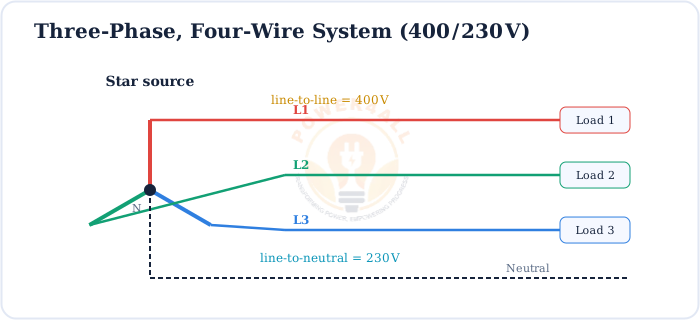
Delta and unearthed-star systems use three wires; the common distribution system uses four wires — three phases plus a neutral — to serve both three-phase and single-phase loads.
Balanced vs unbalanced
If the three loads are equal (balanced), the neutral carries no current. If they differ (unbalanced), the neutral carries the difference — which is exactly why the neutral is there.
Why Three-Phase? (Advantages)
Three-phase isn’t just “more power” — it is fundamentally more efficient and practical than single-phase.
Constant power
Steady total power → smooth torque, no vibration.
Less copper
Carries more power per kg of conductor than single-phase.
Self-starting motors
Creates a rotating field — no starting winding needed.
Two voltages
400 V for machines, 230 V for lighting & sockets.
Where Three-Phase is Used
Three-phase is the backbone of every modern power system, from the generator to the factory floor.
Generation & grid
All large alternators and the entire transmission network are three-phase.
Motors & drives
Three-phase induction motors run pumps, fans, compressors and machine tools.
Transformers
Three-phase transformers step voltage up and down efficiently across the grid.
Power electronics
Three-phase rectifiers & inverters give smoother DC and drive AC motors.
Key Terms at a Glance
The essential three-phase vocabulary students and engineers search for.
Phase (R, Y, B)
One of the three 120°-shifted voltages.
Star / Wye (Y)
Windings share a neutral; VL=√3Vph.
Delta (Δ)
Windings in a triangle; IL=√3Iph.
Line value
Between two supply conductors.
Phase value
Across one winding / phase.
Balanced load
Equal on all three phases; neutral current = 0.
Frequently Asked Questions
Quick, expert answers to the questions people ask most about three-phase systems.
What is a three-phase system in simple words?
It is a power system with three AC voltages of the same size and frequency, each shifted 120° from the next. Think of it as three single-phase supplies working together, produced by one generator, which gives smooth, efficient power.
Why are the three phases 120° apart?
The generator’s three windings are spaced 120° apart, so the voltages they produce are shifted by 120° (a third of a cycle). This even spacing makes the phases sum to zero and gives constant total power.
What is the difference between star and delta?
Star (wye) joins the windings at a common neutral, giving a neutral wire and VL=√3Vph. Delta joins them in a triangle with no neutral, giving VL=Vph but IL=√3Iph.
What is the relationship between line and phase voltage?
In star, line voltage = √3 × phase voltage (about 1.732×), while line current = phase current. In delta it is reversed: line current = √3 × phase current, and line voltage = phase voltage.
What is the three-phase power formula?
P = √3 × VL × IL × cosφ for real power. Reactive power is Q = √3 VLILsinφ and apparent power is S = √3 VLIL.
Why is the supply 400 V and 230 V?
In a 400/230 V four-wire system, 400 V is the line-to-line voltage between two phases and 230 V is the line-to-neutral voltage of one phase. They are related by √3, since 400 ≈ 1.732 × 230.
What is a balanced three-phase load?
A load that draws equal current at the same power factor on all three phases. The three currents are then equal and 120° apart, and in a star system the neutral current is zero.
Why is three-phase better than single-phase?
Three-phase delivers constant power (smooth torque), transmits more power with less conductor, lets induction motors self-start, and provides two useful voltages. That is why grids, industry and large motors all run on three-phase.
Conclusion & Key Takeaways
Three-phase power — three voltages 120° apart — is the elegant, efficient foundation of the entire electrical grid and every industrial motor.
Three voltages, 120° apart
Equal magnitude & frequency.
Star or delta
Neutral vs no neutral.
√3 factor
Links line & phase values.
P = √3 VLILcosφ
Constant total power.
400 / 230 V
Two voltages from one supply.
More efficient
Less copper, self-starting motors.