What is the Current Divider Rule?
The complete guide to how current splits between parallel branches — the current divider rule I1 = IT × R2/(R1+R2) with the opposite resistor on top, the conductance form for many branches, worked examples, and how it mirrors the voltage divider.
Complete Learning Path — Current Divider Rule
From how current splits in parallel branches and the two-resistor formula, to the conductance form, a worked example, current vs voltage divider and where it is used
What is the Current Divider Rule?
The current divider rule (CDR) tells you how the total current entering a set of parallel branches splits between them. Because every parallel branch shares the same voltage, the current divides in inverse proportion to resistance.
In plain terms: the branch with the smaller resistance carries the larger current. It is the parallel-circuit partner of the Ohm's Law family and follows directly from Kirchhoff's Current Law.
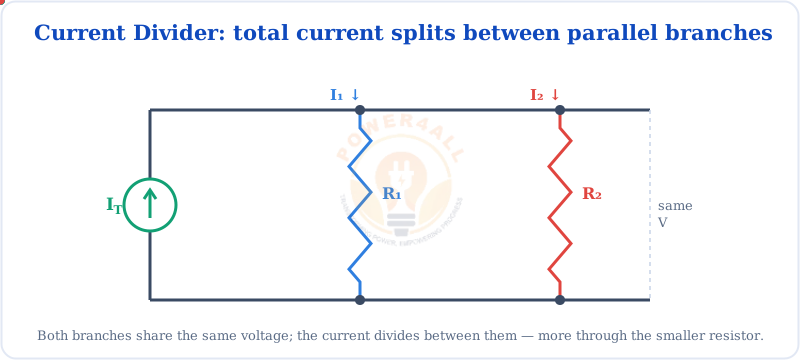
Parallel = same voltage, shared current
The current divider is used whenever current reaches parallel paths. It is the mirror image of the voltage divider, which handles series resistors sharing the same current.
The Two-Resistor Formula
For the common case of two parallel resistors, the current divider rule has a neat form — and one trick to remember: the opposite resistor goes on top.
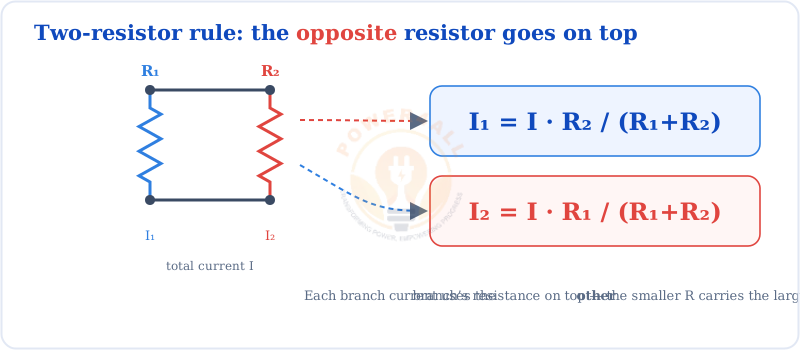
I1 = IT × R2 / (R1 + R2)
Current in branch 1 — the other resistor R2 sits on top
I2 = IT × R1 / (R1 + R2)
Current in branch 2 — now R1 is on top
Don't put your own resistor on top
A common mistake is writing I1 = IT R1/(R1+R2). That would give the bigger resistor more current — the opposite of reality. Always use the other branch's resistance on top.
Worked Example
Put numbers on it. A total current of 12 A enters two parallel resistors of 2 Ω and 4 Ω. Where does the current go?
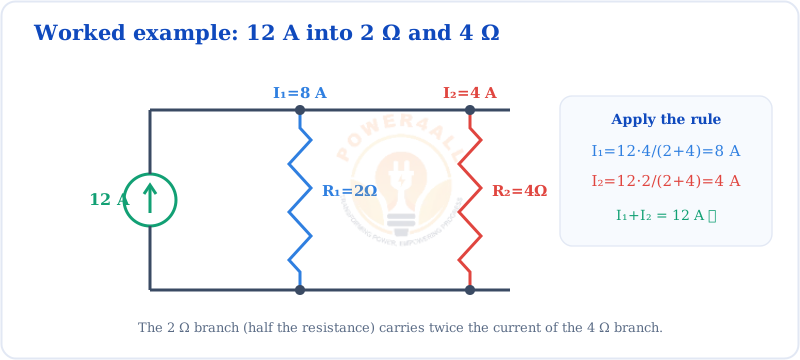
Step by step
1. Sum the resistors: R1 + R2 = 2 + 4 = 6 Ω
2. Branch 1 (2 Ω): I1 = 12 × 4/6 = 8 A (opposite R2 on top)
3. Branch 2 (4 Ω): I2 = 12 × 2/6 = 4 A (opposite R1 on top)
Check: I1 + I2 = 8 + 4 = 12 A — equals the total current. The 2 Ω branch, with half the resistance, carries twice the current.
Sanity check with a calculator
Try your own values in the Current Divider Calculator and cross-check with the Series-Parallel Resistor Calculator.
More Than Two Branches: The Conductance Form
With three or more parallel branches, the “opposite resistor” trick gets messy. The clean, general form uses conductance G = 1/R — current divides in direct proportion to conductance.
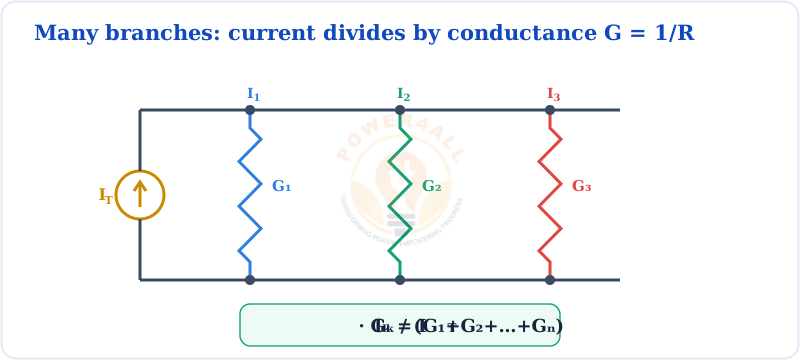
Ik = IT × Gk / (G1 + G2 + … + Gn)
General current divider rule — G = 1/R, works for any number of parallel branches
Two-resistor form is a special case
Put n = 2 into the conductance form and simplify, and you get straight back to I1 = IT R2/(R1+R2). The opposite-resistor rule is just the two-branch shortcut.
Where the Formula Comes From
The current divider rule is not a new law — it drops straight out of Ohm's Law and KCL. Here is the two-resistor derivation.
Derivation for two parallel resistors
1. Parallel branches share one voltage V. The parallel resistance is RP = R1R2/(R1+R2), so V = IT × RP.
2. By Ohm's law, the branch current is I1 = V / R1.
3. Substitute V: I1 = IT × RP / R1 = IT × [R1R2/(R1+R2)] / R1.
4. The R1 cancels, leaving I1 = IT × R2/(R1+R2) — the opposite resistor on top.
V = ITRP → I1 = V/R1 → I1 = ITR2/(R1+R2)
Ohm's law on the shared branch voltage gives the divider directly
Current Divider vs Voltage Divider
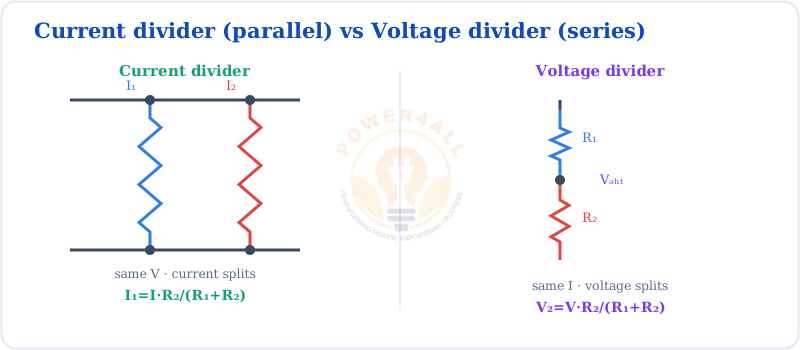
The two dividers are perfect mirror images. Get them straight and half of basic circuit analysis falls into place.
| Current Divider | Voltage Divider | |
|---|---|---|
| Circuit | Parallel branches | Series resistors |
| Shared quantity | Voltage (same across all) | Current (same through all) |
| What splits | Current | Voltage |
| Formula | I1 = IT·R2/(R1+R2) | V1 = V·R1/(R1+R2) |
| On top | Opposite resistor | Own resistor |
Where the Current Divider is Used
The current divider rule is a daily tool in analysis and design — anywhere current takes more than one path.
Ammeter shunts
A shunt resistor diverts most of the current around a meter movement; the divider sets exactly how much each path takes.
Parallel loads
Work out how supply current shares between parallel devices, LEDs or motor windings.
Current sensing & sharing
Balancing current between paralleled transistors or sense resistors relies on the same rule.
Works for AC too
For AC, swap resistance R for impedance Z: I1 = IT Z2/(Z1+Z2), using complex impedances and phasor currents — the opposite-element-on-top pattern is unchanged.
Key Terms at a Glance
The essential current-divider vocabulary students and engineers search for.
Current divider rule
How current splits in parallel branches.
Two-resistor form
I1 = ITR2/(R1+R2).
Opposite resistor
The other branch's R goes on top.
Conductance form
Ik = ITGk/ΣG.
KCL
Branch currents add up to the total.
Shunt
A parallel path that diverts current.
Frequently Asked Questions
Quick, expert answers to the questions people ask most about the current divider rule.
What is the current divider rule?
It states that the current entering parallel branches splits between them in inverse proportion to their resistances. The smaller resistance carries the larger share, because all parallel branches have the same voltage across them.
What is the current divider formula for two resistors?
I1 = IT × R2/(R1+R2) and I2 = IT × R1/(R1+R2). The opposite resistor appears on top: the R1 branch uses R2, and the R2 branch uses R1.
Why is the opposite resistor on top?
Because a smaller resistor should carry more current. Putting the other branch's resistance on top makes the fraction larger when your own resistance is smaller, so the low-resistance branch gets the bigger share. It comes straight from Ohm's law on the shared branch voltage.
What is the current divider rule using conductance?
Using conductance G = 1/R, each branch current is Ik = IT × Gk/(G1+G2+…+Gn). This works for any number of parallel branches, since current divides in direct proportion to conductance.
How do you calculate current in parallel resistors?
Find the total current, then apply the rule. For 12 A into 2 Ω and 4 Ω: I1 = 12 × 4/(2+4) = 8 A and I2 = 12 × 2/(2+4) = 4 A, which add back to 12 A.
What is the difference between the current and voltage divider?
The current divider is for parallel branches where the voltage is shared and the current splits, using the opposite resistor on top. The voltage divider is for series resistors where the current is shared and the voltage splits, using the same resistor on top.
Does the current divider rule work for AC circuits?
Yes. For AC, replace resistance with impedance Z: I1 = IT × Z2/(Z1+Z2), using complex impedances and phasor currents. The same opposite-element-on-top pattern applies.
What law is the current divider rule based on?
It follows from Kirchhoff's current law and Ohm's law. KCL says the branch currents add up to the total, and Ohm's law with the shared branch voltage sets how that total splits between the parallel resistances.
Conclusion & Key Takeaways
The current divider rule shows how current shares between parallel branches: inversely with resistance, directly with conductance. For two resistors, remember the opposite resistor on top.
Parallel → current splits
Same voltage across branches.
Opposite R on top
I1 = ITR2/(R1+R2).
Smaller R, more I
Inverse to resistance.
Conductance form
Ik = ITGk/ΣG.
Mirror of VDR
Voltage divider is the series twin.
AC ready
Use impedance Z for AC.