What is Admittance (Y)?
The complete guide to admittance — how easily a circuit lets AC flow. The reciprocal of impedance: from Y = 1/Z and Y = G + jB to conductance, susceptance, the admittance triangle, and why admittances simply add in parallel circuits.
Complete Learning Path — Admittance
From what admittance is and Y = 1/Z, to the admittance triangle, Y = G + jB, conductance & susceptance, and parallel circuits
What is Admittance?
Admittance measures how easily a circuit lets alternating current flow — the exact opposite of impedance. It is the reciprocal of impedance, given the symbol Y and measured in siemens (S).
Where impedance asks “how much does the circuit oppose current?”, admittance asks “how much does it allow?” A high admittance means current flows freely; a low admittance means it is choked off.
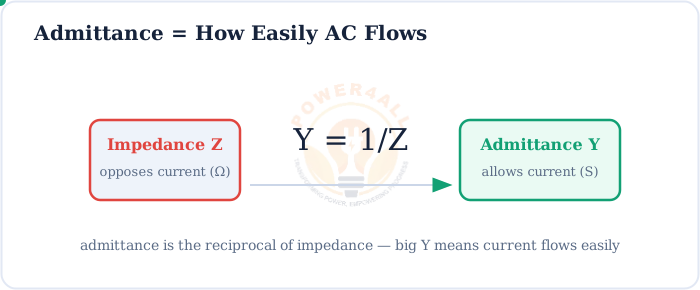
Y = 1 / Z
Admittance (siemens) = 1 ÷ impedance (ohms)
Siemens (S) = 1/ohm
The siemens (older name: mho, ℟, “ohm” backwards) is the unit for admittance and its parts. One siemens is one ampere per volt — the reciprocal of the ohm.
Admittance vs Impedance
Admittance and impedance describe the same circuit from opposite sides — opposition versus ease. They are exact reciprocals.
| Property | Impedance (Z) | Admittance (Y) |
|---|---|---|
| Describes | Opposition to AC | Ease of AC flow |
| Relationship | Z = 1/Y | Y = 1/Z |
| Complex form | R + jX | G + jB |
| Real part | Resistance R | Conductance G |
| Imaginary part | Reactance X | Susceptance B |
| Unit | ohm (Ω) | siemens (S) |
| Best for | Series circuits | Parallel circuits |
Don’t just flip the parts
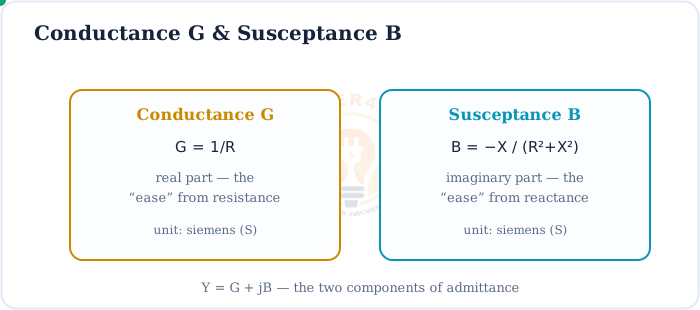
G is not simply 1/R when reactance is present. You invert the whole complex number: Y = 1/(R + jX), which gives G = R/(R²+X²) and B = −X/(R²+X²).
The Admittance Triangle
Just like impedance, admittance has a right-triangle form — but built from conductance and susceptance.
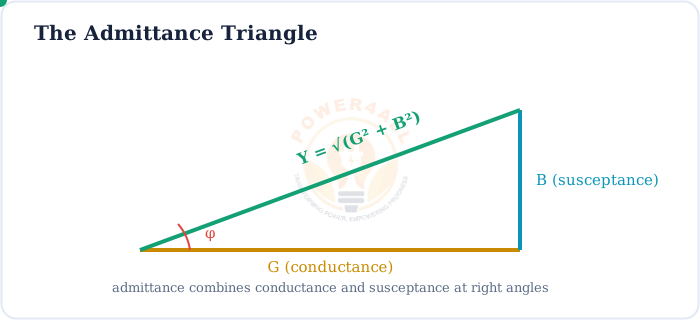
|Y| = √(G² + B²)
Magnitude of admittance from conductance and susceptance
Worked example
A load has impedance Z = 50 Ω at phase 53°. Its admittance magnitude is:
|Y| = 1/|Z| = 1/50 = 0.02 S = 20 mS, at phase −53°.
The Complex Form: Y = G + jB
Admittance is a complex number, Y = G + jB. The real part is conductance; the imaginary part is susceptance. Positive B is capacitive, negative B is inductive — the opposite sign convention to reactance.
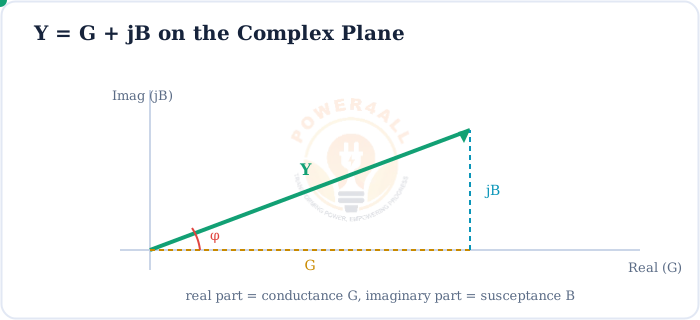
Y = G + jB
G = conductance (real), B = susceptance (imaginary), both in siemens
Conductance (G) & Susceptance (B)
The two building blocks of admittance. Conductance is the ease from the resistive part; susceptance is the ease from the reactive part.
Inductive susceptance
BL = −1/XL
Negative susceptance — an inductor lets low frequencies through more easily.
Capacitive susceptance
BC = ωC
Positive susceptance — a capacitor lets high frequencies through easily.
Why Admittance Shines in Parallel Circuits
This is the real reason admittance exists. In parallel, admittances simply add — no awkward reciprocal-of-reciprocals like impedance needs.
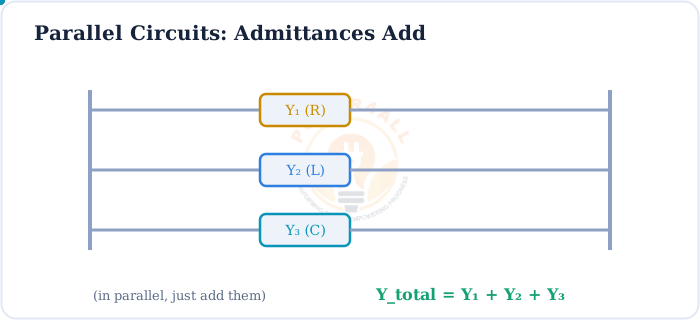
Ytotal = Y₁ + Y₂ + Y₃ + …
Admittances add in parallel (compare: impedances add in series)
Series ↔ Parallel
Series: add impedances (Ztotal = Z₁ + Z₂ + …). Parallel: add admittances (Ytotal = Y₁ + Y₂ + …). Convert with Y = 1/Z whenever it makes the maths easier.
Where Admittance is Used
Admittance is the engineer’s tool for parallel networks, filters and power systems.
Parallel circuit analysis
Adding admittances is far simpler than combining parallel impedances.
Power systems
Bus admittance matrices (Y-bus) are the backbone of power-flow analysis in grids.
Filters & networks
Susceptance makes it easy to design and tune parallel resonant and matching networks.
Power-factor correction
Adding capacitive susceptance cancels inductive susceptance to raise the power factor.
Key Terms at a Glance
The essential admittance vocabulary students and engineers search for.
Admittance (Y)
Ease of AC flow; Y = 1/Z, in siemens.
Conductance (G)
Real part of Y; from resistance.
Susceptance (B)
Imaginary part of Y; from reactance.
Siemens (S)
Unit of Y, G, B; 1 S = 1/Ω (old: mho).
Magnitude |Y|
√(G²+B²).
Impedance (Z)
Reciprocal of admittance, Z = 1/Y.
Frequently Asked Questions
Quick, expert answers to the questions people ask most about admittance.
What is admittance in simple words?
Admittance tells you how easily an AC circuit lets current through. It is the opposite of impedance — its reciprocal, Y = 1/Z — with the symbol Y and unit siemens. High admittance = current flows easily.
What is the formula for admittance?
Y = 1/Z, and in complex form Y = G + jB, where G is conductance and B is susceptance. Its magnitude is |Y| = √(G²+B²).
What is the unit of admittance?
The siemens (S), the reciprocal of the ohm. Its older name is the mho. Conductance and susceptance are also measured in siemens.
What is the difference between admittance and impedance?
Impedance is opposition to AC (ohms); admittance is ease of flow (siemens). They are reciprocals: Y = 1/Z. Impedance suits series circuits, admittance suits parallel circuits.
What are conductance and susceptance?
Conductance G is the real part of admittance (from resistance) and susceptance B is the imaginary part (from reactance). Together, Y = G + jB, both in siemens.
Why is admittance useful for parallel circuits?
Because admittances simply add in parallel: Ytotal = Y₁ + Y₂ + …. Combining parallel impedances is far messier, so engineers convert to admittance for parallel analysis.
Is conductance G always 1/R?
Only for a pure resistor. When reactance is present you invert the whole complex impedance: G = R/(R²+X²) and B = −X/(R²+X²).
What is the admittance of a capacitor?
A capacitor has purely capacitive susceptance BC = ωC, so its admittance rises with frequency — it lets high frequencies through easily and blocks DC.
Conclusion & Key Takeaways
Admittance is impedance turned inside-out — the ease of AC flow, Y = G + jB, and the natural tool for parallel circuits.
Ease of AC flow
Symbol Y, unit siemens.
Y = 1/Z
Reciprocal of impedance.
Y = G + jB
Conductance + susceptance.
|Y| = √(G²+B²)
The admittance triangle.
Adds in parallel
Ytotal = Y₁ + Y₂ + …
Siemens = 1/ohm
The reciprocal unit.