Ampère’s Law
The complete guide to the magnetic effect of electric current — how a current wraps a magnetic field around itself. From the circuital law ∮B·dl = μ₀Ienc and the right-hand rule, to the fields of a wire, solenoid and toroid, the Ampère–Maxwell displacement current, worked examples and real-world uses.
Complete Learning Path — Ampère’s Law
From the statement and right-hand rule, to fields of wires, solenoids and toroids, the Ampère–Maxwell law and applications
What is Ampère’s Law?
Ampère’s law connects a magnetic field to the electric current that produces it. It says that if you add up the magnetic field all the way around any closed loop, the total equals μ₀ times the current passing through that loop. In short: moving charge makes a magnetic field, and Ampère’s law tells you exactly how much.
Named after the French physicist André-Marie Ampère, it is one of the four Maxwell’s equations. Just as Gauss’s law lets us find electric fields from symmetry, Ampère’s law is the fast way to find the magnetic field of highly symmetric arrangements — a straight wire, a solenoid or a toroid.
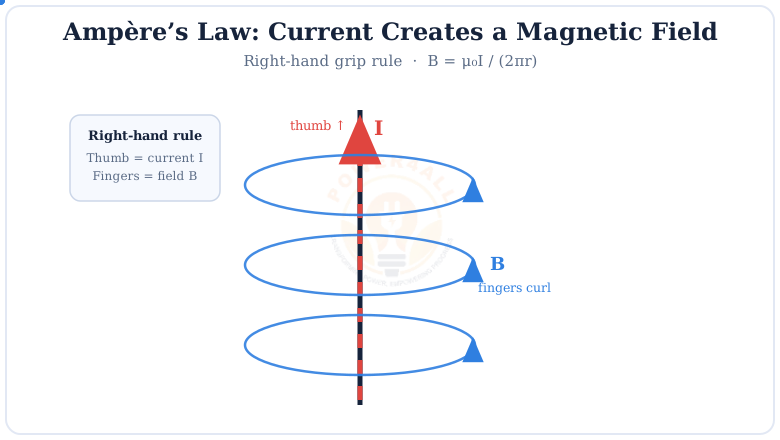
Magnetic effect of current
In 1820 Oersted noticed a compass needle deflect near a current-carrying wire — proof that electricity and magnetism are linked. Ampère’s law is the mathematical form of that discovery, and the partner of Faraday’s law (which does the reverse: magnetism making current).
Statement & the Right-Hand Rule
In words: “the line integral of the magnetic field B around any closed loop equals μ₀ times the net current enclosed by the loop.” The right-hand rule then fixes the direction.
Straight wire
Thumb points along the current; curled fingers show the circular field direction around the wire.
Coil / solenoid
Fingers curl the way the current flows; the thumb points along the field inside the coil (its N pole).
Enclosed current
Only current passing through the loop counts. Current outside the loop contributes nothing to the total.
Why "enclosed" matters
Two wires carrying equal and opposite currents through the same loop cancel: Ienc = 0, so the field integrates to zero around that loop. This is exactly why a coaxial cable traps its field inside.
Ampère’s Circuital Law: the Formula
The law in symbols is compact and powerful. You choose a convenient closed path — the Amperian loop — and add up B·dl all the way around it.
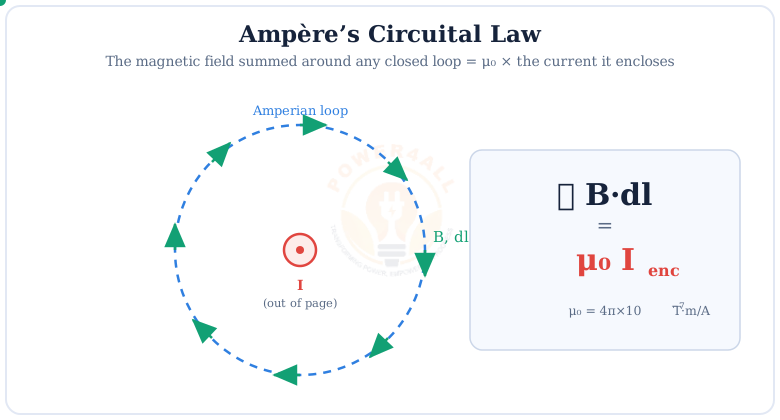
∮ B·dl = μ₀ Ienc
B = magnetic field (T) · dl = loop element (m) · μ₀ = 4π×10−7 T·m/A · Ienc = enclosed current (A)
The trick to using it
Choose a loop where B is either constant and parallel to dl, or perpendicular (contributing nothing). Then ∮B·dl becomes simply B × (length), and you can solve for B in one line.
Field Around a Long Straight Wire
The classic result: a long straight wire is wrapped in concentric circular field lines whose strength falls off with distance.
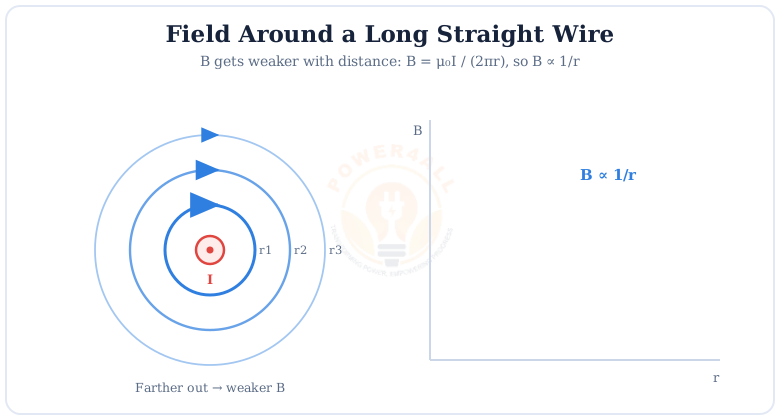
B = μ₀ I / (2πr)
Field at distance r from a long straight wire carrying current I (B ∝ 1/r)
Worked example 1 — wire
Find the field 5 cm from a wire carrying 10 A.
B = μ₀I/(2πr) = (4π×10−7 × 10)/(2π × 0.05) = (2×10−7 × 10)/0.05 = 4×10⁻⁵ T = 40 μT — roughly the Earth’s field.
The Solenoid: a Uniform Field
Wind a wire into a long tight coil and the interior field becomes straight, strong and uniform — the basis of every inductor and electromagnet.
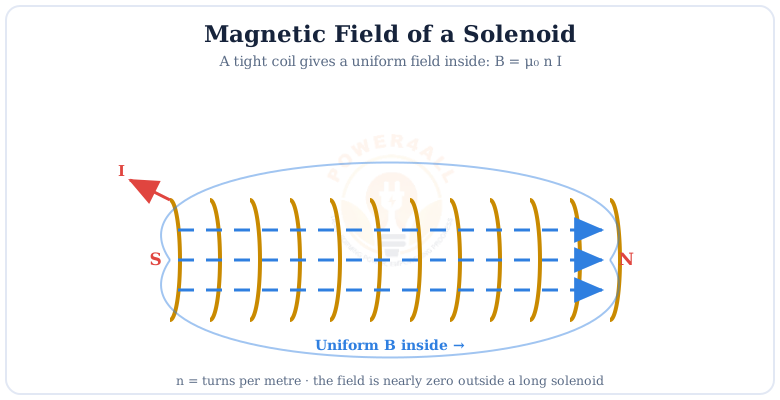
B = μ₀ n I
n = turns per metre (N/L) · I = current · field is uniform inside a long solenoid
Worked example 2 — solenoid
A solenoid has 500 turns over 0.25 m and carries 3 A. So n = 500/0.25 = 2000 turns/m.
B = μ₀nI = 4π×10−7 × 2000 × 3 ≈ 7.5×10⁻³ T = 7.5 mT. Size a real coil with the Coil Inductance Calculator.
The Toroid: a Field in a Ring
Bend a solenoid into a doughnut and the field becomes completely trapped inside the ring — ideal for low-leakage transformers and inductors.
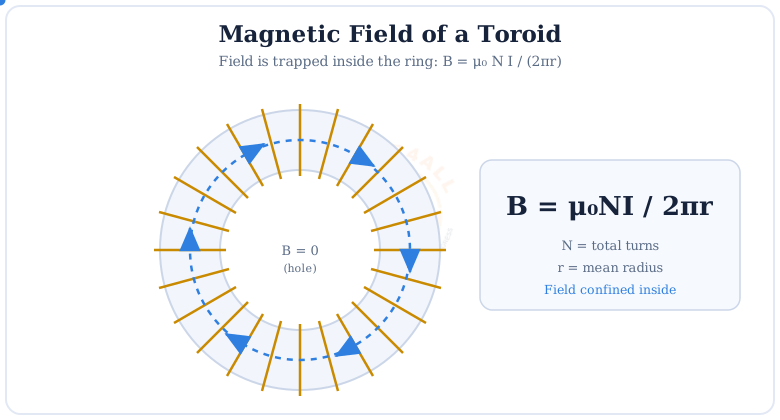
B = μ₀ N I / (2πr)
N = total turns · r = mean radius of the ring · field confined inside the core
Worked example 3 — toroid
A toroid of mean radius 0.10 m has 1000 turns and carries 2 A.
B = μ₀NI/(2πr) = (2×10−7 × 1000 × 2)/0.10 = 4×10⁻³ T = 4 mT.
The Ampère–Maxwell Law & Displacement Current
The original law has one gap: it fails for a charging capacitor, where no current crosses the gap yet a magnetic field is still there. Maxwell fixed it by adding a displacement current.
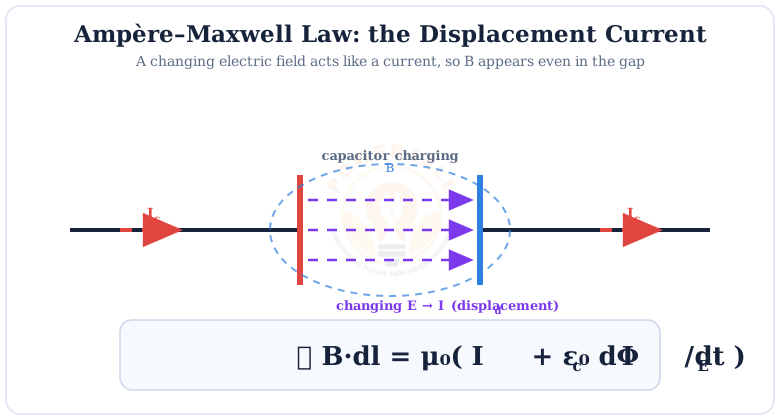
∮ B·dl = μ₀( Ic + ε₀ dΦE/dt )
Ic = conduction current · ε₀ dΦE/dt = displacement current (changing electric flux)
Why it matters
This extra term means a changing electric field creates a magnetic field — and with Faraday’s law (the reverse), the two feed each other and travel as electromagnetic waves: light, radio and Wi-Fi all exist because of this term.
Applications of Ampère’s Law
Anywhere a current makes a magnetic field, Ampère’s law is the tool engineers reach for.
Electromagnets
Solenoid and toroid fields (B = μ₀nI) power relays, lifting magnets, motors and speakers.
Transformers & inductors
Toroidal cores confine the field, cutting leakage in transformers and inductors.
MRI & research magnets
Large superconducting solenoids create the strong uniform fields inside MRI scanners.
Clamp meters
A clamp senses the field around a wire (B ∝ I) to measure current without breaking the circuit.
Key Terms at a Glance
The essential Ampère’s-law vocabulary students and engineers search for.
Amperian loop
Imaginary closed path for the integral.
Ienc
Net current threading the loop.
μ₀
Permeability of free space, 4π×10−7.
Right-hand rule
Thumb = current, fingers = field.
Solenoid
Coil with uniform inner field μ₀nI.
Displacement current
ε₀ dΦE/dt from a changing E field.
Frequently Asked Questions
Quick, exam-ready answers to the questions people ask most about Ampère’s law.
What is Ampère’s law?
Ampère’s law relates a magnetic field to the current that creates it. It states that the line integral of the magnetic field B around any closed loop equals μ₀ times the total current enclosed by that loop: ∮B·dl = μ₀Ienc. It is one of the four Maxwell equations.
What is the formula for Ampère’s law?
The formula is ∮B·dl = μ₀Ienc. Here B is the magnetic field, dl a small element along the closed Amperian loop, μ₀ the permeability of free space (4π×10−7 T·m/A) and Ienc the net current through the loop.
State Ampère’s circuital law.
The line integral of the magnetic field around any closed path equals μ₀ times the net current enclosed by that path. The direction of the field relative to the current is given by the right-hand rule.
What is the magnetic field around a straight wire?
Applying Ampère’s law to a circular loop of radius r around a long straight wire gives B = μ₀I/(2πr). The field forms concentric circles, is strongest near the wire and falls off as 1/r.
What is the right-hand rule?
Point your right thumb along the current in a straight wire; your curled fingers show the direction of the circular field. For a coil or solenoid, curl your fingers along the current and the thumb points along the field inside (the N pole).
What is μ₀, the permeability of free space?
μ₀ links magnetic field to current in a vacuum. Its value is 4π×10−7 ≈ 1.257×10⁻⁶ T·m/A. It appears in Ampère’s law and in the field formulas for wires, solenoids and toroids.
What is the field inside a solenoid?
Inside a long solenoid the field is uniform and equals B = μ₀nI, where n is turns per metre and I the current. It points along the axis and is almost zero outside.
What is the Ampère–Maxwell law and displacement current?
Maxwell added a displacement current, ε₀ dΦE/dt, so that a changing electric field (as between charging capacitor plates) also makes a magnetic field. The full law is ∮B·dl = μ₀(Ic + ε₀ dΦE/dt), and it makes electromagnetic waves possible.
What are the applications of Ampère’s law?
Finding the field of wires, solenoids, toroids and coaxial cables, and designing electromagnets, relays, motors, transformers, inductors, MRI magnets and clamp meters. It is one of the Maxwell equations describing all electromagnetism.
Ampère’s law vs the Biot–Savart law — what’s the difference?
Both give the field from currents. Biot–Savart integrates over each current element and works for any shape but can be hard. Ampère’s law is far quicker but only for symmetric cases (straight wire, solenoid, toroid). For symmetric problems the two agree.
Conclusion & Key Takeaways
Ampère’s law is the shortcut from current to magnetic field: ∮B·dl = μ₀Ienc, made even more powerful by Maxwell’s displacement current.
∮B·dl = μ₀Ienc
Field around a loop = μ₀ × enclosed I.
Right-hand rule
Thumb = current, fingers = field.
Wire
B = μ₀I/2πr (∝ 1/r).
Solenoid
B = μ₀nI, uniform inside.
Toroid
B = μ₀NI/2πr, trapped inside.
Ampère–Maxwell
Adds displacement current.