Faraday's Law of Induction
The complete guide to Faraday's law of electromagnetic induction — how a changing magnetic flux induces a voltage. From the formula EMF = −N dΦ/dt and magnetic flux, to Lenz's law, the three ways to induce an EMF, and the generators and transformers it powers.
Complete Learning Path — Faraday's Law
From the induction experiment and magnetic flux, to the formula, Lenz's law, ways to induce EMF and real machines
What is Faraday's Law?
Faraday's law of electromagnetic induction says that a changing magnetic flux through a coil induces a voltage — an electromotive force (EMF) — in that coil. No changing field, no induced EMF. It is one of the great unifying discoveries of physics.
Michael Faraday showed this in 1831 with a magnet and a coil: push the magnet in and a current flows one way; pull it out and it flows the other; hold it still and nothing happens. The magnetic field must be changing to induce anything.
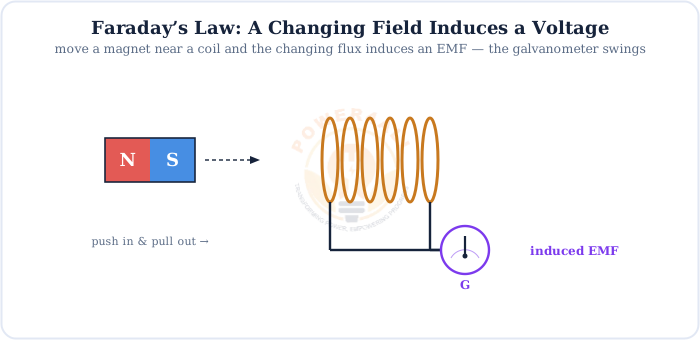
The core idea
It is the rate of change of magnetic flux that matters — not the flux itself. A strong but steady field induces nothing; a weak but rapidly changing one can induce a large EMF.
First, Magnetic Flux (Φ)
To use Faraday's law you first need magnetic flux — a measure of how much magnetic field passes through the loop's area. It depends on the field, the area, and their relative angle.
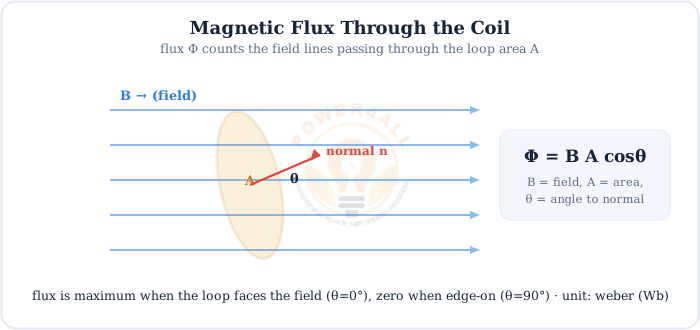
Φ = B × A × cosθ
Magnetic flux = field strength B × area A × cosine of the angle θ to the normal — unit: weber (Wb)
Three knobs, one flux
Because Φ = BA cosθ, you can change the flux by changing B, A, or θ. Change any of them over time and Faraday's law gives you an EMF.
Faraday's Law: EMF = −N dΦ/dt
The induced EMF equals the number of turns times the rate of change of flux. More turns or a faster change means a bigger voltage.
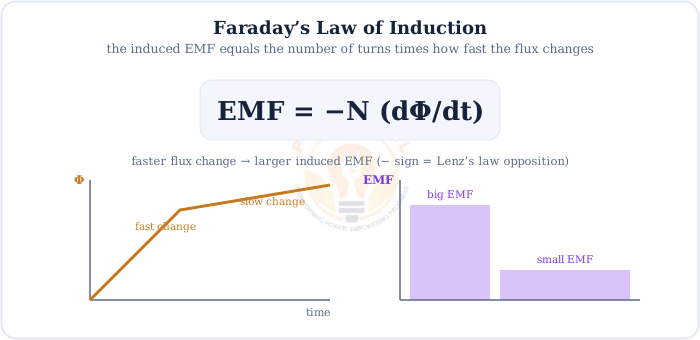
EMF = −N (dΦ/dt)
N = turns · dΦ/dt = rate of change of flux · the minus sign is Lenz's law
Worked example
A coil of N = 200 turns has its flux change from 0.01 Wb to 0.05 Wb in 0.1 s.
dΦ/dt = (0.05 − 0.01)/0.1 = 0.4 Wb/s
|EMF| = N × dΦ/dt = 200 × 0.4 = 80 V
Lenz's Law & the Minus Sign
The minus sign in Faraday's law is Lenz's law: the induced current always flows in the direction that opposes the change that created it. Nature pushes back.
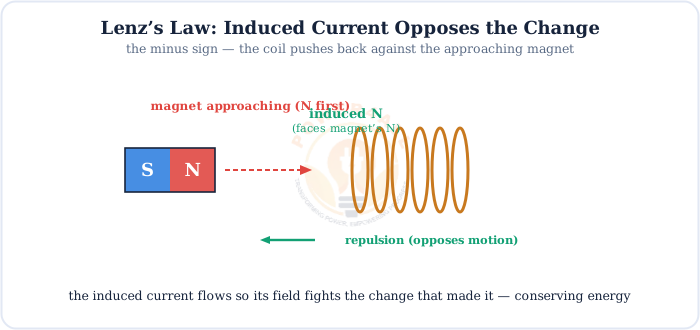
Why it must oppose — energy conservation
If the induced current helped the change instead of opposing it, you would get free, ever-growing energy. Lenz's law is simply energy conservation: you must do work to push the magnet against the opposition, and that work becomes the electrical energy.
Faraday's law gives the size; Lenz's law gives the direction. Together they fully describe the induced EMF.
Three Ways to Induce an EMF
Since flux is Φ = BA cosθ, there are exactly three levers to change it — and every induction device uses one or more of them.
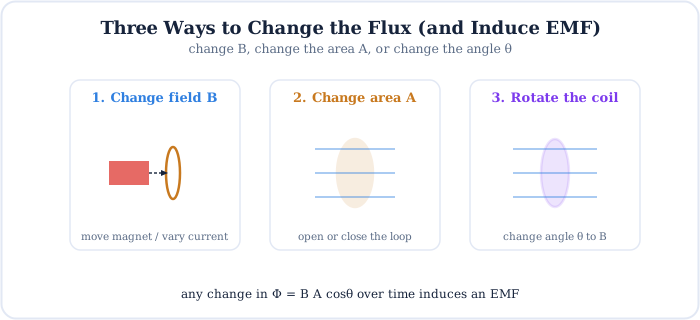
Change B
Move a magnet, or vary the current in a nearby coil (as a transformer does).
Change A
Expand, shrink or slide the loop so its area in the field changes (motional EMF).
Change θ
Rotate the coil in the field — the principle of every generator.
Faraday's Law at Work: The AC Generator
Spin a coil in a magnetic field and the angle θ changes continuously, so the flux — and the induced EMF — vary as a sine wave. That is an AC generator.
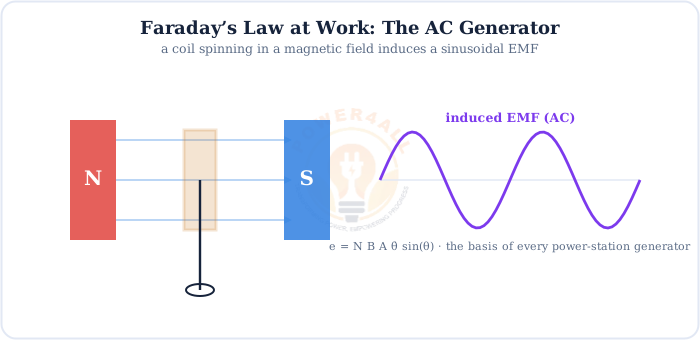
Nearly all of the world's electricity is made this way: a turbine (driven by steam, water or wind) spins coils in a magnetic field, and Faraday's law turns that mechanical motion into an alternating EMF at the grid frequency.
Where Faraday's Law Is Used
Electromagnetic induction runs the modern electrical world — from power stations to the charger on your desk.
Generators & dynamos
Convert mechanical motion into electricity in every power plant.
Transformers
A changing current in one coil induces a voltage in another — stepping voltage up or down.
Induction motors
Induced currents in the rotor produce the torque that drives most industrial machines.
Induction heating
Induction cooktops and furnaces heat metal directly with induced eddy currents.
Microphones & pickups
Moving coils or strings change flux and induce the audio signal.
Wireless charging
A changing field in a base coil induces current in your device's coil.
Also: inductors resist current change
Faraday's law is why an inductor opposes changes in its own current — a changing current changes its own flux, inducing a back-EMF that fights the change (self-induction).
Key Terms at a Glance
The essential Faraday's-law vocabulary students and engineers search for.
Faraday's law
Changing flux induces an EMF.
Magnetic flux (Φ)
B A cosθ; unit weber.
EMF
Induced electromotive force (V).
Lenz's law
Induced current opposes the change.
Induction
Making voltage with a changing field.
Weber (Wb)
The SI unit of magnetic flux.
Frequently Asked Questions
Quick, expert answers to the questions people ask most about Faraday's law.
What is Faraday's law?
Faraday's law of electromagnetic induction states that a changing magnetic flux through a coil induces a voltage, called an electromotive force or EMF, in that coil. The faster the flux changes and the more turns the coil has, the larger the induced EMF.
What is the formula for Faraday's law?
The induced EMF equals minus the number of turns times the rate of change of magnetic flux: EMF = −N (dΦ/dt). N is the number of turns, dΦ/dt is how fast the flux changes, and the minus sign represents Lenz's law.
What is electromagnetic induction?
Electromagnetic induction is the production of a voltage or current in a conductor by a changing magnetic field. Michael Faraday discovered it in 1831. It is how generators create electricity and how transformers pass energy between coils.
What is magnetic flux?
Magnetic flux is a measure of how many magnetic field lines pass through an area. It is given by Φ = B × A × cosθ, where B is the field strength, A is the area, and θ is the angle between the field and the area's normal. Its unit is the weber (Wb).
What does the minus sign in Faraday's law mean?
The minus sign represents Lenz's law: the induced EMF drives a current whose magnetic field opposes the change in flux that produced it. It is a statement of energy conservation, not a real negative voltage.
What is Lenz's law?
Lenz's law states that the direction of an induced current is always such that it opposes the change causing it. If a magnet's north pole approaches a coil, the coil develops a north pole on the near side to push it back, which is why the minus sign appears in Faraday's law.
What are the ways to induce an EMF?
You can induce an EMF by changing the magnetic flux in any way: changing the field strength B (moving a magnet or varying a current), changing the area A of the loop, or changing the angle θ by rotating the coil. Any change in Φ = BA cosθ over time induces an EMF.
What are the applications of Faraday's law?
Faraday's law is behind AC and DC generators, transformers, induction motors, induction cooktops and heating, microphones and pickups, wireless and inductive charging, metal detectors, and the regenerative braking used in electric vehicles.
Who discovered electromagnetic induction?
Michael Faraday discovered electromagnetic induction in 1831, showing that moving a magnet through a coil produced a current. Joseph Henry made a similar discovery independently around the same time.
What is the difference between Faraday's law and Lenz's law?
Faraday's law tells you the size of the induced EMF — how big it is from the rate of change of flux. Lenz's law tells you the direction — that the induced current opposes the change. Together they give both the magnitude and the sign of the induced EMF.
Conclusion & Key Takeaways
Faraday's law is the bridge from magnetism to electricity — a changing field makes a voltage, and that single idea powers the world.
Changing flux
Only a change induces EMF.
Φ = BA cosθ
Field × area × angle.
EMF = −N dΦ/dt
Turns × rate of change.
Lenz's law
Induced current opposes.
Three levers
Change B, A or θ.
Powers the grid
Generators & transformers.