Source Transformation
The complete guide to swapping a voltage source for an equivalent current source and back — the quickest way to simplify a circuit before analysis. A voltage V in series with R equals a current I in parallel with R, using I = V/R and V = I×R. It is also the bridge between Thévenin and Norton equivalents.
Complete Learning Path — Source Transformation
From the two conversions and their rules, to a worked example, the Thévenin–Norton link and why it works
What is Source Transformation?
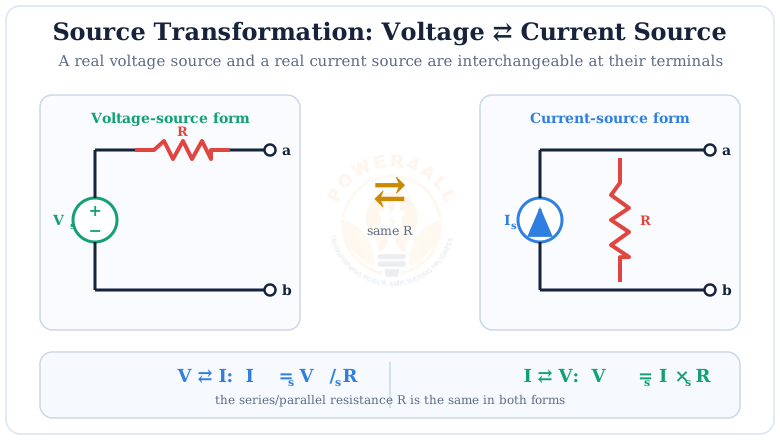
Source transformation replaces a real voltage source (a voltage in series with a resistor) by an equivalent real current source (a current in parallel with the same resistor) — or the reverse. To anything connected outside, the two forms are identical, so you can pick whichever one makes the circuit easier to solve.
It works because every practical source has an internal resistance. A battery is really an EMF in series with a small resistance; a solar cell behaves like a current source in parallel with a resistance. Source transformation just re-draws the same physics in the more convenient form.
The one-line idea
A voltage source in series with R and a current source in parallel with R deliver exactly the same voltage and current to any load. Swapping between them is free — and often turns a hard circuit into an easy one.
Voltage Source → Current Source
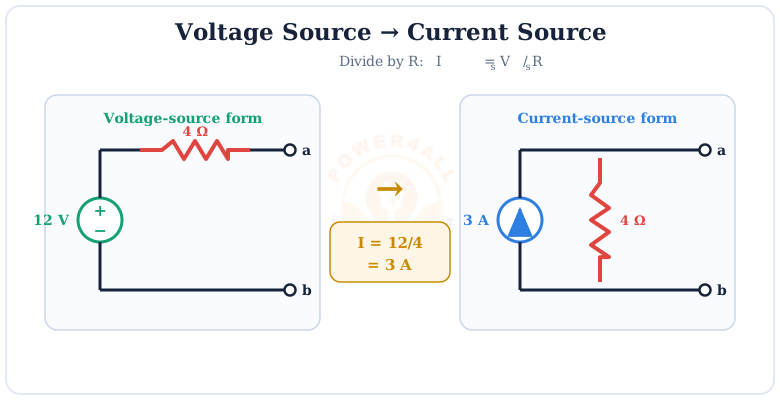
Given a voltage source Vs in series with R, the equivalent current source is Is = Vs/R, with R moved into parallel.
Is = Vs / R
The series resistor R becomes a parallel resistor of the same value
Quick example
A 24 V source with a 6 Ω series resistor → Is = 24/6 = 4 A in parallel with 6 Ω. Check it with the Source Transformation Calculator.
Current Source → Voltage Source
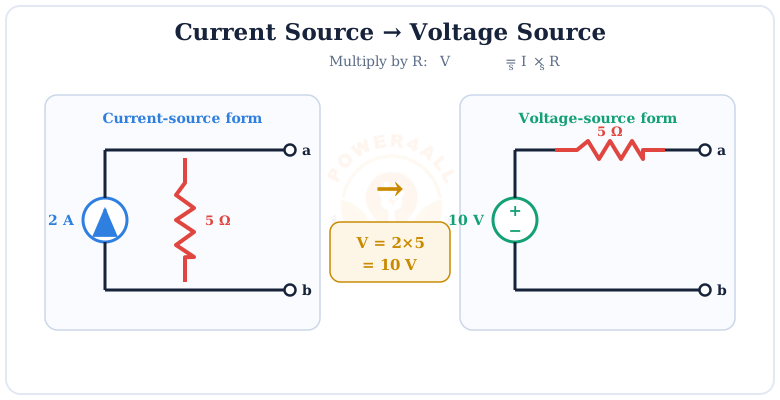
Given a current source Is in parallel with R, the equivalent voltage source is Vs = Is×R, with R moved into series.
Vs = Is × R
The parallel resistor R becomes a series resistor of the same value
Mind the polarity & direction
The voltage source’s + terminal points the way the current source’s arrow does. Keep the reference direction consistent, or your signs will flip.
The Rules & Conditions
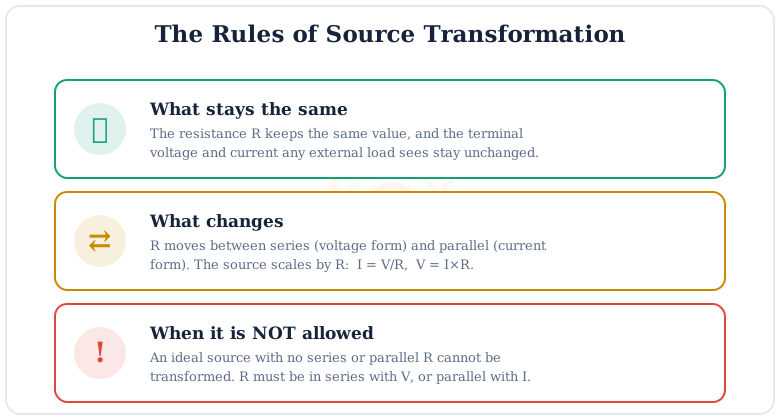
Source transformation is simple, but it only works when a resistor is in the right place. Keep these three rules in mind.
The key limitation
You cannot transform an ideal source. A voltage source needs a resistor in series; a current source needs one in parallel. No resistor, no transformation — there is nothing to divide by or move.
Why It Works: One Shared Load Line
Both forms are valid because they produce the identical terminal voltage–current relationship. Any load connected to a–b cannot tell them apart.
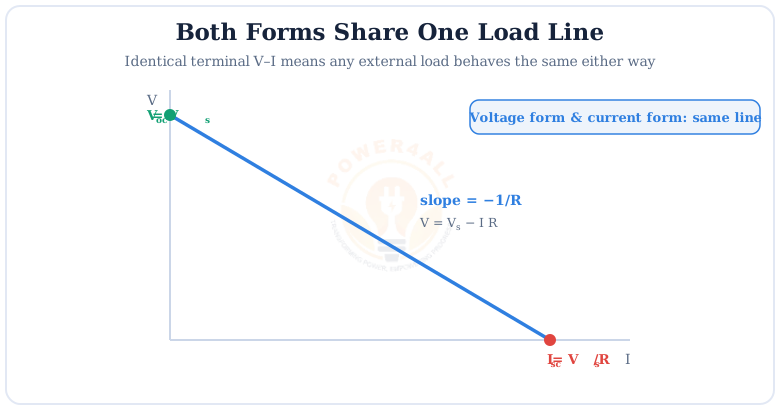
V = Vs − IR is the same straight line for both forms — from open-circuit Voc = Vs to short-circuit Isc = Vs/R.Open the terminals and both forms give the same open-circuit voltage Voc = Vs. Short the terminals and both give the same short-circuit current Isc = Vs/R. Two points fix the line — so the entire load line is identical, and that is exactly why the swap is allowed.
Worked Example: Simplify to Find a Load Current
Source transformation shines when it collapses a network. Here we find the current in a load resistor in three quick steps.
The circuit
A 12 V source with a 3 Ω series (internal) resistance feeds a node. From that node, a 6 Ω resistor and the load RL = 6 Ω both go to ground. Find the current through RL.
Step 1 — transform the source
Convert the 12 V / 3 Ω voltage source to a current source: Is = 12/3 = 4 A in parallel with 3 Ω. Now everything hangs across one node.
Step 2 — combine the parallel resistors
The 3 Ω (from the source), the 6 Ω and the 6 Ω load are all in parallel: 3∥6∥6. Since 1/3 + 1/6 + 1/6 = 4/6, the combined resistance is 6/4 = 1.5 Ω.
Step 3 — find the node voltage & load current
Node voltage V = Is × R = 4 × 1.5 = 6 V. So the load current is IL = V / RL = 6 / 6 = 1 A.
Result
The load carries 1 A — found without a single simultaneous equation, just by transforming one source and combining resistors.
The Thévenin ⇄ Norton Bridge
Source transformation is the exact step that turns a Thévenin equivalent into a Norton equivalent and back.
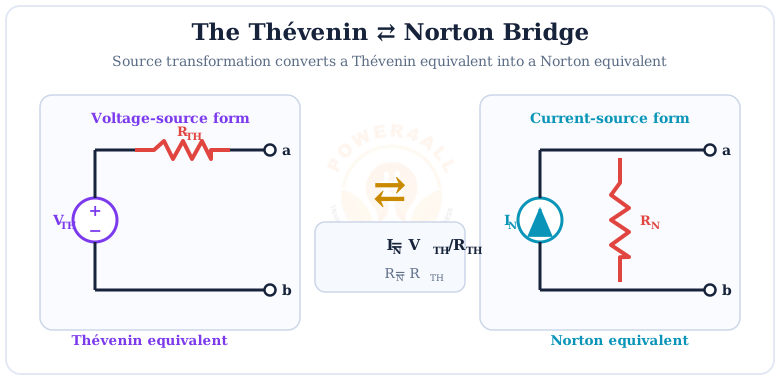
A Thévenin equivalent is a voltage source in series with a resistance; a Norton equivalent is a current source in parallel with a resistance. They describe the same black box, and source transformation converts one to the other: IN = VTH/RTH, with the resistance unchanged. Try the Norton Equivalent Calculator.
When to Use Source Transformation
Reach for it whenever converting a source lets you combine elements or shrink the circuit.
Simplify before nodal/mesh
Turn voltage sources into current sources to make nodal analysis tidy, or the reverse for mesh.
Combine sources
Convert to the same type so parallel current sources add, or series voltage sources add.
Find Thévenin / Norton
Move quickly between the two equivalents when reducing a network.
Ladder networks
Repeatedly transform and combine to collapse a ladder down to one source and one resistor.
Key Terms at a Glance
The essential source-transformation vocabulary students and engineers search for.
Real voltage source
EMF in series with R.
Real current source
Current in parallel with R.
I = V/R
Voltage → current form.
V = I×R
Current → voltage form.
Voc / Isc
Open-circuit V, short-circuit I.
Thévenin / Norton
The two equivalent forms.
Frequently Asked Questions
Quick, exam-ready answers to the questions people ask most about source transformation.
What is source transformation?
A circuit-analysis technique that swaps a real voltage source (a voltage V in series with a resistance R) for an equivalent real current source (a current I in parallel with the same R), or the reverse. The two forms are indistinguishable at their terminals, so you use whichever makes the circuit easier to solve.
What is the formula for source transformation?
Voltage to current: I = V/R. Current to voltage: V = I×R. In both directions the resistance R keeps the same value; only its position changes from series (voltage form) to parallel (current form).
How do you convert a voltage source to a current source?
Divide the source voltage by its series resistance to get the current, I = V/R, and place the same resistor in parallel with the new current source. Example: 12 V in series with 4 Ω becomes 3 A in parallel with 4 Ω.
How do you convert a current source to a voltage source?
Multiply the source current by its parallel resistance to get the voltage, V = I×R, and place the same resistor in series with the new voltage source. Example: 2 A in parallel with 5 Ω becomes 10 V in series with 5 Ω.
Does the resistance change?
No. R keeps exactly the same value; only its connection changes — series with a voltage source, parallel with a current source. The source value scales by R through I = V/R or V = IR.
Can you transform an ideal source?
No. You need a resistor in series with the voltage source, or in parallel with the current source. An ideal source (no series/parallel R) has nothing to move or divide by, so it cannot be transformed.
Why is source transformation useful?
It simplifies circuits before analysis: converting sources lets you combine series and parallel resistors, merge sources, and cut the number of nodes or loops — making nodal or mesh analysis much quicker.
How is it related to Thévenin and Norton?
A Thévenin equivalent (VTH in series with RTH) and a Norton equivalent (IN in parallel with RN) are the two source-transformation forms of the same circuit, with IN = VTH/RTH and RN = RTH.
Does it work for AC circuits?
Yes. Use impedance Z in place of R and phasor sources. A voltage phasor V in series with Z equals a current phasor I = V/Z in parallel with the same Z, exactly as in DC.
Do both forms behave the same for a load?
Yes. Both give the same terminal relationship V = Voc − IR, so any external load draws the same current and sees the same voltage. That shared load line is why the transformation is valid.
Conclusion & Key Takeaways
Source transformation is a small trick with big payoff: swap a voltage source for a current source (or back) and watch a tangled circuit collapse.
V ⇄ I forms
Series-R voltage ⇄ parallel-R current.
I = V/R
Voltage to current source.
V = I×R
Current to voltage source.
Same R
Resistance never changes value.
No ideal sources
Needs a series/parallel R.
Thévenin ⇄ Norton
The bridge between them.