Substitution Theorem
Any branch of a circuit can be swapped out for anything that keeps the same voltage across it and current through it — a voltage source, a current source, or a resistor — and the rest of the circuit never notices. Learn the statement, the conditions that make it valid, the proof idea, worked examples, and how it quietly underpins Thévenin and Norton.
Complete Learning Path — Substitution Theorem
From the statement and a worked circuit, to the three substitutes, why the rest is unaffected, the validity conditions, the link to Thévenin/Norton and real uses
What is the Substitution Theorem?
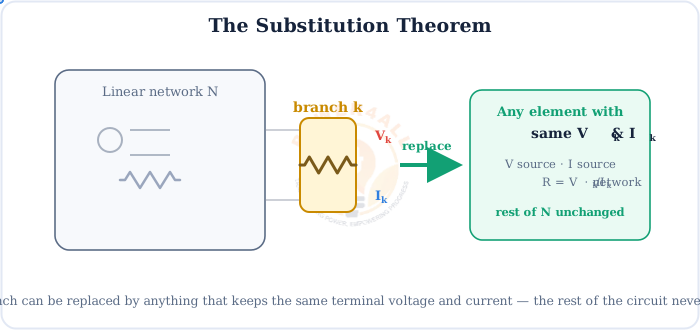
The Substitution Theorem says that any branch in a network can be replaced ("substituted") by a completely different element — as long as the replacement keeps the same voltage across it and the same current through it. When it does, every voltage and current in the rest of the circuit stays exactly the same.
It is one of the most intuitive of the network theorems: the outside world only "feels" a branch through its terminal voltage and current, so anything that reproduces those two numbers is indistinguishable to the rest of the circuit.
Linear or nonlinear
Unlike superposition, the Substitution Theorem does not require the circuit to be linear. It only needs a unique solution and a branch that connects to the rest through its terminals.
Formal Statement
In a network with a unique solution, if a branch k carries voltage Vk and current Ik, that branch may be replaced by any branch that also carries Vk and Ik at its terminals — and all other branch voltages and currents remain unchanged.
branch (Vk, Ik) → any element giving the same Vk, Ik
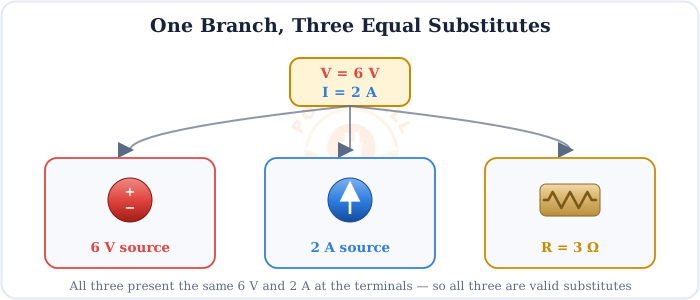
Typical substitutes: a Vk voltage source, an Ik current source, or a resistor R = Vk/Ik
The key insight
The rest of the circuit interacts with the branch only through its terminal voltage and current. Match those two and you have matched everything the rest of the circuit can "see".
A Worked Circuit
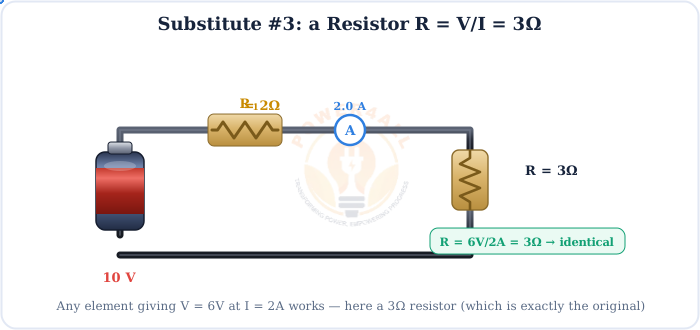
Take a simple circuit so we know the branch's voltage and current exactly. A 10 V source drives a 2Ω resistor and a 3Ω branch in series.
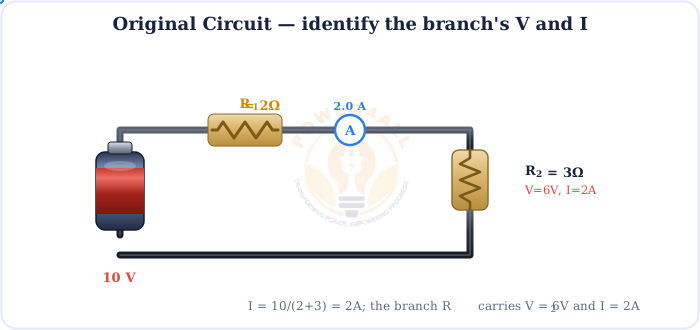
Those two numbers — 6 V and 2 A — are all that matter. Whatever we put in that branch, if it holds 6 V at 2 A, the source current, the drop across the 2Ω resistor and every other quantity stay put.
The Three Classic Substitutes
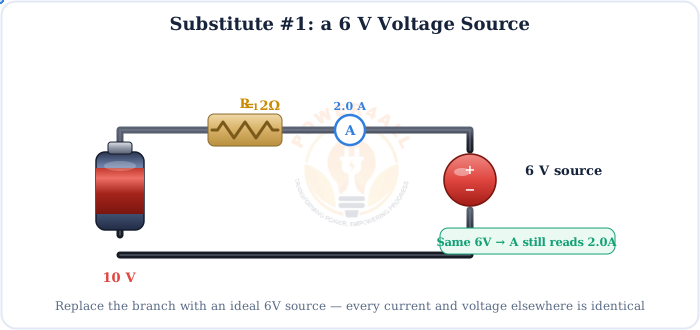
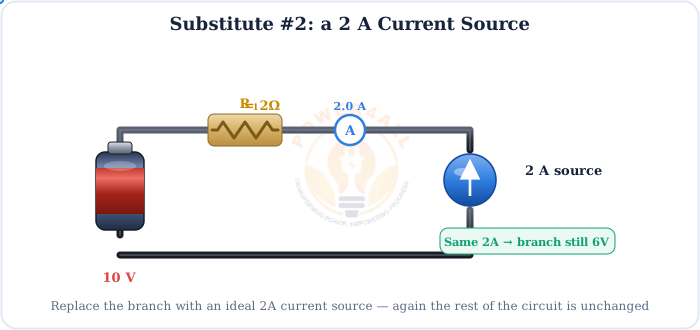
The same branch (6 V, 2 A) can be replaced three different ways — each keeps the terminal conditions identical.
The Rest of the Network Is Unaffected
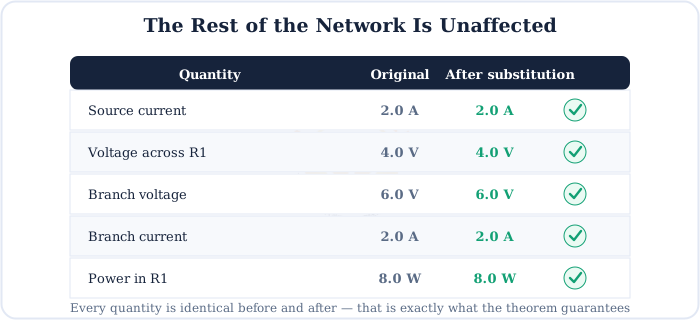
This is the heart of the theorem: after substituting the branch, every other voltage, current and power in the circuit reads exactly the same as before.
Why it must be so
The equations for the rest of the network depend on the branch only through its terminal V and I. Fix those, and the solution to those equations cannot change.
When Is Substitution Valid?
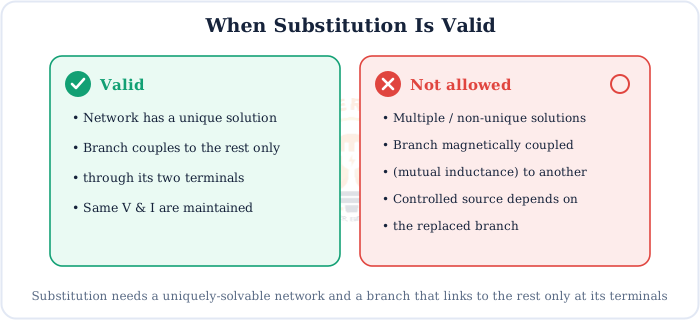
The theorem is powerful but has a few guard-rails. Break them and the "equivalent" branch may no longer behave the same.
Unique solution
The network must have exactly one set of branch voltages and currents.
Terminal coupling only
The branch links to the rest only through its two terminals.
No hidden dependence
No mutual inductance and no controlled source that depends on the replaced branch.
The Principle Behind Thévenin & Norton
Substitution is the general idea; Thévenin and Norton are famous special cases of it applied to a whole one-port.

Because a Thévenin or Norton equivalent reproduces the exact terminal voltage-current relationship of the network it stands in for, swapping it in is really just substitution applied at a port — which is why these theorems are so closely related and often used together with maximum power transfer.
Proof Idea & Worked Example
The proof is short: since the rest of the network sees only Vk and Ik, forcing those with a source cannot change its equations. Let's verify with numbers.
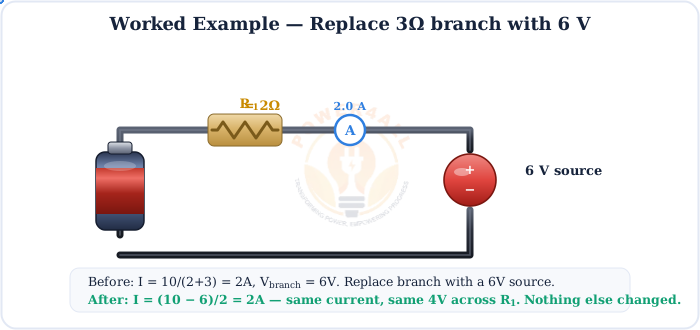
Worked example
Before: 10 V across (2Ω + 3Ω) gives I = 10/5 = 2 A; the 3Ω branch has V = 2×3 = 6 V.
Substitute the 3Ω branch with a 6 V source.
After: KVL gives I = (10 − 6)/2 = 2 A. Same current, same 4 V across the 2Ω resistor — the substitution is transparent.
Why the current source substitute also works
Replace the branch with a 2 A current source instead. The source forces 2 A through the loop, so the 2Ω resistor drops 4 V and the branch must sit at 10 − 4 = 6 V — identical terminal conditions, identical rest-of-circuit behaviour.
Applications of the Substitution Theorem
It is more a reasoning tool than a calculator — but a very useful one.
Simplifying analysis
Swap an awkward branch for an equivalent source to make the remaining circuit easy to solve.
Modelling nonlinear parts
Replace a diode or transistor branch by an equivalent source at its operating point.
Circuit simulation
Solvers substitute known-state branches with sources to iterate large networks.
Key Terms at a Glance
The essential substitution-theorem vocabulary.
Branch
A single two-terminal element or path in the network.
Terminal V & I
The voltage across and current through the branch.
Substitute
Any element giving the same V and I.
Unique solution
Exactly one valid set of voltages/currents.
One-port
A network seen at two terminals.
Coupling
Interaction beyond the terminals (mutual L, controlled sources).
Frequently Asked Questions
Quick, expert answers to the questions people ask most about the Substitution Theorem.
What is the Substitution Theorem in simple words?
Any branch of a circuit can be swapped for anything that keeps the same voltage across it and current through it — a source or a resistor — and the rest of the circuit behaves exactly the same.
What can a branch be replaced with?
An independent voltage source equal to the branch voltage, an independent current source equal to the branch current, a resistor R = V/I, or any sub-network presenting the same terminal V and I.
Why does the theorem work?
The rest of the network only interacts with a branch through its terminal voltage and current. Reproduce those two values and the rest of the network sees no difference at all.
What are the conditions for it to be valid?
The network must have a unique solution, and the branch must connect to the rest only through its terminals — no mutual inductance, and no controlled source elsewhere that depends on the replaced branch.
Does it apply to nonlinear circuits?
Yes. It does not require linearity — only a unique solution and terminal-only coupling — so it works for both linear and nonlinear networks.
How is it different from Thévenin's theorem?
Thévenin replaces a whole source network at two terminals with one source and one resistance. Substitution is broader: it replaces a single branch by anything with the same terminal V and I. Thévenin and Norton are special cases.
What is it used for?
Simplifying analysis by replacing an awkward branch with an equivalent source, modelling nonlinear elements at an operating point, and as a step in proving Thévenin, Norton and reciprocity.
Can a branch really be replaced by a resistor?
Yes — a resistor R = V/I develops exactly that voltage at that current. In the standard example a branch with 6 V and 2 A can be replaced by a 3Ω resistor.
Conclusion & Key Takeaways
The Substitution Theorem captures a simple truth — a branch is known entirely by its terminal voltage and current — and turns it into a flexible tool for analysis and proof.
Match V & I
Keep terminal V and I.
Rest unchanged
Everything else stays put.
Three substitutes
V source, I source, or R.
Any circuit
Linear or nonlinear.
Needs uniqueness
And terminal-only coupling.
Underpins theorems
Thévenin & Norton.