Form Factor & Crest Factor
The complete guide to the two ratios that capture a waveform’s shape — the form factor kf = RMS/average (1.11 for a sine) and the crest (peak) factor kc = peak/RMS (1.414 for a sine). Their formulas, values for every common waveform, and why they decide meter accuracy and component stress.
Complete Learning Path — Form & Crest Factor
From what the two ratios mean, to the form factor, the crest factor, values across waveforms, meter calibration, component stress and applications
What Are Form & Crest Factor?
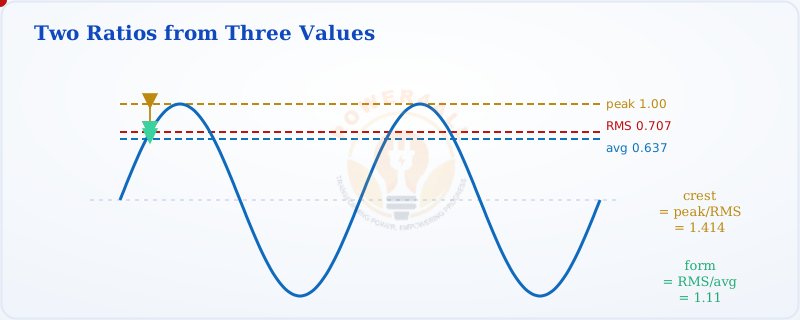
Form factor and crest factor are two simple ratios that describe the shape of an AC waveform. They are built from the three values you already know — peak, RMS and average.
- Form factor (kf) = RMS ÷ average — tells how “full” the wave is.
- Crest factor (kc), also called peak factor = peak ÷ RMS — tells how “spiky” the peaks are.
Both are pure numbers (no units), and both are fixed for a given waveform shape. For the all-important sine wave they are 1.11 and 1.414.
Shape fingerprints
Two waveforms with the same RMS can behave very differently. Form factor and crest factor are the “fingerprints” that tell those shapes apart — and they warn you when a wave is peaky.
Form Factor: kf = RMS / Average = 1.11
The form factor compares the RMS value with the average value. It reflects how the area of the wave is distributed — a fuller shape sits closer to 1.
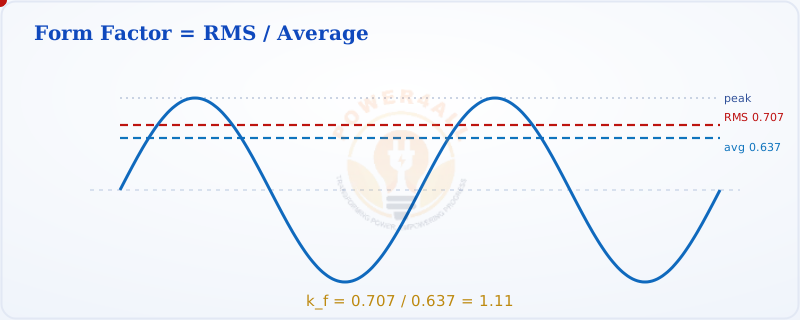
kf = Vrms / Vavg = 0.707 / 0.637 = 1.11
Form factor of a sine wave (a pure, shape-only number)
Reading the number
A form factor near 1.0 means a flat, full wave (a square wave is exactly 1). A larger form factor means the wave dips toward zero more, like a triangle (1.15).
Crest Factor: kc = Peak / RMS = 1.414
The crest factor (or peak factor) compares the peak with the RMS. It measures how tall the peaks are relative to the effective value — how “spiky” the wave is.
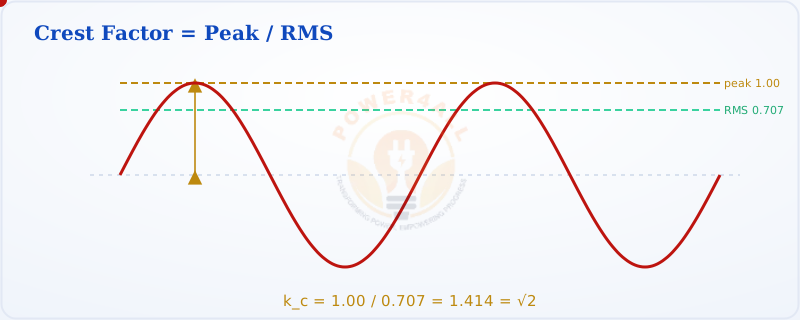
kc = Vm / Vrms = 1 / 0.707 = 1.414 = √2
Crest factor (peak factor) of a sine wave
High crest factor = trouble
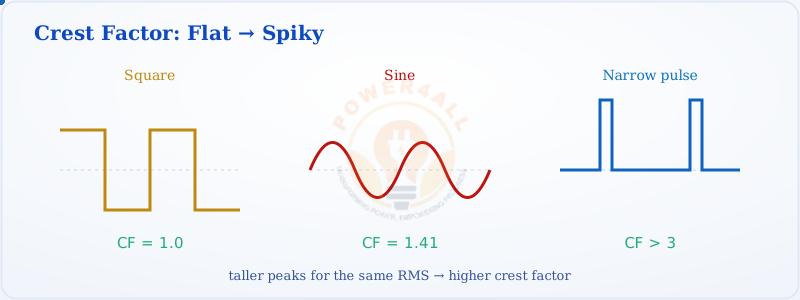
A square wave has a crest factor of 1 (no spike), but a narrow pulse can have a crest factor of 3, 5 or more — huge peaks hiding behind a modest RMS, which can overload components and clip amplifiers.
Spiky vs Flat: What Crest Factor Shows
Crest factor is easiest to feel by comparison. Same RMS, very different peaks — the spikier the wave, the higher its crest factor.
Form & Crest Factor for Common Waveforms
Each waveform shape has its own fixed pair of factors. These are the values that appear in exams and datasheets.
| Waveform | Average | RMS | Form factor | Crest factor |
|---|---|---|---|---|
| Sine | 0.637 Vm | 0.707 Vm | 1.11 | 1.414 |
| Square | Vm | Vm | 1.00 | 1.00 |
| Triangle / sawtooth | 0.5 Vm | 0.577 Vm | 1.155 | 1.732 |
| Full-wave rectified sine | 0.637 Vm | 0.707 Vm | 1.11 | 1.414 |
| Half-wave rectified sine | 0.318 Vm | 0.5 Vm | 1.57 | 2.0 |
Pattern to remember
The flatter the wave, the closer both factors are to 1 (square = 1.0, 1.0). The pointier the wave, the larger they grow (triangle, half-wave rectified).
Form Factor & Meter Calibration
The form factor is not just theory — it is baked into how most affordable multimeters work. An average-responding meter measures the average, then multiplies by 1.11 to display the RMS.
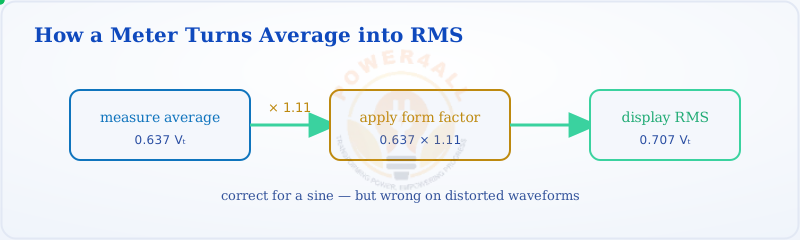
Use true-RMS for distorted signals
On non-sinusoidal current (LED drivers, motor drives, switch-mode supplies) the form factor is not 1.11, so an average-responding meter reads wrong. Use a true-RMS meter instead.
Why Form & Crest Factor Matter
These two ratios quietly govern instrument accuracy, power-supply design and audio quality.
Instrumentation
Form factor sets how average-responding meters read RMS — and why they fail on distorted waveforms.
Power supplies
Rectifier input current has a high crest factor; components and cabling must handle the tall peaks, not just the RMS.
Audio
Music has a high crest factor; amplifiers need headroom for the peaks or they clip and distort.
Signal analysis
Crest factor is a quick health check — a rising crest factor can flag bearing faults or clipping.
See the underlying values in RMS Value, Peak & Peak-to-Peak and Average Value.
Key Terms at a Glance
The essential form / crest factor vocabulary students and engineers search for.
Frequently Asked Questions
Quick, expert answers to the questions people ask most about form and crest factor.
What is form factor in simple words?
Form factor is the ratio of a waveform’s RMS value to its average value. It is a shape number: for a sine it is 0.707 / 0.637 = 1.11. A square wave, being flat, has a form factor of exactly 1.
What is crest factor?
Crest factor (also called peak factor) is the ratio of the peak value to the RMS value. It shows how spiky the wave is. For a sine it is 1 / 0.707 = 1.414 (√2).
What is the form factor of a sine wave?
1.11. It comes from dividing the RMS (0.707 of peak) by the average (0.637 of peak). This is the factor average-responding meters use to display RMS.
What is the crest factor of a sine wave?
1.414, the square root of 2, because the peak is √2 times the RMS for a sine. A square wave has a crest factor of 1, while narrow pulses can exceed 3.
Why is form factor important?
Average-responding meters measure the average and multiply by the form factor (1.11) to show the RMS. They therefore read correctly only for pure sines and are inaccurate on distorted waveforms — where you need a true-RMS meter.
Why does a high crest factor cause problems?
A high crest factor means tall, narrow peaks relative to the RMS. Those peaks can overload components, blow fuses on inrush, and clip amplifiers — so equipment must have headroom for them even when the RMS looks safe.
What is the difference between form factor and crest factor?
Form factor compares RMS to average (overall fullness); crest factor compares peak to RMS (spikiness). For a sine they are 1.11 and 1.414 respectively.
Is peak factor the same as crest factor?
Yes. Peak factor, crest factor and amplitude factor are all names for the same ratio: peak value divided by RMS value. For a sine it is 1.414.
Conclusion & Key Takeaways
Form and crest factor are the two shape numbers of a waveform. They connect peak, RMS and average, calibrate meters, and warn when peaks will bite.
Form = RMS/avg
1.11 for a sine.
Crest = peak/RMS
1.414 (√2) for a sine.
Pure numbers
No units; fixed per shape.
Flatter → near 1
Square = 1.0, 1.0.
Calibrates meters
Average × 1.11 = RMS.
Warns of spikes
High crest factor stresses parts.