Peak & Peak-to-Peak Value
The complete guide to the two “size” measures of a waveform — the peak value Vm (amplitude) and the peak-to-peak value Vpp = 2Vm. How they read on a scope, how they relate to RMS and average, their values for different waveforms, and why they decide component ratings.
Complete Learning Path — Peak & Peak-to-Peak
From the peak value and peak-to-peak value, to how they compare with RMS and average, waveform values, conversions, ratings and measurement
What is Peak Value?
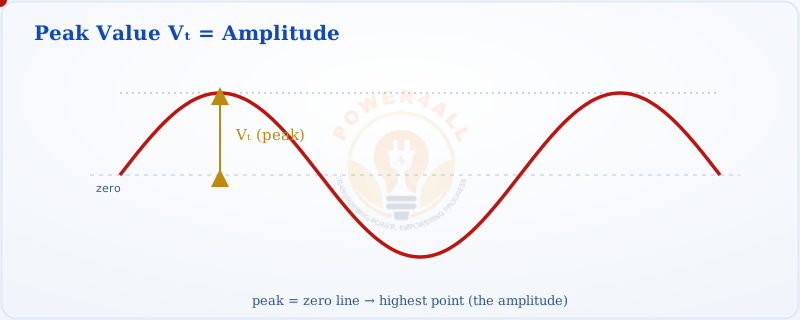
The peak value of an alternating voltage or current is the maximum instantaneous value it reaches — measured from the zero line up to the crest. It is also called the amplitude or maximum value, with the symbol Vm (or Vp) for voltage and Im for current.
A sine wave climbs from zero, reaches its peak, falls back through zero to the negative peak, and repeats. The peak is simply how high that climb goes — the tallest the waveform ever gets in one direction.
Peak vs instantaneous
The instantaneous value changes moment to moment along the wave; the peak is the single largest one it ever reaches. Amplitude and peak value mean the same thing for a symmetrical wave.
Peak-to-Peak Value: Vpp = 2Vm
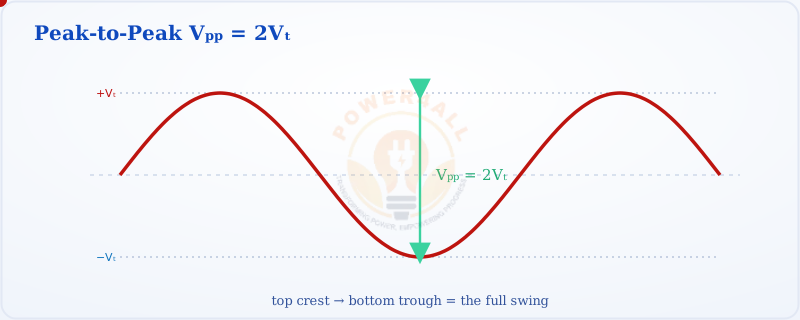
The peak-to-peak value is the total vertical swing of the waveform — from the highest crest all the way down to the lowest trough. For a symmetrical wave that is simply twice the peak.
Vpp = 2 × Vm
Peak-to-peak value = twice the peak value (for a symmetrical waveform)
Scope-friendly
Peak-to-peak is popular because it is easy to see: just measure from the top of the trace to the bottom. No need to find the zero line first.
Peak vs RMS vs Average
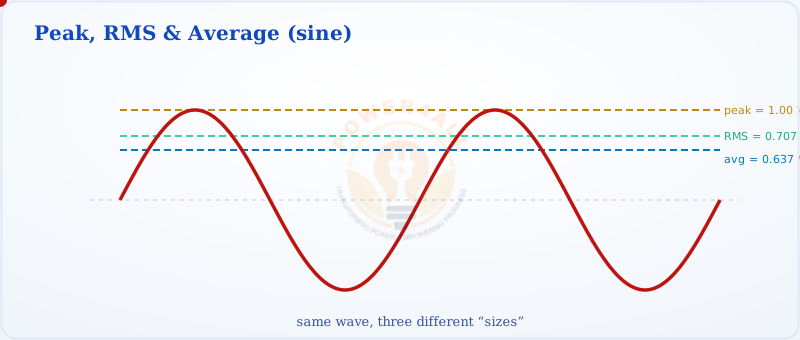
Peak, RMS and average are three different ways to put a number on the same AC waveform. On a sine they sit at fixed heights relative to the peak.
| Measure | For a sine | Meaning |
|---|---|---|
| Peak (Vm) | 1.000 Vm | Maximum from zero (amplitude) |
| Peak-to-peak (Vpp) | 2.000 Vm | Full swing, crest to trough |
| RMS | 0.707 Vm | Effective (heating) value |
| Average (half-cycle) | 0.637 Vm | Mean of one half-cycle |
Peak & Peak-to-Peak on Different Waveforms
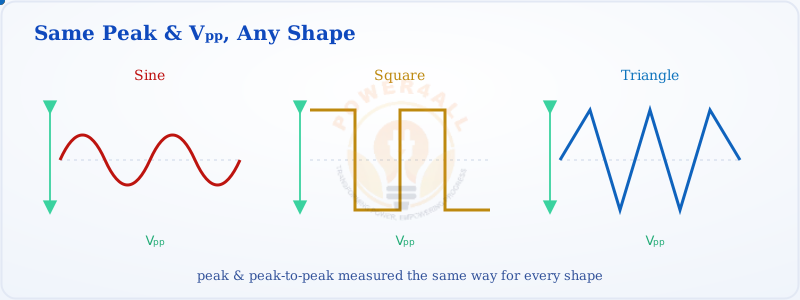
Peak and peak-to-peak are defined the same way for any shape — zero-to-crest and crest-to-trough — even though the RMS differs between shapes.
Conversions & Formulas
For a sine wave, all four values are locked together by simple constants. Learn these and you can jump between any of them.
Vpp = 2Vm · Vm = √2 Vrms
Peak-to-peak = 2 × peak; peak = √2 (1.414) × RMS
Vrms = 0.707 Vm · Vpp = 2.828 Vrms
RMS = 0.707 × peak; peak-to-peak = 2√2 × RMS (sine only)
Worked example — a 5 Vrms sine
A signal generator outputs 5 Vrms sine. Then:
Vm = √2 × 5 = 7.07 V
Vpp = 2 × 7.07 = 14.14 V — the full swing the scope will show.
These constants are sine-only
The 0.707, 1.414 and 2.828 factors hold for a pure sine. For square, triangle or distorted waves the peak-to-peak is still 2Vm, but the RMS relationship changes — see RMS Value.
Why the Peak Sets Component Ratings
Meters quote RMS, but components must survive the peak. Insulation, capacitor voltage ratings and diode reverse voltage all depend on the peak or peak-to-peak — which is much higher than the RMS.
Capacitor rating
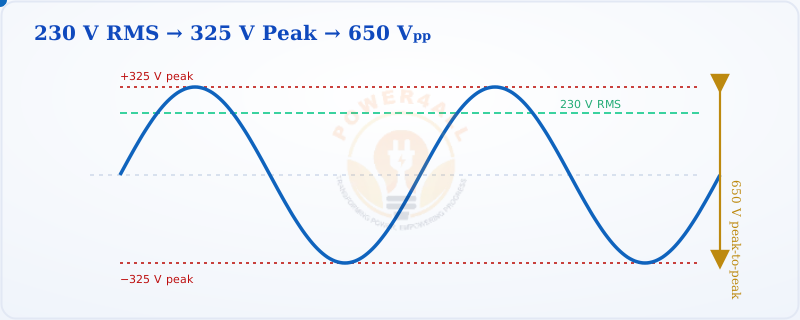
Must exceed the peak, not the RMS — mains caps are rated 400 V+ for a 230 V supply.
Diode reverse voltage
A rectifier diode sees the peak reverse voltage — choose its PIV above Vm.
Amplifier headroom
Audio gear is limited by peak swing; exceed it and the peaks clip and distort.
Measuring Peak & Peak-to-Peak
The oscilloscope is the natural tool — it shows the waveform directly, so peak and peak-to-peak are simply distances on the screen.
Oscilloscope
Read peak-to-peak as the vertical distance from crest to trough × the volts/division. Most scopes also show Vpp automatically.
From an RMS meter
Measure Vrms, then compute Vm = 1.414 Vrms and Vpp = 2Vm — for a sine only.
Scope tip
Peak-to-peak is the most reliable scope reading because it does not need an accurate zero reference — you just measure top-to-bottom of the trace.
Where Peak & Peak-to-Peak Matter
These values decide safety margins, signal levels and audio quality.
Power & insulation
Insulation and clearances are sized for the peak voltage, not the RMS.
Audio & signals
Signal levels and clipping are quoted peak-to-peak; headroom protects the peaks.
Electronics design
Component ratings, ADC input ranges and gain staging all work from peak / Vpp.
Communications
Modulation depth and signal swing are described in peak-to-peak terms.
See the related values in RMS Value and the waveform basics in Alternating Current and Frequency.
Key Terms at a Glance
The essential peak-value vocabulary students and engineers search for.
Peak value (Vm)
Maximum instantaneous value; the amplitude.
Peak-to-peak (Vpp)
Crest to trough; Vpp = 2Vm.
Amplitude
Same as peak value for a symmetrical wave.
Instantaneous value
The value at one instant along the wave.
Crest & trough
The highest and lowest points of the waveform.
Crest factor
Peak ÷ RMS = 1.414 for a sine.
Frequently Asked Questions
Quick, expert answers to the questions people ask most about peak and peak-to-peak.
What is peak value in simple words?
The peak value is the highest an AC waveform reaches from the zero line — the top of the crest. It is also called the amplitude or maximum value, symbol Vm (or Vp).
What is peak-to-peak value?
Peak-to-peak is the full vertical swing from the top crest to the bottom trough. For a symmetrical wave it equals twice the peak: Vpp = 2Vm. It is the easiest value to read on an oscilloscope.
What is the difference between peak and peak-to-peak?
Peak is measured from zero to one crest; peak-to-peak is measured from the top crest to the bottom trough. For a symmetrical waveform, peak-to-peak is exactly double the peak.
How do you convert peak to RMS?
For a sine, Vrms = Vm/√2 = 0.707 Vm, and the reverse is Vm = 1.414 Vrms. The peak-to-peak is Vpp = 2.828 Vrms. See RMS Value for the derivation.
What is the peak value of the 230 V mains?
230 V is the RMS value, so the peak is 1.414 × 230 ≈ 325 V, and the peak-to-peak is about 650 V. That is why mains-rated capacitors are 400 V or higher.
Is amplitude the same as peak value?
Yes — for a symmetrical wave the amplitude is the peak value: the maximum displacement from zero. Peak-to-peak is twice the amplitude.
How do I measure peak-to-peak on a scope?
Count the vertical divisions from the highest to the lowest point of the trace and multiply by the volts-per-division. Digital scopes usually display Vpp automatically as a measurement.
Why does the peak value matter more than RMS for components?
Because a component experiences the actual instantaneous voltage, which reaches the peak. Insulation, capacitor voltage ratings and diode reverse voltage must all withstand the peak (or peak-to-peak), which is higher than the RMS meters display.
Conclusion & Key Takeaways
Peak and peak-to-peak describe how big a waveform gets. Pair them with RMS and average and you can fully describe any AC signal.
Peak = amplitude
Zero line to the crest (Vm).
Vpp = 2Vm
Crest to trough, the full swing.
Vm = √2 Vrms
Peak is 1.414 × RMS (sine).
Defined for any shape
Only RMS changes with shape.
Sets ratings
Caps, diodes, insulation follow the peak.
Scope-friendly
Vpp is easiest to read directly.