What is Magnetic Saturation?
The complete guide to magnetic saturation — the point where a magnetic core can hold almost no more flux. From the B-H curve and saturation flux density Bsat, to magnetic domains, hysteresis, why permeability collapses, and how core saturation wrecks transformers and inductors.
Complete Learning Path — Magnetic Saturation
From what saturation is, to the B-H curve, domains, hysteresis, permeability, its effects and how to prevent it
What is Magnetic Saturation?
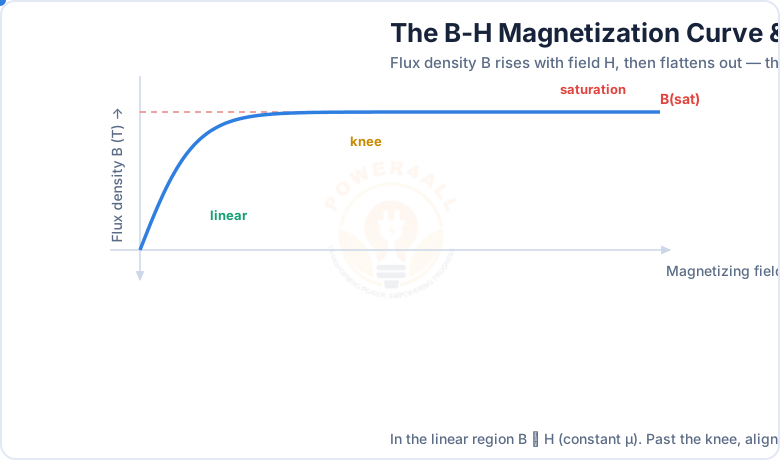
Magnetic saturation is the state where a ferromagnetic core can carry almost no more magnetic flux, no matter how hard you drive it. As the magnetizing field H rises, the flux density B climbs — until the material runs out of unaligned domains and B levels off at the saturation flux density Bsat.
The whole story is told by the B-H curve (magnetization curve): a straight linear region, a bend called the knee, and a flat saturation region.
| Material | Typical Bsat | Common use |
|---|---|---|
| Silicon (electrical) steel | 1.5 – 2.0 T | Mains transformers, motors |
| Ferrite (MnZn / NiZn) | 0.3 – 0.5 T | High-frequency SMPS, chokes |
| Permalloy / Mu-metal | 0.6 – 0.8 T | Sensitive / shielding cores |
| Powdered iron | 1.0 – 1.5 T | Gapped power inductors |
Saturation is a hard limit
Unlike a resistor, a core has a ceiling. Once B reaches Bsat the core behaves almost like air — and everything that relied on the core (inductance, transformer action) suddenly fails.
Why It Happens: Magnetic Domains
A ferromagnetic material is divided into tiny regions called magnetic domains, each already magnetized in some direction. Applying a field makes them line up with it — and once they all point the same way, there is nothing left to align.
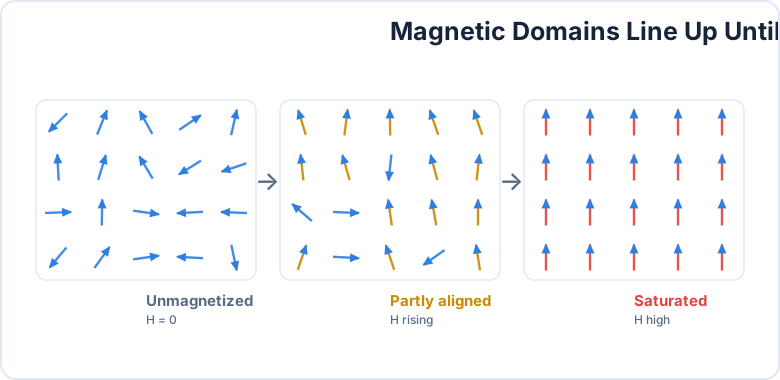
The intuition
Think of turning a crowd to face one way. At first each nudge turns many people; near the end almost everyone already faces forward, so extra effort achieves almost nothing. That "diminishing return" is the knee of the B-H curve.
Saturation & the Hysteresis Loop
Drive the core back and forth with AC and the B-H curve opens into a hysteresis loop. Its tips flatten at ±Bsat, and it reveals two more key properties: remanence and coercivity.
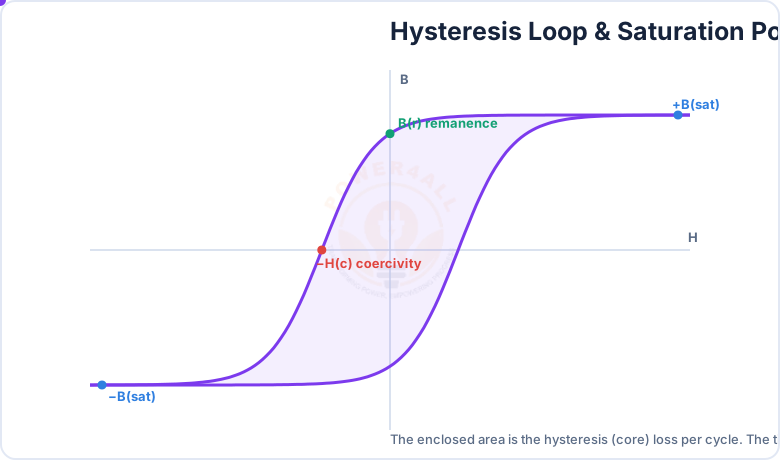
Br = remanence · Hc = coercivity · loop area ∝ hysteresis loss
A wider loop means more energy lost as heat each cycle
Permeability Collapses at Saturation
The slope of the B-H curve is the permeability — the very thing that makes a core useful. In the linear region it is high; once the core saturates it collapses toward the permeability of free space, μ0.
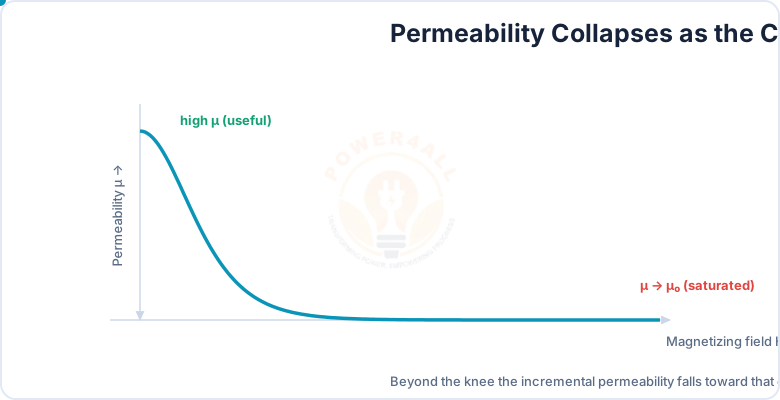
μ = B / H · μ = μ0μr
Permeability is the slope of the B-H curve; at saturation μr → 1
Effects: Inrush Current & Distortion
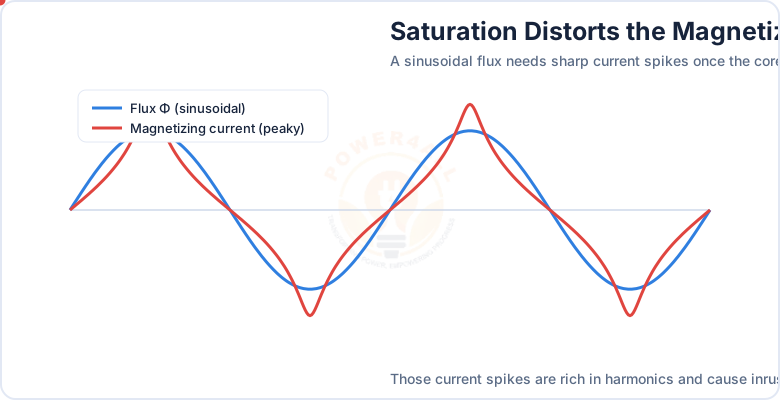
The most visible symptom of core saturation is a peaky magnetizing current. Because the flux is fixed by the applied voltage, the current must spike hard to push flux past the knee — the cause of transformer inrush current.
Bmax = V / (4.44 · f · N · A)
Transformer flux from the EMF equation — Bmax must stay below Bsat
Worked example
A 230 V, 50 Hz winding of 500 turns on a 10 cm² (0.001 m²) core:
Bmax = 230 / (4.44 × 50 × 500 × 0.001) ≈ 2.07 T — above silicon steel's ~1.8 T Bsat, so this core would saturate. Fix it with more turns, a bigger core, or lower voltage.
Why it matters
Saturation causes inrush that trips breakers, overheating, acoustic noise, waveform distortion and, in switching converters, runaway current that can destroy the switch.
Inductance Drops: Saturation Current Isat
For an inductor, saturation shows up as a sudden loss of inductance above a certain current, the saturation current Isat. Below it, L is at its rated value; above it, L falls off a cliff.
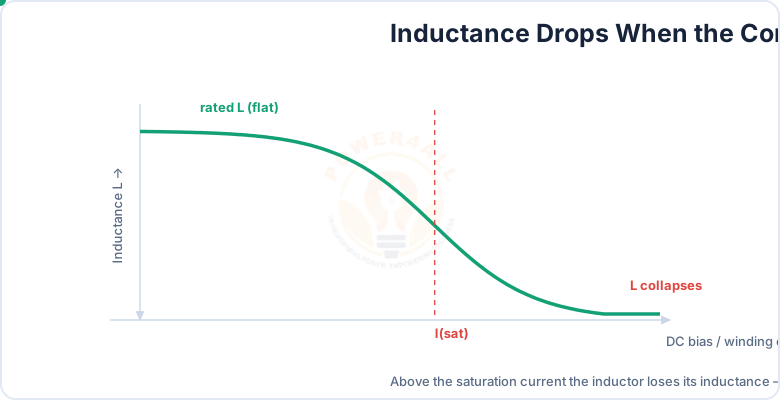
This is why inductor datasheets always quote a saturation current alongside the inductance value: exceed it and the part effectively disappears from the circuit. A DC bias current pushes the core toward saturation and lowers the effective inductance.
How to Prevent Saturation
Saturation is a design constraint, not a mystery. Keep the working flux safely below Bsat using these levers.
Bigger core
More cross-section A lowers Bmax for the same flux (B = Φ/A).
Air gap
A small gap stores energy and dramatically raises Isat (at the cost of some inductance).
More turns / higher f
Both lower Bmax = V/(4.44 f N A).
Higher-Bsat material
Silicon steel or powdered iron over ferrite where flux is high.
The air-gap trick
Adding an air gap is the classic fix for DC-biased inductors: it linearises the B-H curve and pushes saturation far higher, which is why power inductors are almost always gapped.
Key Terms at a Glance
The essential magnetic-saturation vocabulary students and engineers search for.
Magnetic saturation
Flux stops rising with field.
Bsat
Saturation flux density (T).
B-H curve
Flux density vs field; the magnetization curve.
Knee point
Where the curve bends into saturation.
Hysteresis loop
Br remanence, Hc coercivity.
Isat
Current where inductance collapses.
Frequently Asked Questions
Quick, expert answers to the questions people ask most about magnetic saturation.
What is magnetic saturation in simple words?
It is the point where a magnetic core is "full" — it already carries as much flux as it can, so pushing harder with more current barely increases the flux. The flux density levels off at Bsat.
What is the B-H curve?
It plots flux density B against magnetizing field H. It has a linear region (B ∝ H), a knee, and a flat saturation region. Its slope is the permeability of the material.
What is saturation flux density (Bsat)?
The maximum flux density a material can hold. Roughly 1.5–2.0 T for silicon steel, 0.3–0.5 T for ferrite, and about 0.7 T for permalloy. Designs keep the working flux below it.
Why does saturation happen?
The material is full of magnetic domains. The field lines them up one by one; once they are all aligned, there are none left to add flux, so B stops rising.
What happens to a transformer when the core saturates?
The magnetizing current becomes a series of sharp spikes, producing large inrush currents, overheating, humming, harmonic distortion and possible nuisance tripping. The transformer stops behaving ideally.
What is the saturation current of an inductor?
Isat is the current at which the core saturates and the inductance drops significantly (often defined as a 20–30% fall). Above Isat the inductor no longer limits current well.
How do I stop a core from saturating?
Use a bigger core, add an air gap, add turns or raise the frequency (all lower Bmax = V/4.44fNA), pick a higher-Bsat material, or reduce the DC bias current.
Does an air gap prevent saturation?
Largely, yes. An air gap stores much of the energy and greatly raises the saturation current, at the cost of lower inductance. That is why DC-carrying power inductors are almost always gapped.
Conclusion & Key Takeaways
Magnetic saturation is the ceiling of every magnetic core — the flux limit that shapes how transformers, inductors and motors are designed.
Flux ceiling
B levels off at Bsat.
B-H knee
Linear → knee → saturation.
Domains align
None left to add flux.
μ collapses
Core stops helping.
Inrush & L drop
Peaky current, lost inductance.
Design below Bsat
Bigger core, gap, more turns.