Magnetic Permeability
The complete guide to magnetic permeability (μ) — the property that decides how easily a material carries a magnetic field. From B = μH and μ = μ0μr, to the permeability of free space, relative permeability, diamagnetic/paramagnetic/ferromagnetic materials, and the B–H curve.
Complete Learning Path — Permeability
From the meaning and formulas, to free-space value, relative permeability, material classes, the B–H curve and the magnetic analogy
What is Magnetic Permeability?
Magnetic permeability (μ) measures how easily a material lets a magnetic field form inside it — how much magnetic flux it carries for a given magnetising effort. It is defined by B = μH: the flux density B a material develops for an applied field strength H.
Put a coil around air and it makes only a little flux. Put the same coil around an iron rod and the flux jumps by thousands of times — because iron’s permeability is thousands of times higher. Permeability is to magnetism what conductivity is to electricity: a measure of how freely the “flow” passes.
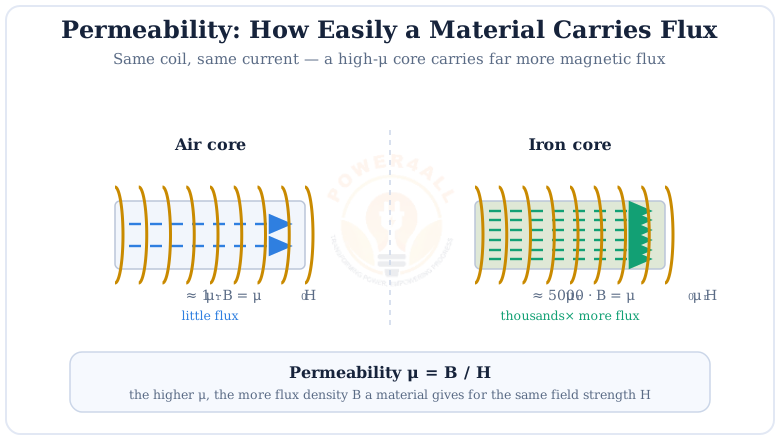
Permeability vs field strength
Don’t confuse the two. H (field strength, A/m) is the magnetising effort you apply; B (flux density, T) is the result. Permeability μ is the ratio that connects them — how much B you get per unit H.
The Permeability Formulas
Two formulas capture everything: one defines permeability, the other splits it into a universal constant and a material factor.
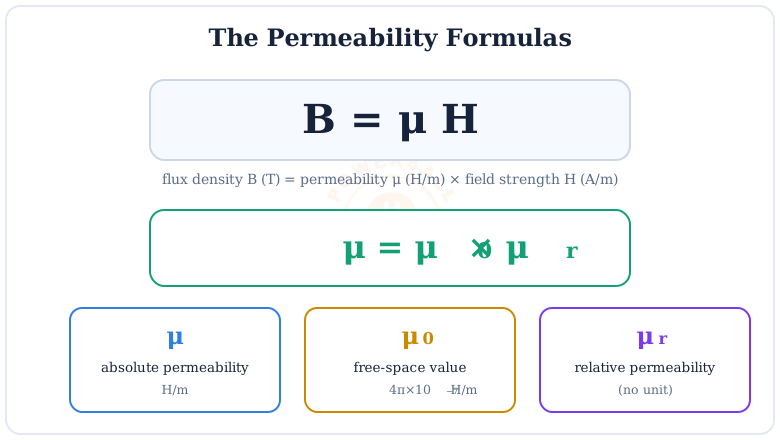
B = μ H and μ = μ0 μr
B = flux density (T) · H = field strength (A/m) · μ = absolute permeability (H/m) · μr = relative (no unit)
Worked example 1 — absolute permeability
Iron has μr = 5000. Find its absolute permeability.
μ = μ0μr = (4π×10−7)(5000) ≈ 6.28×10⁻³ H/m.
Permeability of Free Space (μ0)
The permeability of free space — also called the magnetic constant — is the permeability of a vacuum. It is the baseline every material is compared against.
μ0 = 4π × 10−7 ≈ 1.257 × 10⁻⁶ H/m
Also written T·m/A; it appears in Ampère’s law and every magnetic-field formula
In a vacuum (or, to a very good approximation, air), permeability equals μ0 exactly, so B = μ0H. Every other material is described by how many times bigger its permeability is — that multiple is the relative permeability.
Worked example 2 — flux density in air
A field strength of H = 1000 A/m in air. Find B.
B = μ0H = (4π×10−7)(1000) ≈ 1.26×10⁻³ T = 1.26 mT.
Relative Permeability (μr)
Relative permeability is the dimensionless ratio μr = μ/μ0 — how many times better than vacuum a material carries flux. It ranges from about 1 to tens of thousands.
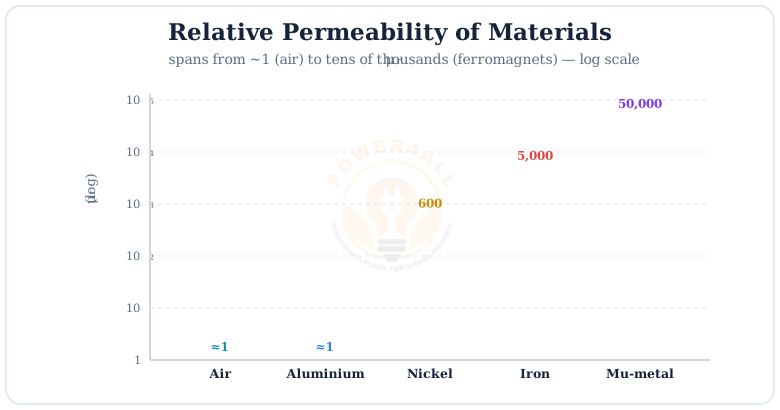
Relative permeability also links to magnetic susceptibility χ through μr = 1 + χ. Susceptibility is slightly negative for diamagnets, small and positive for paramagnets, and very large for ferromagnets.
Worked example 3 — μr from a measurement
A core gives B = 1.0 T at H = 200 A/m. Find its relative permeability.
μr = B / (μ0H) = 1.0 / (4π×10−7 × 200) ≈ 3980.
The Three Classes of Magnetic Material
Every material falls into one of three families, set by whether its relative permeability is below, just above, or far above 1.
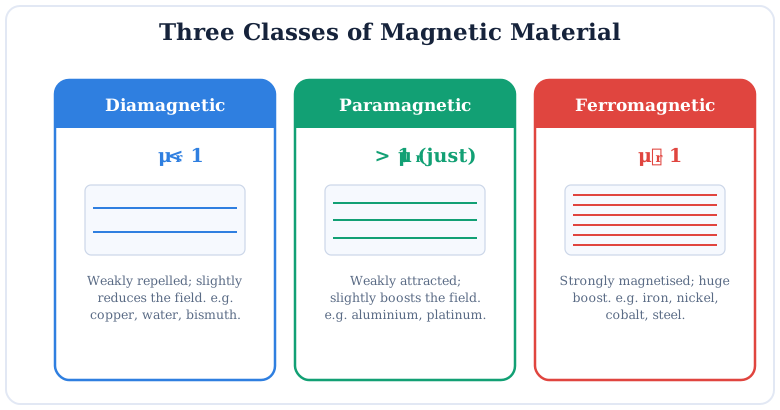
| Class | μr | Behaviour | Examples |
|---|---|---|---|
| Diamagnetic | slightly < 1 | Weakly repelled by a magnet | Copper, water, bismuth, gold |
| Paramagnetic | slightly > 1 | Weakly attracted | Aluminium, platinum, oxygen |
| Ferromagnetic | ≫ 1 (100s–10000s) | Strongly magnetised, retains magnetism | Iron, nickel, cobalt, steel |
Permeability & the B–H Curve
For iron and other ferromagnets, permeability is not constant. It is the slope of the B–H curve, and that slope changes as the material magnetises and eventually saturates.
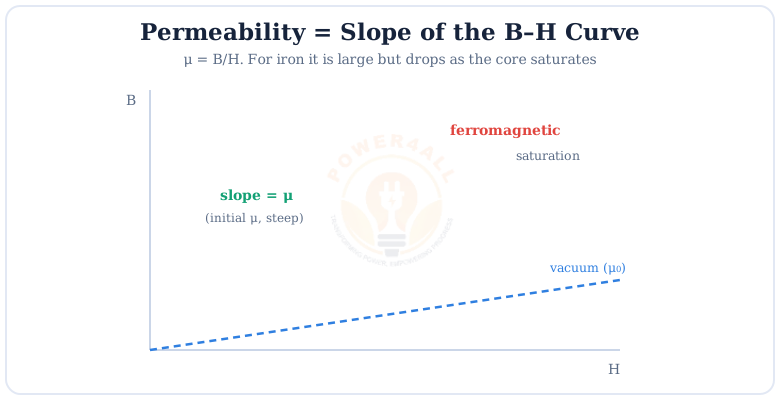
Because of this, engineers quote several permeabilities: the initial permeability (slope near the origin), the maximum permeability (steepest point), and the effective permeability at the operating point. Once the core saturates, extra H produces almost no extra B — the permeability collapses toward μ0.
Saturation matters
A transformer or inductor core is designed to stay below saturation. Push it too hard and permeability drops, inductance falls, and current spikes — a key limit in magnetic design.
The Magnetic–Electric Analogy
Permeability makes more sense next to its electrical twin. A high-μ core guides magnetic flux exactly as a good conductor guides current.

In a magnetic circuit, reluctance ℛ plays the role of resistance and is inversely proportional to permeability: ℛ = ℓ/(μA). A high-permeability core has low reluctance, so a small magnetomotive force (MMF = NI, from Ampère’s law) drives a large flux — just as low resistance lets a small voltage drive a large current.
Why Permeability Matters: Applications
Permeability is one of the first numbers an engineer checks when choosing a magnetic material.
Transformer & inductor cores
High-μ silicon steel or ferrite concentrates flux, boosting inductance and coupling.
Magnetic shielding
Mu-metal (μr up to ~100 000) diverts stray fields around sensitive electronics.
Electromagnets & motors
Soft-iron cores give a strong field from a modest current and release it when switched off.
Antennas & sensors
Ferrite rods raise permeability to shrink antennas and concentrate flux in sensors.
Key Terms at a Glance
The essential permeability vocabulary students and engineers search for.
Permeability μ
B/H; how easily flux forms.
μ0
Free space: 4π×10−7 H/m.
μr
Relative: μ/μ0 (no unit).
Susceptibility χ
μr = 1 + χ.
Saturation
Core stops taking more B.
Reluctance ℛ
ℓ/(μA); magnetic resistance.
Frequently Asked Questions
Quick, exam-ready answers to the questions people ask most about magnetic permeability.
What is magnetic permeability?
Permeability μ measures how easily a material lets a magnetic field form inside it, or how much flux it carries for a given field. It is defined by B = μH. High permeability (iron) concentrates a lot of flux; low permeability (air, vacuum) barely responds.
What is the formula for permeability?
The defining formula is B = μH, so μ = B/H. The absolute permeability is also μ = μ0μr, where μ0 is the permeability of free space and μr is the relative permeability.
What is the permeability of free space?
The permeability of free space (magnetic constant) μ0 is the permeability of a vacuum: 4π×10−7 ≈ 1.257×10⁻⁶ H/m. It is the baseline for every material’s relative permeability.
What is relative permeability?
Relative permeability μr = μ/μ0 is a dimensionless number: ~1 for air, just under 1 for diamagnets, just over 1 for paramagnets, and hundreds to tens of thousands for ferromagnets like iron and mu-metal.
What is the unit of permeability?
The SI unit of absolute permeability is the henry per metre (H/m), equal to tesla metre per ampere (T·m/A). Relative permeability has no unit because it is a ratio.
What is the difference between permeability and permittivity?
Permeability μ is a material’s response to a magnetic field (links B and H). Permittivity ε is its response to an electric field (links D and E). Permeability is the magnetic analogue of permittivity, and together they fix the speed of light in a medium.
What is the permeability of iron?
Pure iron has a relative permeability of roughly 5000 (it varies with purity and field). Nickel is ~600, silicon (transformer) steel ~4000–5000, and mu-metal/permalloy 20 000–100 000. These are used for cores and shielding.
Diamagnetic vs paramagnetic vs ferromagnetic?
Diamagnetic (copper, water): μr just below 1, weakly repelled. Paramagnetic (aluminium): μr just above 1, weakly attracted. Ferromagnetic (iron, nickel, cobalt): μr far above 1, strongly magnetised.
How is permeability related to susceptibility?
By μr = 1 + χ, where χ is the magnetic susceptibility. χ is slightly negative for diamagnets, small and positive for paramagnets, and large and positive for ferromagnets.
Why is permeability important?
It decides how well a material carries flux, so it governs transformer and inductor cores, electromagnets, motors and magnetic shielding. High-μ cores concentrate flux and boost inductance; mu-metal shields sensitive gear from stray fields.
Conclusion & Key Takeaways
Permeability is the single number that tells you how magnetic a material is — how much flux density B it gives for a field H.
B = μH
Permeability = B/H.
μ = μ0μr
Free-space × relative.
μ0 = 4π×10−7
H/m, the baseline.
Three classes
Dia, para, ferromagnetic.
Slope of B–H
Falls at saturation.
μ ↔ σ
Magnetic conductivity.