Magnetomotive Force (MMF)
The magnetic "pressure" that drives magnetic flux around a circuit — produced by a current-carrying coil. Just as EMF drives current, MMF = N·I (ampere-turns) drives flux. The foundation of every electromagnet, relay and transformer.
Complete Learning Path — Magnetomotive Force
From what MMF is and its formula, to the magnetic circuit, field strength, how to raise it, and uses
What is Magnetomotive Force?
Magnetomotive force (MMF) is the magnetic driving force that sets up flux in a magnetic circuit — the magnetic equivalent of the EMF that drives current in an electric circuit. It is produced whenever current flows through a coil.
Wind N turns of wire around an iron core and pass a current I through it, and the coil creates an MMF that pushes magnetic flux (Φ) all the way around the core. More turns or more current means a stronger MMF, and therefore more flux. Despite the name, it is not a mechanical force — think of it as magnetic "pressure".
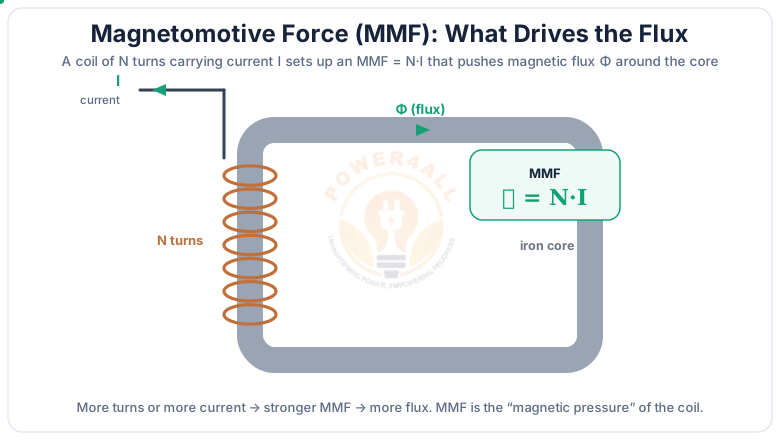
The magnetic-circuit view
Just as a battery's EMF pushes current through resistance, a coil's MMF pushes flux through reluctance. That single idea lets us analyse magnetic circuits with the same tools we use for electric ones.
The MMF Formula: F = N·I
The magnetomotive force of a coil is simply the number of turns multiplied by the current — the "ampere-turns".
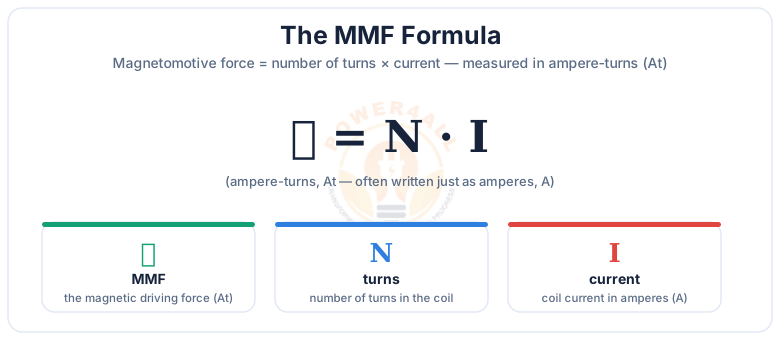
ℱ = N · I
ℱ = MMF (ampere-turns), N = number of turns, I = current (A)
Worked example
A coil has N = 250 turns and carries I = 1.5 A.
MMF = N × I = 250 × 1.5 = 375 ampere-turns. Double the current to 3 A and the MMF doubles to 750 At — and so (for the same reluctance) does the flux.
Ampere-turns, not newtons
Because "turns" is just a count, MMF has the dimensions of current, so it is sometimes quoted plainly in amperes. It is not a force in newtons.
The Magnetic Circuit & the EMF Analogy
MMF makes the most sense through the magnetic-circuit analogy: it plays exactly the role that EMF plays in an electric circuit.
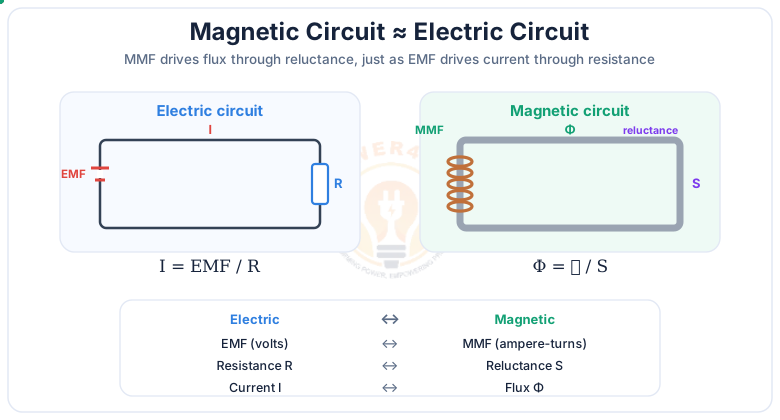
Φ = ℱ / S
flux = MMF ÷ reluctance (the "Ohm's law" of magnetic circuits, or Hopkinson's law)
| Electric circuit | Magnetic circuit |
|---|---|
| EMF (volts) | MMF (ampere-turns) |
| Resistance R (Ω) | Reluctance S (At/Wb) |
| Current I (A) | Magnetic flux Φ (Wb) |
| I = EMF / R | Φ = MMF / S |
So for a given MMF, a low-reluctance path (like a closed iron core) carries far more flux than a high-reluctance path (like an air gap).
MMF, Field Strength (H) & the Magnetic Path
MMF is the total drive around the loop. Spread it over the mean path length l and you get the magnetic field strength H.
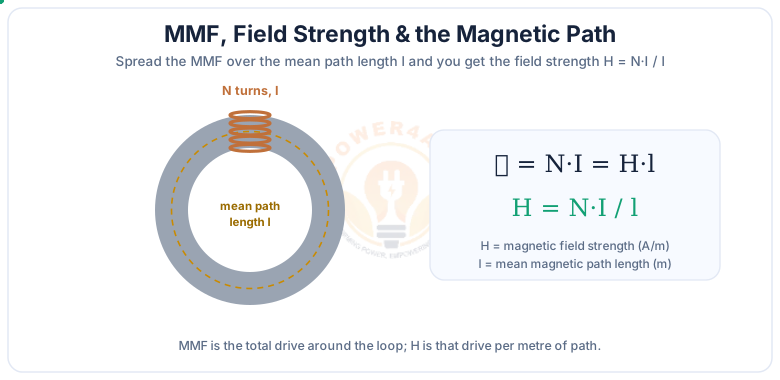
H = N·I / l = ℱ / l
H = magnetic field strength (A/m), l = mean magnetic path length (m)
H (also called the magnetising force) is what you plug into the B–H curve of a material to find the resulting flux density B. Two coils with the same ampere-turns produce the same MMF, but the shorter magnetic path gives the higher H and stronger field.
Two Ways to Increase the MMF
Because ℱ = N·I, there are exactly two levers: more turns or more current.
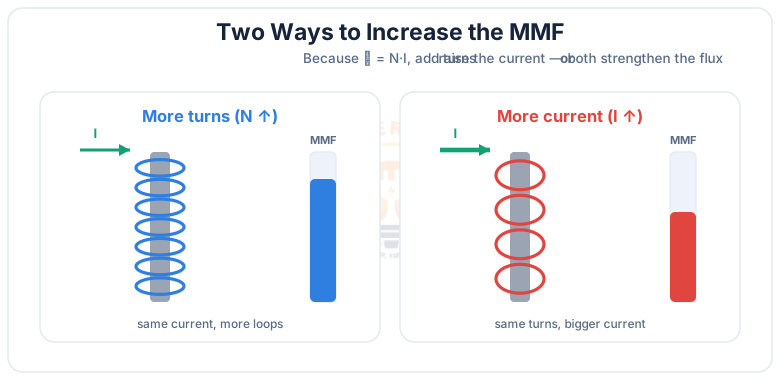
More turns (N↑)
Winding more turns multiplies the ampere-turns without extra current — the usual choice, limited by space and wire resistance.
More current (I↑)
A bigger current raises the MMF directly — limited by heating (I²R loss) and the driver's capacity.
Lower reluctance
For a given MMF, a better iron core (lower reluctance) yields more flux — not more MMF, but more result.
Watch saturation
Beyond a point the core saturates and extra MMF gives little extra flux.
MMF at Work: Applications
Every coil-and-core device is designed around the MMF it needs. The clearest example is the electromagnet.
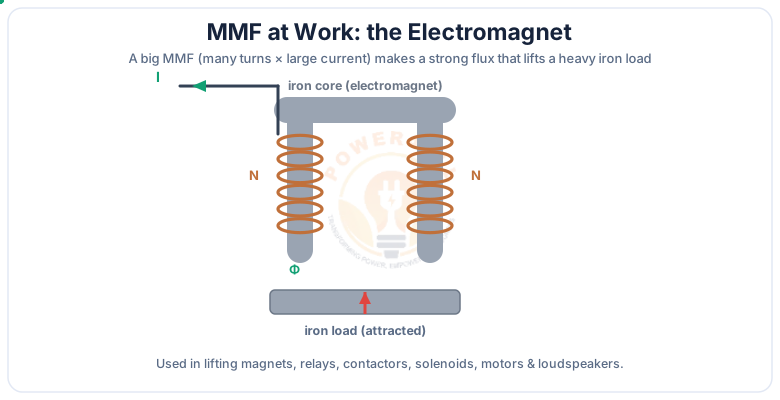
Lifting magnets
High-ampere-turn coils lift scrap steel; switch off the current and the flux collapses.
Relays & contactors
A coil's MMF pulls an armature to switch contacts — see relays.
Solenoids
MMF pulls a plunger to move valves, locks and actuators.
Transformers
Primary ampere-turns set the core flux that couples to the secondary (Faraday's law).
Motors & generators
Field windings' MMF creates the magnetic field that produces torque or EMF.
Loudspeakers
A voice-coil's changing MMF vibrates the cone to make sound.
Key Terms at a Glance
The essential MMF vocabulary students and engineers search for.
MMF (ℱ)
Magnetic drive; N·I ampere-turns.
Ampere-turn
The unit of MMF (At).
Reluctance (S)
Magnetic "resistance" (At/Wb).
Flux (Φ)
Φ = ℱ/S, in webers.
Field strength (H)
H = ℱ/l, in A/m.
Hopkinson's law
Ohm's law for magnetic circuits.
Frequently Asked Questions
Quick, clear answers to the questions people ask most about magnetomotive force.
What is magnetomotive force (MMF)?
It is the magnetic driving force that sets up flux in a magnetic circuit, just as EMF drives current in an electric circuit. It is produced by a current-carrying coil and equals the number of turns times the current. A bigger MMF pushes more flux through the magnetic path.
What is the formula for MMF?
MMF = N × I, where N is the number of turns and I the current. A 200-turn coil carrying 2 A gives 400 ampere-turns. Equivalently, MMF = H × l (field strength times mean path length).
What is the unit of magnetomotive force?
The ampere-turn (At). Since "turns" is a pure count, MMF is dimensionally just amperes, so it is sometimes written plainly in amperes. One ampere-turn is the MMF of a single turn carrying one ampere.
What is the difference between MMF and EMF?
EMF drives electric current around an electric circuit (in volts); MMF drives magnetic flux around a magnetic circuit (in ampere-turns). They are analogous: MMF↔EMF, flux↔current, reluctance↔resistance. Neither is a mechanical force despite the name.
What is the difference between MMF and field strength H?
MMF is the total drive around the whole circuit (ampere-turns); H is that drive per metre of path (A/m). They are linked by MMF = H × l, so H = N·I / l. MMF is a total; H is a per-metre intensity.
How is MMF related to flux and reluctance?
By the magnetic Ohm's law (Hopkinson's law): Φ = MMF / S. Reluctance S is the opposition of the magnetic path to flux. So for a given MMF, a lower-reluctance path carries more flux.
How do you increase the MMF of a coil?
Because MMF = N·I, either add more turns or raise the current. Both increase the ampere-turns and the flux, which is why electromagnets use many turns and a substantial current.
Is MMF a real force?
No. It is not a force in newtons. It is a driving quantity — a magnetic "pressure" or potential difference — that makes flux flow around a magnetic circuit. The word "force" is used loosely, as in "electromotive force".
What is the difference between MMF and magnetic flux?
MMF is the cause; flux is the effect. MMF is the driving force from the coil (ampere-turns); flux is the magnetic field that actually flows (webers). They are linked by Φ = MMF / S.
Where is magnetomotive force used?
In every coil-based magnetic device: electromagnets and lifting magnets, relays and contactors, solenoids, transformers, motors and generators, and loudspeakers. Designers pick the turns and current to give the MMF needed for the required flux.
Conclusion & Key Takeaways
Magnetomotive force is the driving cause behind every magnetic field a coil creates — the magnetic twin of EMF.
Magnetic "pressure"
Drives flux around a circuit.
ℱ = N·I
Ampere-turns.
Like EMF
MMF↔EMF, flux↔current.
Φ = ℱ/S
Flux from reluctance.
H = ℱ/l
Drive per metre.
More N or I
Raises MMF & flux.