What are Charge Carriers?
The mobile charges that actually carry current — free electrons and holes in semiconductors, electrons in metals, and ions in electrolytes. Learn how holes move, majority vs minority carriers, carrier concentration, drift & diffusion, and how pairs are generated and recombine.
Complete Learning Path — Charge Carriers
From what charge carriers are and how holes move, to majority/minority carriers, concentration, drift & diffusion, generation and carriers in different materials
What are Charge Carriers?
Charge carriers are the mobile charged particles that actually carry electric current through a material. Current is simply charge carriers on the move. Which particle does the carrying depends on the material.
In a semiconductor there are two: free electrons (negative) and holes (effectively positive). They drift in opposite directions under a field, and both add to the current.
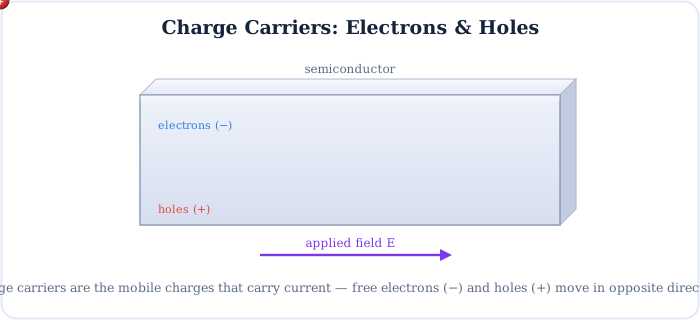
No carriers, no current
A material conducts only if it has mobile charge carriers. Metals have plenty (free electrons); insulators have almost none; semiconductors have a controllable number — which is what makes them so useful.
How a Hole Moves
A hole is a missing electron in a bond — a vacancy that behaves like a mobile positive charge. It "moves" because neighbouring electrons keep hopping in to fill it.
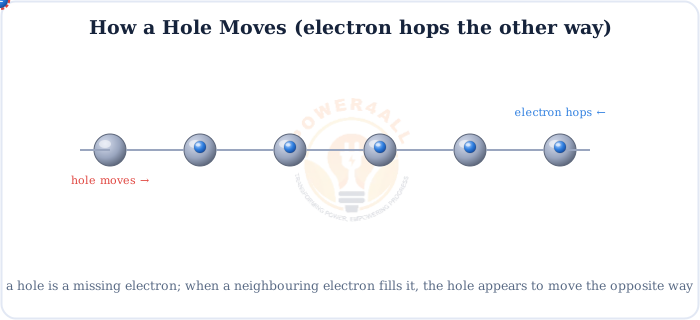
A useful bookkeeping trick
Rather than track millions of electrons shuffling in a nearly-full band, physics tracks the few empty spots as positive "holes" — far simpler, and it correctly predicts the current.
Majority & Minority Carriers
Doping decides which carrier dominates. The more numerous type is the majority carrier; the scarcer type is the minority carrier.
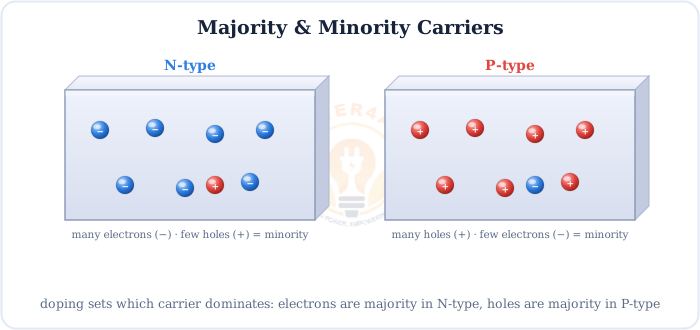
| Material | Majority carrier | Minority carrier | Dopant |
|---|---|---|---|
| N-type | Electrons (−) | Holes (+) | Pentavalent (donor) |
| P-type | Holes (+) | Electrons (−) | Trivalent (acceptor) |
| Intrinsic | Equal electrons & holes | None (pure) | |
Carrier Concentration
In a pure (intrinsic) semiconductor, electrons and holes are created in pairs, so they are equal: n = p = ni, the intrinsic carrier concentration. Doping changes the balance — but their product stays fixed.
n × p = ni²
Mass-action law: at a given temperature the electron-hole product is constant
Worked idea
If doping raises electrons (n) by 1000×, then holes (p) must fall by 1000× to keep n·p = ni². That is why one carrier becomes "majority" and the other "minority".
ni rises fast with temperature
The intrinsic concentration ni grows steeply as the material heats up (more pairs generated), which is why a semiconductor’s conductivity increases with temperature.
How Carriers Move: Drift & Diffusion
Carriers move by two mechanisms. Drift is motion driven by an applied electric field; diffusion is motion from a crowded region to an emptier one. Both create current in real devices.
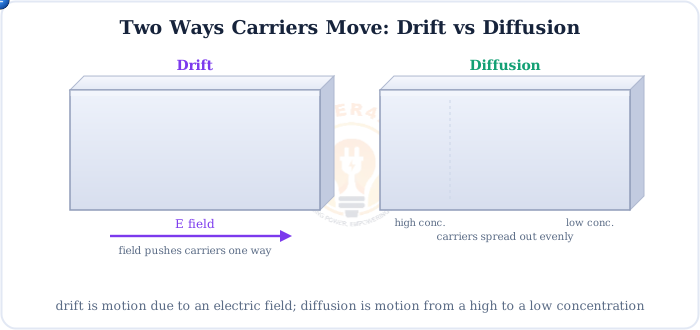
vdrift = µ × E
Drift velocity = carrier mobility (µ) × electric field (E); higher mobility means faster carriers
Both drift and diffusion currents appear together inside a PN junction and every transistor.
Generation & Recombination
Carriers are not permanent. Energy generates electron-hole pairs, and carriers continually recombine — the balance sets how many carriers exist.
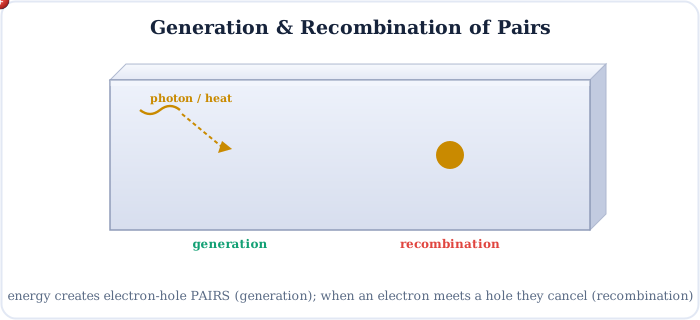
Generation
Heat or light frees an electron, creating an electron-hole pair.
Recombination
An electron falls into a hole; energy is released as heat or light (LEDs!).
Equilibrium
Generation = recombination sets the steady carrier count.
Charge Carriers in Different Materials
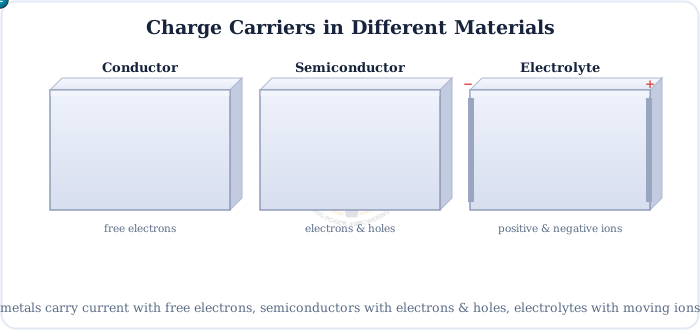
The type of carrier changes with the material — electrons, holes or ions.
| Material | Charge carriers | Example |
|---|---|---|
| Metal / conductor | Free electrons | Copper, aluminium |
| Semiconductor | Electrons & holes | Silicon, germanium |
| Electrolyte | Ions (cations & anions) | Salt water, batteries |
| Ionised gas (plasma) | Electrons & ions | Neon tube, arc |
Why Charge Carriers Matter
Controlling carriers — their type, number and motion — is what makes every semiconductor device work.
Diodes
Majority/minority carriers crossing a junction give one-way conduction.
Transistors
Injecting and controlling carriers switches and amplifies signals.
LEDs & lasers
Electron-hole recombination emits light.
Batteries & cells
Ion carriers move charge through the electrolyte.
Key Terms at a Glance
The essential charge-carrier vocabulary students search for.
Charge carrier
Mobile charge that carries current.
Free electron
Negative carrier in the conduction band.
Hole
Missing electron; acts as a positive carrier.
Majority / minority
More / fewer carrier type (by doping).
Drift & diffusion
Field-driven vs concentration-driven motion.
Mobility (µ)
How fast a carrier drifts per unit field.
Frequently Asked Questions
Quick, expert answers to the questions people ask most about charge carriers.
What are charge carriers in simple words?
They are the tiny charged particles that move to carry electric current — free electrons in metals, electrons and holes in semiconductors, and ions in liquids like salt water.
What are the charge carriers in a semiconductor?
Two types: free electrons (negative) and holes (positive). Both move and both add to the current.
How does a hole move?
A hole is a missing electron. When a neighbouring electron hops in to fill it, the vacancy shifts the other way — so the hole appears to move, carrying positive charge opposite to the electrons.
What are majority and minority carriers?
Majority = the more numerous type set by doping; minority = the fewer type. N-type: electrons majority, holes minority. P-type: holes majority, electrons minority.
What is the mass-action law?
n × p = ni² at a fixed temperature. Raising one carrier concentration by doping lowers the other, keeping the product constant.
What is the difference between drift and diffusion?
Drift is carrier motion caused by an electric field; diffusion is carrier motion from high to low concentration. Both produce current in diodes and transistors.
What are generation and recombination?
Generation creates an electron-hole pair when energy frees an electron; recombination is when a free electron falls into a hole, both vanishing and releasing energy (as heat or light).
What carries current in metals and electrolytes?
Metals: free electrons. Electrolytes: ions — positive cations move to the negative electrode and negative anions to the positive electrode.
Conclusion & Key Takeaways
Current is charge carriers in motion — and knowing which carriers exist, how many, and how they move explains every material and device.
Carriers = mobile charge
Electrons, holes, ions.
Holes act positive
Move opposite to electrons.
Majority vs minority
Set by doping.
n·p = ni²
Mass-action law.
Drift & diffusion
Two ways to move.
Generate & recombine
Pairs created & cancelled.