Coulomb's Law
The complete guide to Coulomb's law — the force between two electric charges. From the formula F = k q1q2/r2 and the Coulomb constant, to why like charges repel, the inverse-square law, superposition, and the link to the electric field.
Complete Learning Path — Coulomb's Law
From the force between charges and the formula, to the inverse-square law, superposition and the electric field
What is Coulomb's Law?
Coulomb's law gives the electrostatic force between two point charges. The force is bigger for bigger charges and much smaller as they move apart, and it acts along the straight line joining them.
The French physicist Charles-Augustin de Coulomb measured this in the 1780s. His law is the foundation of electrostatics — it explains why capacitors store charge, how atoms hold together, and where the electric field comes from.
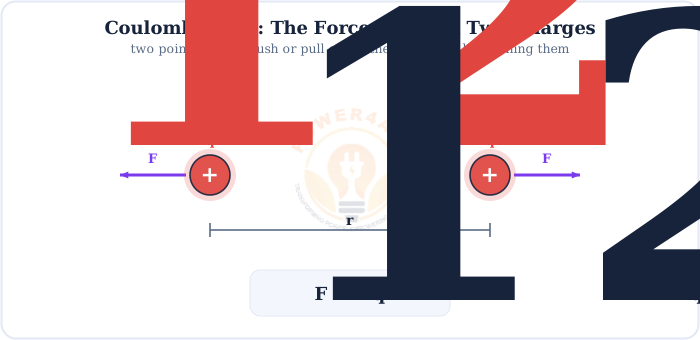
In words
The force is proportional to the product of the charges and inversely proportional to the square of the distance between them.
Like Charges Repel, Unlike Charges Attract
The signs of the charges decide the direction of the force. The rule is simple and universal.
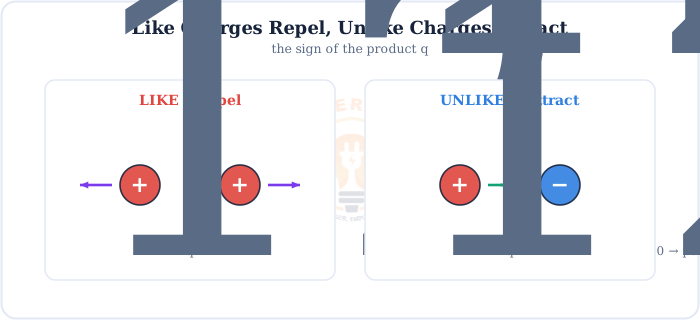
Like → repel
Two + or two − charges: q1q2 > 0, force pushes them apart.
Unlike → attract
One + and one −: q1q2 < 0, force pulls them together.
Newton's third law still holds
The two charges always feel equal and opposite forces — even if one charge is far larger than the other. Coulomb's law respects action-reaction.
The Formula & the Coulomb Constant
Everything about Coulomb's law lives in one compact equation. Here is each symbol, and a worked example.
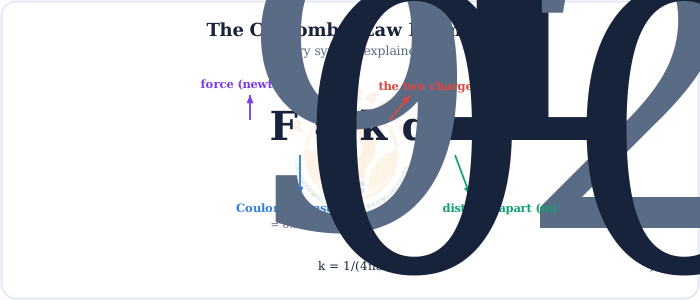
F = k q1q2 / r2 · k = 1/(4πε0) ≈ 8.99×10⁹ N·m2/C2
Force (N) from charges q (C), distance r (m) and the Coulomb constant k
Worked example
Two charges q1 = 2 µC and q2 = 3 µC sit r = 0.1 m apart.
F = 8.99×109 × (2×10−6 × 3×10−6) / (0.1)2
F = 8.99×109 × 6×10−12 / 0.01 ≈ 5.4 N (repulsive, both positive)
The Inverse-Square Law
Distance matters a lot. Because the force depends on 1/r2, moving the charges apart weakens it dramatically.
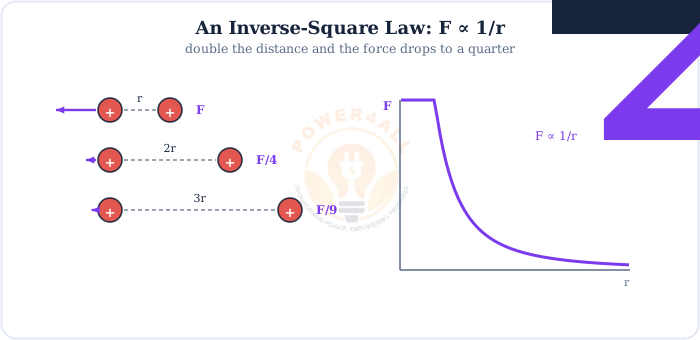
Why the square?
A charge's influence spreads out over the surface of an imaginary sphere. That surface area grows as 4πr2, so the effect is diluted by r2 — the same reason gravity and light intensity are inverse-square too.
Superposition: Many Charges at Once
Real problems have more than two charges. The superposition principle says the total force on any charge is the vector sum of the separate Coulomb forces from each other charge.

Fnet = F1 + F2 + F3 + … (vector sum)
Each force from Coulomb's law; combine by direction, not just magnitude
Because forces are vectors, two forces of 5 N do not simply make 10 N unless they point the same way — you must add their components.
From Force to the Electric Field
Coulomb's law also defines the electric field. A charge Q fills the space around it with a field, and any charge placed there feels a Coulomb force.
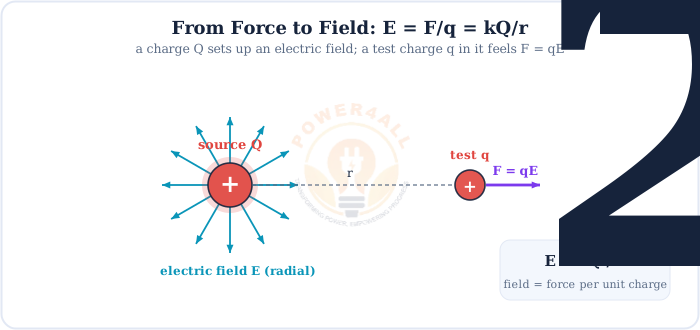
E = F / q = k Q / r2
Electric field = Coulomb force per unit charge — unit: N/C (or V/m)
This is why the field and Coulomb's law are inseparable: the field is just the force a unit charge would feel, and it too falls off as 1/r2 from a point charge. It also connects directly to potential difference, the energy side of the same picture.
Where Coulomb's Law Applies
From single atoms to industrial machines, the electrostatic force is everywhere.
Atoms & bonding
Holds electrons to nuclei and binds atoms into molecules.
Capacitors
Stored charge and the energy it holds follow from Coulomb forces.
Photocopiers & printers
Charged toner is attracted to oppositely charged paper.
Electrostatic precipitators
Charge dust and pull it from flue gas to clean the air.
Lightning & static
Built-up charge and the forces it creates, right up to a spark.
Spray painting
Charged paint droplets wrap evenly onto a grounded target.
Key Terms at a Glance
The essential Coulomb's-law vocabulary students and engineers search for.
Coulomb's law
Force between two charges.
Coulomb constant (k)
8.99×10⁹ N·m2/C2.
Point charge
Charge treated as a single point.
Inverse-square
Force ∝ 1/r2.
Permittivity (ε0)
Sets k for free space.
Superposition
Forces add as vectors.
Frequently Asked Questions
Quick, expert answers to the questions people ask most about Coulomb's law.
What is Coulomb's law?
Coulomb's law describes the electrostatic force between two point charges. The force is directly proportional to the product of the charges and inversely proportional to the square of the distance between them, and it acts along the line joining them.
What is the formula for Coulomb's law?
The formula is F = k q1 q2 / r2, where F is the force, q1 and q2 are the two charges in coulombs, r is the distance between them in metres, and k is the Coulomb constant.
What is the value of the Coulomb constant k?
The Coulomb constant k is about 8.99×10⁹ N·m2/C2. It equals 1/(4πε0), where ε0 is the permittivity of free space.
Do like charges attract or repel?
Like charges repel and unlike charges attract. If the product q1q2 is positive (both charges the same sign) the force pushes them apart; if it is negative (opposite signs) the force pulls them together.
Why is Coulomb's law an inverse-square law?
Because the force depends on 1/r2. If you double the distance between the charges, the force drops to a quarter; at three times the distance it drops to a ninth. The influence spreads over the surface of a sphere, whose area grows as r2.
What is the SI unit of charge in Coulomb's law?
Charge is measured in coulombs (C) and the resulting force in newtons (N), with distance in metres (m). One coulomb is a very large charge, so practical charges are often in microcoulombs or nanocoulombs.
How does Coulomb's law relate to the electric field?
A charge Q creates an electric field E = k Q / r2 around it. A second charge q placed in that field feels a force F = q E. So Coulomb's law and the electric field are two views of the same thing: force per unit charge times the charge.
What is the superposition principle in Coulomb's law?
When several charges act on one charge, the total force is the vector sum of the individual Coulomb forces from each other charge. You calculate each force separately and add them head to tail as vectors.
How is Coulomb's law similar to Newton's law of gravitation?
Both are inverse-square laws: force falls off as 1 over distance squared. Coulomb's law uses charge where gravity uses mass, and it can be attractive or repulsive, whereas gravity is always attractive. The electric force is also vastly stronger than gravity for the same particles.
What are the limitations of Coulomb's law?
Coulomb's law in its simple form applies to point charges (or spheres) that are stationary, in a vacuum or air. For charges in a material medium you divide by the medium's relative permittivity, and for moving charges you also need magnetic effects.
Conclusion & Key Takeaways
Coulomb's law is the rule that governs all electrostatics — one equation that sets the force between any two charges.
F = kq1q2/r2
Force between charges.
Like repel
Unlike attract.
k = 8.99×10⁹
The Coulomb constant.
Inverse-square
Falls as 1/r2.
Superposition
Forces add as vectors.
E = kQ/r2
The electric field.