What are Eddy Currents?
The swirling loop currents a changing magnetic field induces inside a solid conductor — the same effect that wastes energy in transformer cores yet powers induction cooktops and contactless brakes. Learn how eddy currents form, why they heat and brake, their losses, and how laminations tame them.
Complete Learning Path — Eddy Currents
From what eddy currents are and how they form, to Lenz’s law, heating, core losses, laminations, braking and real uses
What are Eddy Currents?
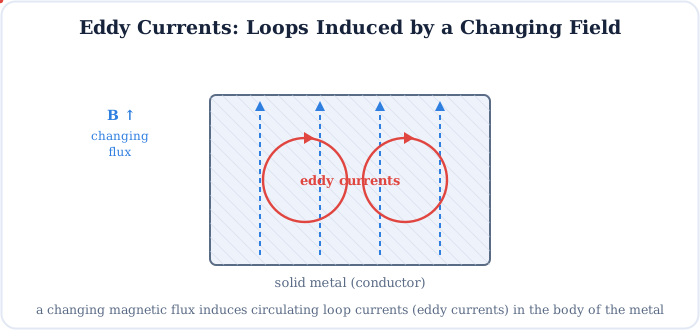
Eddy currents (also called Foucault currents) are circulating loops of electric current induced inside a solid conductor when the magnetic flux through it changes. They are named after the swirling “eddies” you see in flowing water.
Whenever a metal experiences a changing magnetic field — or moves through one — Faraday’s law induces an EMF, and because a solid block offers countless closed paths, the induced current flows in circular eddies rather than a single neat loop.
Induced, not supplied
No wires connect to the metal — eddy currents are induced purely by the changing field, exactly like the secondary current in a transformer, but flowing as loops inside the bulk material.
How Eddy Currents Form
The chain is simple: changing flux → induced EMF → circulating current. It is the same electromagnetic induction that runs generators and transformers, applied to a solid lump of metal.
EMF = − dΦ / dt
Faraday’s law — a changing magnetic flux Φ induces an EMF (the minus sign is Lenz’s law)
A changing flux appears in two common ways, both of which drive eddy currents:
Changing field
An AC current in a nearby coil makes the field rise and fall — as in cores and induction heaters.
Moving conductor
A metal moving through a steady field sees a changing flux — as in eddy-current brakes and meters.
Lenz’s Law: They Always Oppose the Change
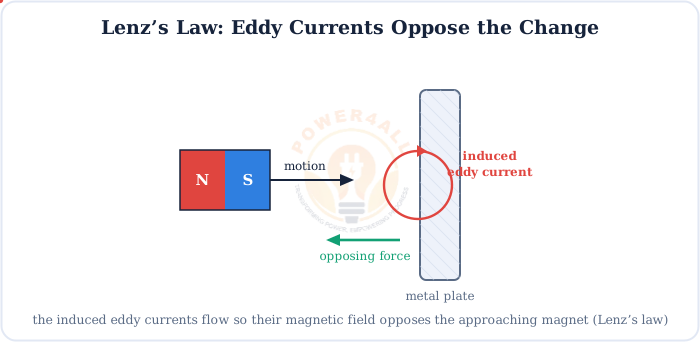
By Lenz’s law, eddy currents flow in whatever direction makes their own magnetic field oppose the change that created them. This opposition is what produces drag and braking forces.
Drop a magnet down a copper pipe
A classic demo: a magnet falls through a copper tube in slow motion. The eddy currents it induces oppose its fall, braking it — even though copper is not magnetic.
The Heating Effect (I²R Loss)
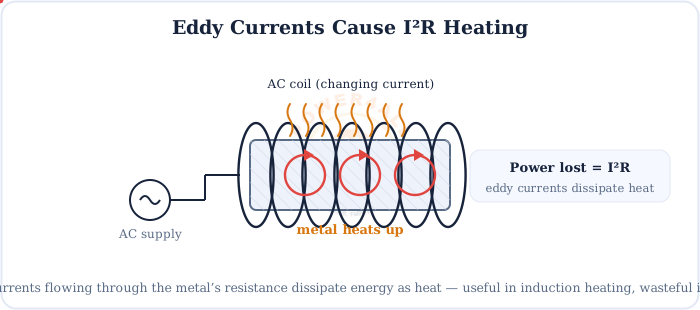
Eddy currents flow through the metal’s own resistance, so they dissipate energy as heat. This is wasteful in cores but extremely useful when heating is the goal.
Peddy = I² × R
Power dissipated by the induced eddy currents flowing through the conductor’s resistance
Eddy-Current Losses & Laminations
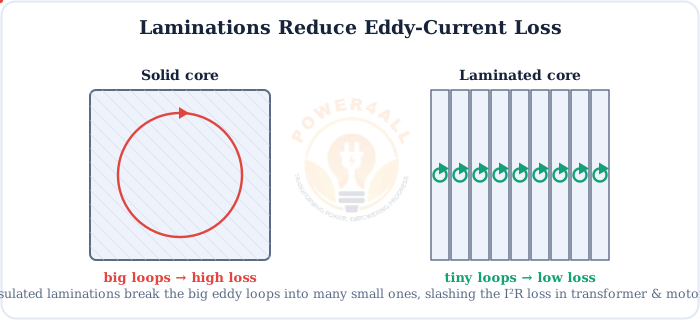
In a transformer or motor core the changing flux is wanted, but the eddy currents it induces are pure waste heat — part of the “iron losses”. The cure is laminations.
Peddy ∝ Bmax² × f² × t²
Eddy-current loss grows with the square of peak flux density B, frequency f and lamination thickness t
Why thin sheets win
Because loss depends on thickness squared, halving the lamination thickness cuts eddy loss to about a quarter. That is why cores use stacks of thin (0.3–0.5 mm) insulated silicon-steel (CRGO) sheets, not solid iron.
Eddy-Current Braking
Turn Lenz’s law into a machine: move a conductor past a magnet and the drag becomes a smooth, contactless brake with no pads to wear out.
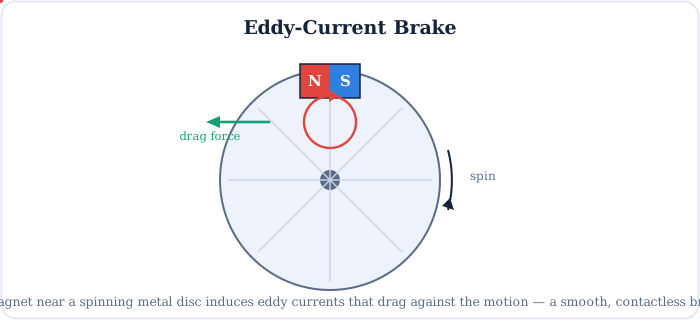
The braking force grows with speed, so eddy-current brakes are naturally smooth and self-limiting, with nothing physically touching the disc.
Applications of Eddy Currents
Once you can induce heat and force without contact, the uses are everywhere.
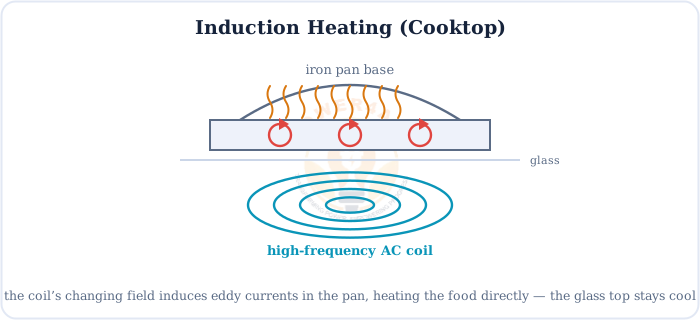
Induction heating
Cooktops, furnaces, metal hardening, brazing and sealing — fast, clean, contactless heat.
Braking & damping
Train & roller-coaster brakes, gym resistance, and damping in balances and meters.
Metal detectors
Eddy currents in hidden metal disturb the sensor coil, revealing the object.
NDT testing (ECT)
Eddy-current testing finds cracks and corrosion in metal without damaging it.
Energy meters
The classic spinning-disc meter used an eddy-current drag proportional to power.
Levitation & more
Maglev repulsion, coin validators and proximity/speed sensors all rely on eddies.
How to Reduce Eddy Currents
Where eddy currents are unwanted (cores, poles), the goal is to make the induced current small and its path resistive.
Laminate the core
Thin insulated sheets break big loops into small ones.
High resistivity
Silicon steel (CRGO) raises R, lowering the current.
Ferrite cores
At high frequency, ceramic ferrites almost eliminate eddy loss.
Thinner at high f
Higher frequency needs thinner laminations (loss ∝ f²t²).
Worked idea
Because Peddy ∝ t², replacing one 1 mm solid slab with ten 0.1 mm laminations cuts each loop’s loss by 10² = 100× per sheet — a dramatic reduction in total core loss.
Key Terms at a Glance
The essential eddy-current vocabulary students and engineers search for.
Eddy current
Induced circulating current in a conductor.
Foucault current
Another name for eddy current.
Faraday’s law
EMF = −dΦ/dt.
Lenz’s law
Induced current opposes the change.
Core / iron loss
Eddy + hysteresis loss in a core.
Lamination
Thin insulated sheet that cuts eddy loss.
Frequently Asked Questions
Quick, expert answers to the questions people ask most about eddy currents.
What are eddy currents in simple words?
They are swirling loops of current that appear inside a piece of metal when the magnetic field through it changes. The changing field induces a voltage, and the metal lets current circulate in little whirlpools — hence “eddy” currents.
What causes eddy currents?
A changing magnetic flux through a conductor — either a field that varies in time (an AC coil) or a conductor moving through a field. Faraday’s law induces the EMF that drives the loops.
Are eddy currents good or bad?
Both. Bad in cores (wasted heat = eddy-current loss) but useful in induction heating, brakes, metal detectors and non-destructive testing.
Why do eddy currents produce heat?
They flow through the resistance of the metal, dissipating power equal to I²R. In cores this is a loss; in induction cooktops and furnaces it is the whole point.
How are eddy currents reduced in a core?
Use thin insulated laminations and high-resistivity silicon steel (CRGO), or ferrite at high frequency. Laminations split the big loops into many small ones, and higher resistivity lowers the current.
What is the eddy-current loss formula?
Approximately P ∝ Bmax² f² t² — loss rises with the square of peak flux density, frequency and lamination thickness, so thin sheets and lower flux cut it sharply.
What is the difference between eddy-current and hysteresis loss?
Both are core losses. Eddy loss is from induced circulating currents (reduced by laminations); hysteresis loss is from re-magnetising the core each cycle (reduced by soft magnetic material with a narrow loop).
How does an eddy-current brake work?
A conductor moving near a magnet has eddy currents induced in it. By Lenz’s law their field opposes the motion, creating a smooth, contactless drag that grows with speed — ideal for trains and roller coasters.
Conclusion & Key Takeaways
Eddy currents are induced circulating currents — a nuisance in cores, a gift in heating and braking — and understanding them is key to efficient magnetic machines.
Induced loops
From a changing flux.
Oppose change
Lenz’s law → drag.
Cause I²R heat
Useful & wasteful.
P ∝ B²f²t²
Loss grows fast.
Laminations cut loss
Thin silicon-steel sheets.
Many uses
Heating, brakes, NDT.