What is Flux Density (B)?
The complete guide to magnetic flux density — the field packed into each unit of area, B = Φ/A in tesla — how it differs from magnetic flux, its link to field strength H through permeability, the force F = BIL that defines the tesla, and typical values from the Earth's field to MRI scanners.
Complete Learning Path — Flux Density
From what flux density is and B = Φ/A, to field strength & permeability, the force F = BIL, typical values and tesla/gauss units
What is Flux Density?
Magnetic flux density, symbol B, is the amount of magnetic flux passing through each unit of area — a measure of how concentrated the magnetic field is. Picture it as the number of field lines packed into every square metre.
It is defined as flux divided by area: B = Φ/A. Where the field lines crowd together, B is high; where they spread out, B is low. Flux density is measured in tesla (T), and it is what most people loosely call the “strength” of a magnetic field.
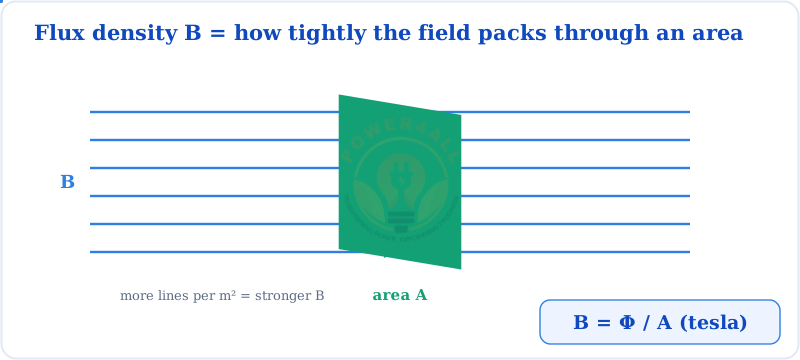
Flux density is a "per area" quantity
Magnetic flux Φ (weber) is the total field through an area; flux density B (tesla) is that field per unit area. Same flux, smaller area, bigger B.
B = Φ/A — Area is Everything
Because flux density is flux per area, the same amount of flux gives very different B values depending on how big an area it passes through.
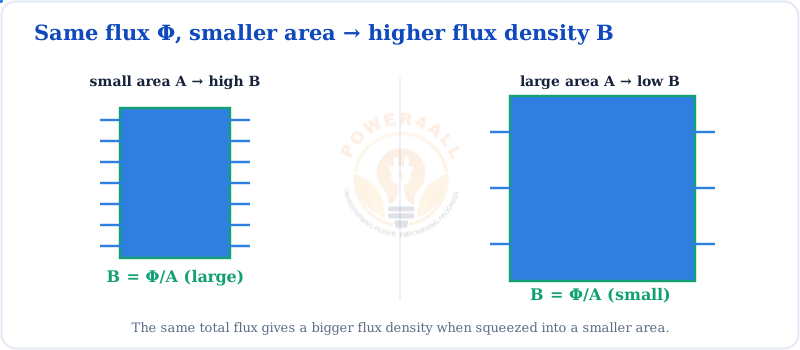
B = Φ / A • Φ = B · A
Flux density = flux ÷ area (tesla); rearranged, flux = flux density × area
Worked example — flux density in a core
A magnetic flux of Φ = 0.006 Wb passes through a core of cross-section A = 0.003 m²:
B = Φ/A = 0.006 / 0.003 = 2 T
Halve the core area to 0.0015 m² and the flux density doubles to 4 T — which may push the iron into saturation.
Flux Density B vs Field Strength H
Flux density B is often confused with the magnetic field strength H. H (in amp/metre) is the magnetizing field you apply; B (in tesla) is the field you get. They are joined by permeability.
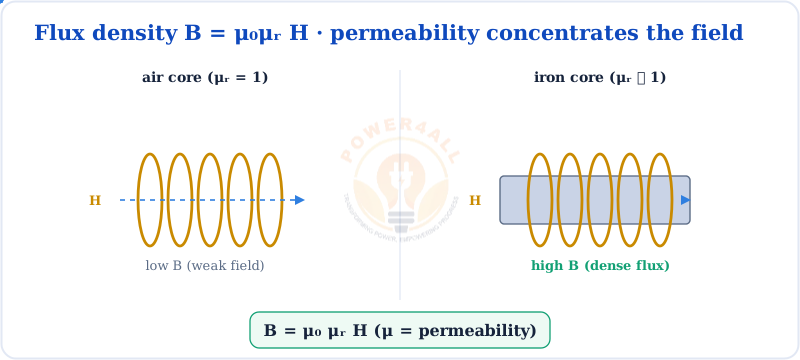
B = μ₀ · μᵣ · H
Flux density = permeability of free space × relative permeability × field strength
Why cores use iron
A ferromagnetic core can have a relative permeability μr of hundreds or thousands, so it multiplies the flux density enormously for the same current — the reason transformers and inductors use iron or ferrite cores.
The Physical Meaning: Force F = BIL
Flux density is not just a picture — it has a direct force meaning. A wire of length L carrying current I in a field B feels a force F = BIL. This is what actually defines the tesla.
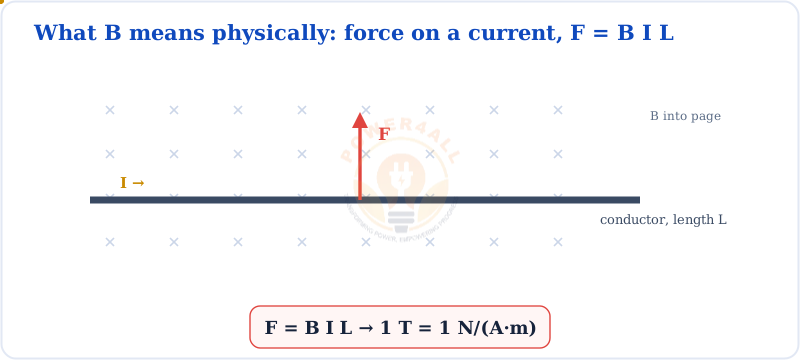
F = B I L → 1 T = 1 N/(A·m)
Force on a current-carrying conductor — the definition of one tesla
Force on a moving charge too
A single charge q moving at speed v across the field feels F = qvB. Both laws show B as the “force per unit current” that a field exerts — the essence of motors and loudspeakers.
Typical Flux Density Values
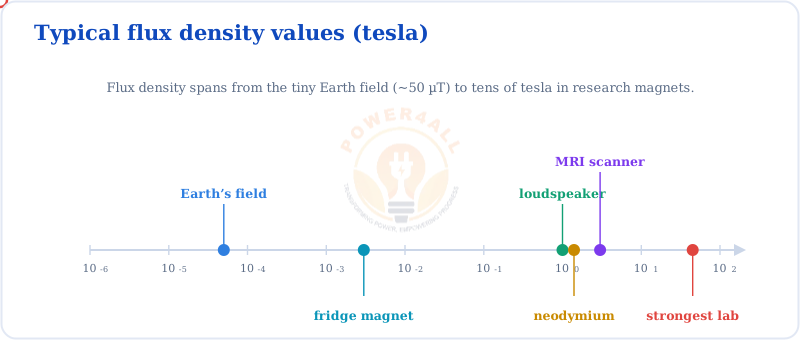
Flux density spans an enormous range — from the faint field of the Earth to the intense fields inside research magnets.
| Source | Flux density B | In gauss |
|---|---|---|
| Earth's magnetic field | ~50 µT | ~0.5 G |
| Fridge magnet | ~5 mT | ~50 G |
| Loudspeaker gap | ~1 T | ~10 000 G |
| Neodymium magnet surface | ~1.4 T | ~14 000 G |
| MRI scanner | 1.5–3 T | 15 000–30 000 G |
| Strongest lab magnets | up to ~45 T | ~450 000 G |
Tesla, Gauss and the Weber
Flux density has one SI unit — the tesla — but you will still meet the older gauss on magnet data sheets.
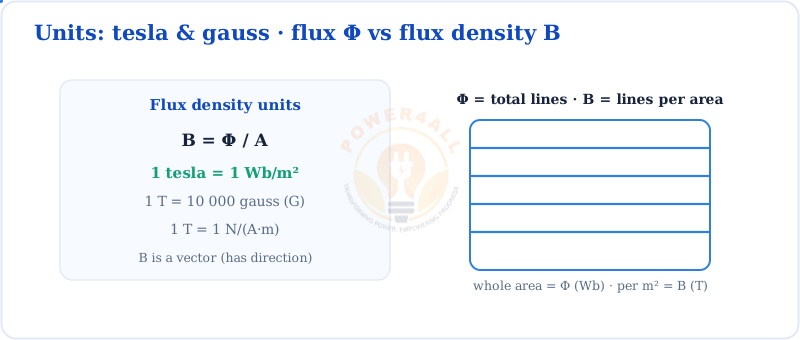
1 T = 1 Wb/m² = 10 000 G = 1 N/(A·m)
The tesla tied to flux-area, to gauss, and to the force law
B is a vector
Flux density has a direction as well as a magnitude — it points along the field lines. That is why flux uses the dot product: Φ = B·A·cosθ.
Where Flux Density Matters
Flux density is the number engineers design around — too little wastes the core, too much saturates it.
Transformer & motor cores
Cores are sized so the peak B stays below saturation (~1.5–1.8 T for silicon steel) to avoid loss and distortion.
Magnet design
Data sheets quote remanent flux density Br in tesla or gauss to rate a permanent magnet's strength.
Sensors & MRI
Hall sensors read B directly; MRI needs a very high, uniform B to image the body.
Saturation limits
Push B too high and the core saturates — inductance collapses and current spikes, a key design constraint.
Flux density links the whole magnetic chain
Current sets H (Ampère's law), the core turns H into B via permeability, and a changing B drives voltage (Faraday's law). B sits right in the middle.
Key Terms at a Glance
The essential flux-density vocabulary students and engineers search for.
Flux density (B)
Flux per area; B = Φ/A, in tesla.
Tesla (T)
1 T = 1 Wb/m² = 10 000 G.
Gauss (G)
CGS unit; 1 T = 10 000 G.
Field strength (H)
Applied field, A/m; B = μ₀μᵣH.
Permeability (μ)
Links H to B; big for iron.
Saturation
Where extra H no longer raises B much.
Frequently Asked Questions
Quick, expert answers to the questions people ask most about flux density.
What is magnetic flux density in simple words?
It is how concentrated a magnetic field is — the flux passing through each unit of area: B = Φ/A. More field lines per square metre means a higher flux density. It is measured in tesla (T).
What is the formula for flux density?
B = Φ / A, where Φ is the flux in webers and A is the area in m². So B is in webers per square metre, which is the tesla.
What is the unit of magnetic flux density?
The tesla (T). 1 T = 1 Wb/m² = 10 000 gauss = 1 N/(A·m). The last form comes from the force law F = BIL.
What is the difference between magnetic flux and flux density?
Magnetic flux (Φ, webers) is the total field through an area; flux density (B, tesla) is the flux per unit area, B = Φ/A. Same flux in a smaller area gives a higher B.
What is the difference between B and H?
H (amp/metre) is the magnetizing field you apply; B (tesla) is the resulting flux density in the material. They are linked by permeability: B = μ₀μᵣH. A high-permeability core gives a much larger B for the same H.
How does flux density define the tesla?
A wire of length L carrying current I in a field B feels a force F = BIL. So one tesla is the flux density that makes a 1 m wire carrying 1 A feel 1 N: 1 T = 1 N/(A·m).
How many gauss are in a tesla?
One tesla equals 10 000 gauss. The Earth's field is about 0.5 gauss (~50 µT), while a strong neodymium magnet is around 14 000 gauss (~1.4 T).
What is saturation flux density?
It is the maximum flux density a magnetic material can reach — beyond it, extra field strength H barely raises B. For silicon steel it is roughly 1.5–1.8 T, a key limit in transformer and inductor design.
Conclusion & Key Takeaways
Flux density B is the magnetic field per unit area, B = Φ/A, measured in tesla. It links flux, field strength and force, and it is the number every magnetic design revolves around.
B = Φ/A
Flux per unit area.
Unit: tesla
1 T = 1 Wb/m² = 10 000 G.
B = μ₀μᵣH
Permeability links H to B.
F = BIL
Defines the tesla; runs motors.
Huge range
50 µT (Earth) to 45 T (lab).
Watch saturation
Cores limited to ~1.5–1.8 T.