Forward & Reverse Bias
The complete guide to biasing a PN-junction diode — how forward bias makes it conduct and reverse bias makes it block. From the depletion region and 0.7 V knee voltage to the full I-V characteristic curve.
Complete Learning Path — Forward & Reverse Bias
From what biasing is, through forward and reverse bias, to the I-V curve, knee voltage, a full comparison and applications
What is Biasing?
Biasing means applying an external DC voltage across a diode to control its depletion region. The direction of that voltage decides everything: a diode is a one-way valve — it conducts one way and blocks the other.
Connect the supply one way (forward bias) and the diode conducts like a closed switch. Reverse the connection (reverse bias) and it blocks like an open switch. This single behaviour is the foundation of rectifiers, logic, and every semiconductor device.
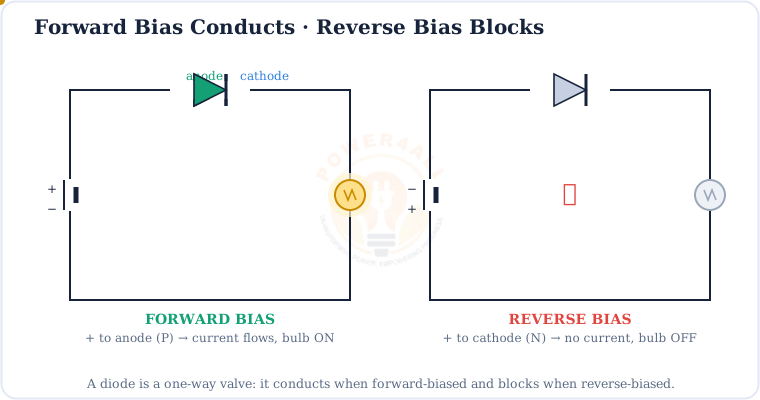
Anode and cathode
The anode is the P side, the cathode the N side (marked by the band on the body). Current flows anode→cathode only — in the direction of the diode’s arrow.
Forward Bias: the Diode Conducts
In forward bias the battery’s + goes to the P side (anode) and − to the N side (cathode). This applied voltage opposes the built-in barrier, so the depletion region narrows and the barrier falls.
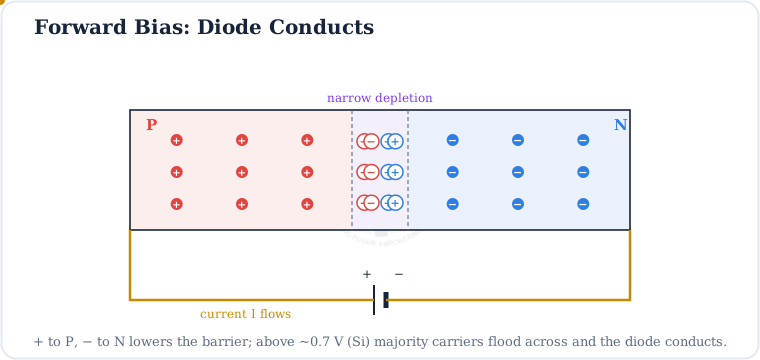
IF = (VS − Vknee) / R (simple series circuit)
Once VS > ~0.7 V (Si), current is limited mainly by the series resistor
Worked example
A silicon diode, 5 V supply, 1 kΩ series resistor:
IF = (5 − 0.7) / 1000 = 4.3 mA. The diode drops ~0.7 V; the resistor takes the rest.
Reverse Bias: the Diode Blocks
In reverse bias the battery’s + goes to the N side (cathode) and − to the P side (anode). Now the applied voltage adds to the barrier, so the depletion region widens and the barrier rises.
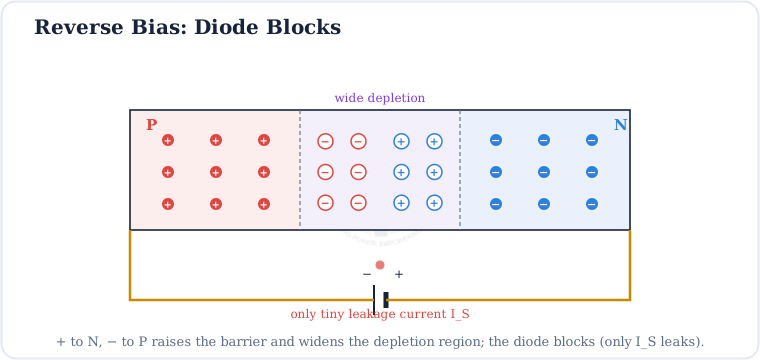
Reverse breakdown
Beyond the breakdown voltage the diode suddenly conducts in reverse (avalanche or Zener effect). It is destructive for ordinary diodes but deliberately used in Zener diodes for voltage regulation.
The Diode I-V Characteristic
Plot current against voltage and the whole story appears in one curve — the diode’s I-V characteristic.
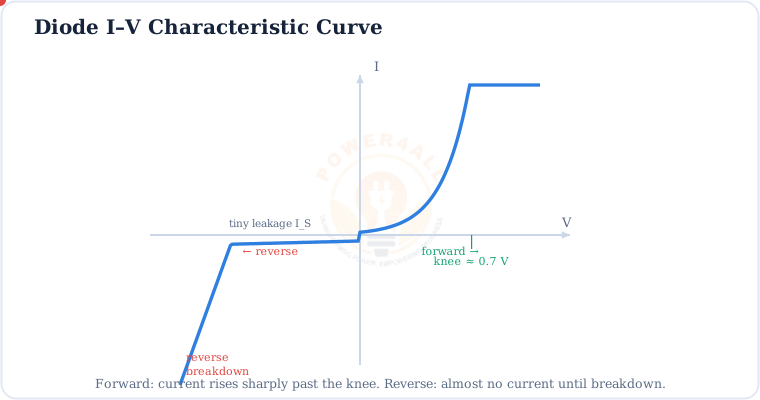
I = IS(eV/nVT − 1) (Shockley diode equation)
VT ≈ 26 mV at room temperature; n is the ideality factor (1–2)
The four regions
1) Forward below knee (small I) · 2) Forward above knee (large I) · 3) Reverse (tiny leakage) · 4) Reverse breakdown (large reverse I).
Knee / Threshold Voltage (Si vs Ge)
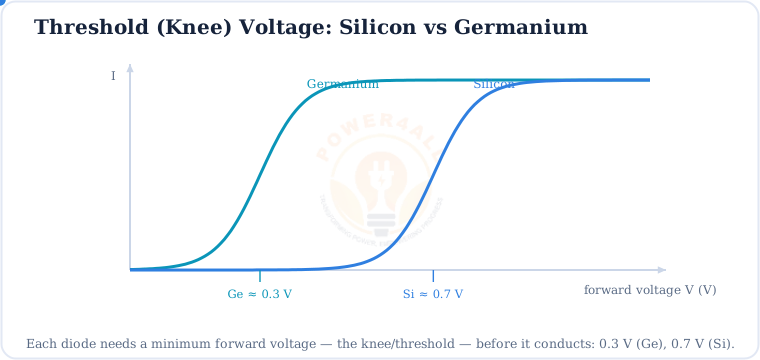
Every diode needs a minimum forward voltage — the knee, threshold or cut-in voltage — before it conducts properly. It equals the junction barrier potential.
| Material | Knee voltage | Notes |
|---|---|---|
| Silicon (Si) | ≈ 0.7 V | Most common; lower leakage |
| Germanium (Ge) | ≈ 0.3 V | Lower drop; higher leakage |
| Schottky | ≈ 0.2–0.4 V | Very fast, low drop |
| LED | ≈ 1.8–3.3 V | Depends on colour |
Forward vs Reverse Bias
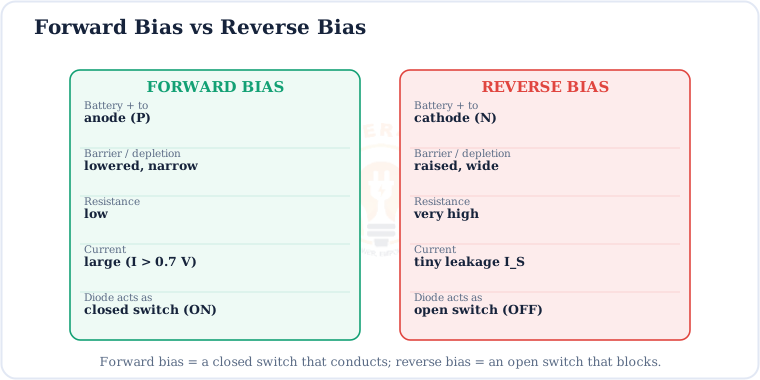
Same diode, opposite behaviour. This side-by-side is the summary to remember.
Memory aid
“P to +, current flows.” If the P side (anode) is at the higher potential, the diode is forward-biased and conducts.
Where Biasing Is Used
Controlling when a junction conducts is the basis of countless circuits.
Rectifiers
Diodes conduct only on forward half-cycles to turn AC into DC in every rectifier.
Protection
Reverse-biased diodes block wrong polarity and clamp inductive spikes (flyback).
LEDs
Forward-biased LEDs emit light above their threshold voltage.
Zener regulation
A reverse-biased Zener in breakdown holds a steady voltage.
Clippers & clampers
Bias sets the level where a diode starts to conduct and reshape a signal.
Transistor biasing
BJT junctions are biased (forward B-E, reverse B-C) to set the operating point.
Key Terms at a Glance
The essential biasing vocabulary students and engineers search for.
Bias
External DC voltage across a diode.
Forward bias
+ to anode (P); conducts.
Reverse bias
+ to cathode (N); blocks.
Knee voltage
Turn-on: 0.7 V (Si), 0.3 V (Ge).
I-V characteristic
Current vs voltage curve.
Leakage current IS
Tiny reverse current.
Breakdown
Reverse conduction (avalanche/Zener).
Anode / cathode
P side / N side of the diode.
Frequently Asked Questions
Quick, expert answers to the questions people ask most about forward and reverse bias.
What is forward and reverse bias in simple words?
Forward bias means connecting the battery so the diode conducts (+ to the anode); reverse bias means connecting it the other way so the diode blocks (+ to the cathode). A diode only lets current through one way.
Which way does current flow through a diode?
Only from anode to cathode — the direction the diode symbol’s triangle points — and only when forward-biased above the knee voltage.
What is the knee (threshold) voltage?
The minimum forward voltage to start real conduction: about 0.7 V for silicon and 0.3 V for germanium. Below it, only a tiny current flows.
What is the difference between forward and reverse bias?
Forward: + to anode, barrier low, depletion narrow, low resistance, large current, acts as a closed switch. Reverse: + to cathode, barrier high, depletion wide, very high resistance, only leakage, acts as an open switch.
Does a reverse-biased diode carry any current?
Only a tiny reverse saturation (leakage) current, from thermally generated minority carriers — typically nanoamps to microamps, roughly doubling every 10°C.
How do I calculate the current in a forward-biased diode circuit?
Subtract the diode drop from the supply and divide by the series resistor: I = (VS − 0.7) / R for silicon. E.g. 5 V, 1 kΩ → 4.3 mA.
What is reverse breakdown?
At a high enough reverse voltage the diode suddenly conducts in reverse (avalanche or Zener). Ordinary diodes can be damaged; Zener diodes use it on purpose to regulate voltage.
Why is a diode called a one-way switch?
Because forward bias makes it a low-resistance closed switch and reverse bias makes it a high-resistance open switch — it passes current in only one direction.
Conclusion & Key Takeaways
Bias direction decides whether a diode conducts or blocks — the one-way behaviour behind all diode circuits.
+ to anode → ON
Forward bias conducts.
+ to cathode → OFF
Reverse bias blocks.
Knee 0.7/0.3 V
Si / Ge turn-on.
Reverse = leakage
Tiny IS until breakdown.
I-V curve
Knee, leakage, breakdown.
One-way switch
Closed vs open.