Reluctance & Permeance
The complete guide to reluctance — a magnetic circuit's resistance to flux — and its inverse, permeance. From the formula ℛ = ℓ/(μA) and the magnetic Ohm's law MMF = Φ×ℛ, to series & parallel reluctance, air gaps and permeability.
Complete Learning Path — Reluctance & Permeance
From the magnetic circuit and the formula, to the magnetic Ohm's law, permeance, air gaps and permeability
What is Reluctance?
Reluctance (ℛ) is a magnetic circuit's opposition to magnetic flux — the magnetic twin of electrical resistance. A magnetomotive force (MMF) tries to push flux around a core; reluctance is what holds it back.
When a coil of N turns carries a current I, it produces an MMF of N·I ampere-turns. That MMF drives a flux Φ around the magnetic path, and the reluctance decides how much flux you get for a given MMF.
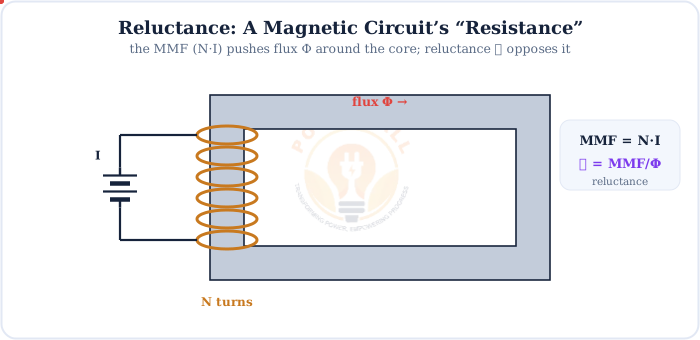
The magnetic version of resistance
Just as resistance opposes current in a wire, reluctance opposes flux in a core. Low reluctance = flux flows easily; high reluctance = it takes a lot of MMF to make flux.
The Reluctance Formula
Reluctance depends on the shape of the magnetic path and the material it is made of — longer paths raise it, wider areas and better materials lower it.
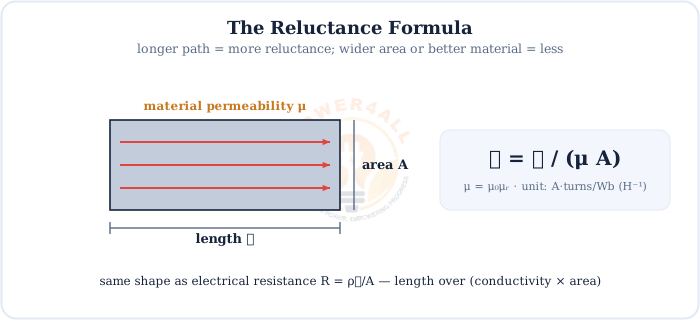
ℛ = ℓ / (μ A) · μ = μ0μr
ℓ = path length, A = cross-section area, μ = permeability — unit: ampere-turns per weber (H−1)
Worked example
An iron core has mean path ℓ = 0.5 m, area A = 0.001 m2, relative permeability μr = 2000.
μ = 4π×10−7 × 2000 = 2.51×10⁻³
ℛ = 0.5 / (2.51×10−3 × 0.001) ≈ 1.99×10⁵ A·t/Wb
The Magnetic Ohm's Law (Hopkinson's Law)
Reluctance, MMF and flux obey a relationship identical in form to Ohm's law. This is Hopkinson's law, the magnetic Ohm's law.
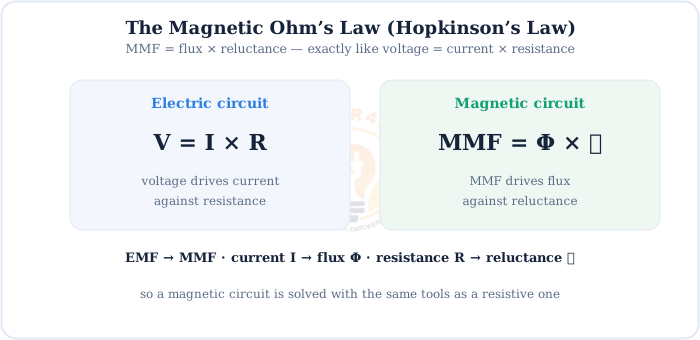
MMF = Φ × ℛ → Φ = MMF / ℛ = N·I / ℛ
The flux equals the MMF divided by the reluctance
Continuing the example
The core above is wound with N = 500 turns carrying I = 2 A, so MMF = 500 × 2 = 1000 A·t.
Φ = MMF/ℛ = 1000 / (1.99×10⁵) ≈ 5.0×10⁻³ Wb = 5 mWb
Permeance: The Ease of Flux
Permeance (P) is simply the reciprocal of reluctance — a measure of how easily flux passes, the way conductance measures how easily current flows.
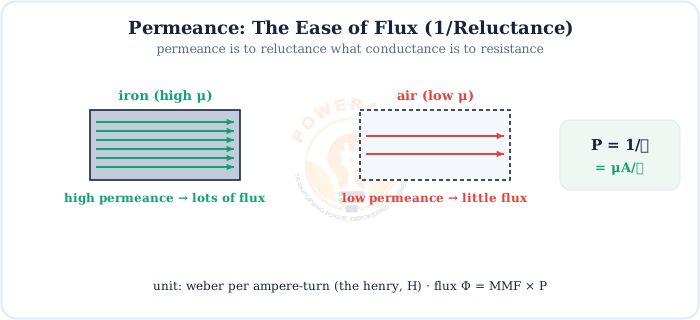
P = 1 / ℛ = μ A / ℓ · Φ = MMF × P
Permeance is the flux per unit MMF — unit: the henry (Wb per ampere-turn)
The full analogy of "ease" and "opposition"
Reluctance : resistance :: permeance : conductance. High permeance is a wide, welcoming path for flux; high reluctance is a narrow, obstructed one.
Series, Parallel & the Air Gap
Because a magnetic circuit follows Ohm's-law rules, reluctances combine exactly like resistances — and this is where the notorious air gap comes in.
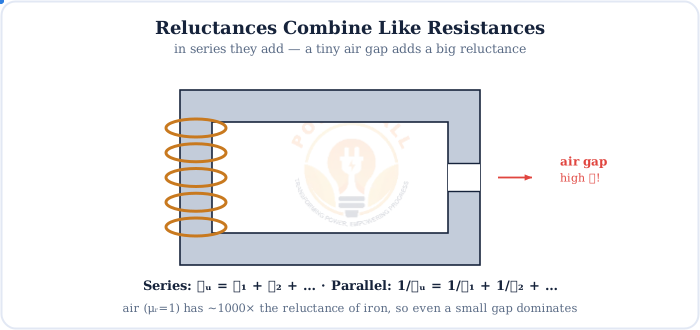
Series: ℛtotal = ℛ1 + ℛ2 + … · Parallel: 1/ℛtotal = 1/ℛ1 + 1/ℛ2 + …
The same combination rules as resistors
Why designers add a gap on purpose
A controlled air gap dominates the reluctance, which makes an inductor's value depend mainly on the gap (stable and predictable) and stops the core saturating under high current. The gap trades some efficiency for control.
Permeability Sets the Reluctance
The material property behind it all is permeability μ. A higher permeability means a lower reluctance — which is why cores are built from special magnetic materials.
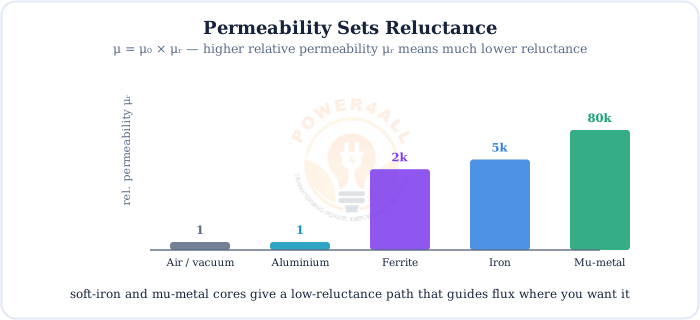
μ = μ0 × μr · μ0 = 4π×10−7 H/m
Absolute permeability = free-space permeability × the material's relative permeability
Soft-magnetic cores guide the flux
Soft iron, silicon steel, ferrite and mu-metal offer a low-reluctance path that concentrates and steers flux where it is wanted — the heart of every transformer and motor. (Note: real cores also show saturation, where μr falls at high flux.)
Where Reluctance Matters
Reluctance is the working language of magnetic-circuit design.
Transformers
Low-reluctance cores link the windings so almost all flux is shared.
Inductors
A gapped core sets a stable inductance and avoids saturation.
Motors & generators
The rotor-stator air gap is a designed reluctance in the magnetic path.
Relays & solenoids
Moving an armature changes the gap, and the force follows the reluctance change.
Reluctance motors
Torque comes purely from the rotor seeking the minimum-reluctance position.
Magnetic shielding
High-permeability mu-metal offers flux an easy path around a shielded region.
Key Terms at a Glance
The essential reluctance and permeance vocabulary students and engineers search for.
Reluctance (ℛ)
Opposition to flux; ℓ/μA.
Permeance (P)
Ease of flux; 1/ℛ.
MMF
Magnetomotive force N·I.
Hopkinson's law
MMF = Φℛ.
Permeability (μ)
μ0μr; carries flux.
Air gap
A high-reluctance break in a core.
Frequently Asked Questions
Quick, expert answers to the questions people ask most about reluctance and permeance.
What is reluctance?
Reluctance is a magnetic circuit's opposition to magnetic flux — the magnetic equivalent of electrical resistance. A high reluctance means it is hard to establish flux for a given magnetomotive force; a low reluctance means flux flows easily.
What is the formula for reluctance?
Reluctance ℛ = ℓ/(μ A), where ℓ is the length of the magnetic path, A is the cross-sectional area, and μ is the permeability of the material (μ = μ0 × relative permeability). It is the same shape as electrical resistance R = ρℓ/A.
What is the unit of reluctance?
Reluctance is measured in ampere-turns per weber (A·t/Wb), which is the same as the inverse henry (H−1). It expresses how much magnetomotive force is needed to drive one weber of flux.
What is permeance?
Permeance is the reciprocal of reluctance, P = 1/ℛ = μ A/ℓ. It measures the ease with which magnetic flux can pass, just as conductance is the ease of current flow. Its unit is the henry (weber per ampere-turn).
What is the magnetic Ohm's law?
The magnetic Ohm's law, or Hopkinson's law, states that magnetomotive force equals flux times reluctance: MMF = Φ × ℛ. It mirrors electrical Ohm's law V = I × R, with MMF like voltage, flux like current and reluctance like resistance.
How is reluctance like electrical resistance?
Both oppose a flow: resistance opposes current, reluctance opposes flux. Both follow the same formula shape (length over the product of a material property and area), obey an Ohm's-law relationship, and combine in series and parallel by the same rules.
Why does an air gap increase reluctance so much?
Air has a relative permeability of about 1, while iron can be thousands. Since reluctance is inversely proportional to permeability, even a millimetre of air gap can add more reluctance than the entire iron path, dominating the magnetic circuit.
How do reluctances combine in series and parallel?
Exactly like resistances. In series the reluctances add: ℛtotal = ℛ1 + ℛ2 + … In parallel the reciprocals add: 1/ℛtotal = 1/ℛ1 + 1/ℛ2 + … So an air gap in series with an iron core adds to the core's reluctance.
What is permeability and how does it affect reluctance?
Permeability μ measures how easily a material carries magnetic flux, written μ = μ0 × μr. A higher permeability gives a lower reluctance, which is why cores are made of soft iron, ferrite or mu-metal to guide flux with little opposition.
Where is reluctance important?
Reluctance is central to designing transformers, inductors, motors, generators, relays and magnetic sensors. Engineers minimise reluctance to concentrate flux, or use a controlled air gap to set inductance and avoid saturation.
Conclusion & Key Takeaways
Reluctance turns a magnetic circuit into an Ohm's-law problem — and permeance is just the same idea seen the other way round.
ℛ = ℓ/μA
Opposition to flux.
MMF = Φℛ
The magnetic Ohm's law.
P = 1/ℛ
Permeance = ease of flux.
Combine like R
Series add, parallel reciprocal.
Air gap dominates
Low μ = huge reluctance.
High μ = low ℛ
Cores guide the flux.