What is Watt's Law (the Power Law)?
The complete guide to Watt's Law — power equals voltage times current, P = V × I — plus the two forms it gains from Ohm's law, P = I²R and P = V²/R, the power triangle, the 12-formula power wheel, and why power climbs with the square of current.
Complete Learning Path — Watt's Law
From P = V × I and the power triangle, to the three forms, the power wheel, square-law heating, Watt's vs Ohm's law and real applications
What is Watt's Law?
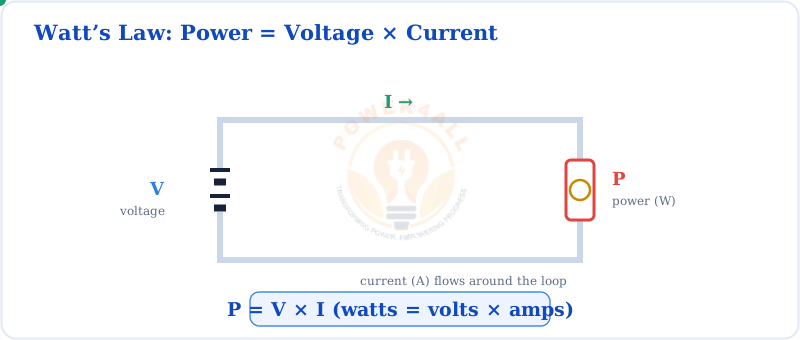
Watt's Law — also called the power law — says that electrical power equals voltage multiplied by current: P = V × I. It tells you how fast electrical energy is delivered or used.
Power is measured in watts (W), named after James Watt. One watt is one volt pushing one amp: 1 W = 1 V × 1 A. So a device on 12 V drawing 2 A uses 24 W. Watt's Law is the partner of Ohm's Law — together they let you find every electrical quantity in a circuit.
Watt's Law vs Ohm's Law
Ohm's Law links V, I and R (V = I × R). Watt's Law links power to V and I (P = V × I). Combine the two and you can solve for any quantity from any other two.
The Power Triangle
The power triangle is the quickest way to rearrange P = V × I. Put P on top and V and I along the bottom, then simply cover the quantity you want.
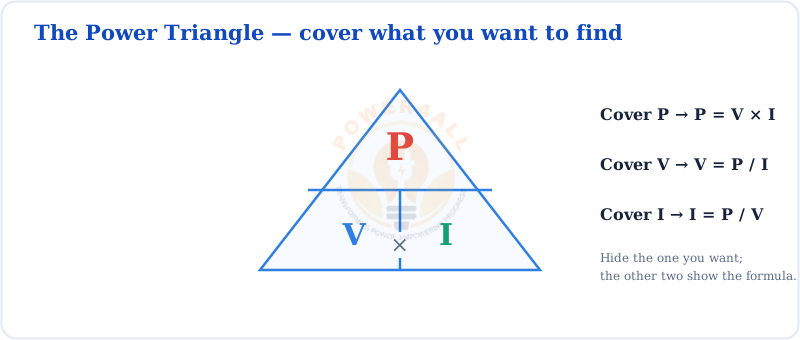
P = V × I • V = P / I • I = P / V
The three rearrangements of Watt's Law from the power triangle
Worked example — find the current a bulb draws
A 60 W bulb runs on 240 V mains. Cover I in the triangle to get I = P / V:
I = 60 / 240 = 0.25 A
So the bulb draws a quarter of an amp — handy for choosing a fuse or cable.
The Three Forms of the Power Formula
Watt's Law by itself needs voltage and current. But you often know a resistance instead. Substituting Ohm's Law (V = I × R) gives two more forms.
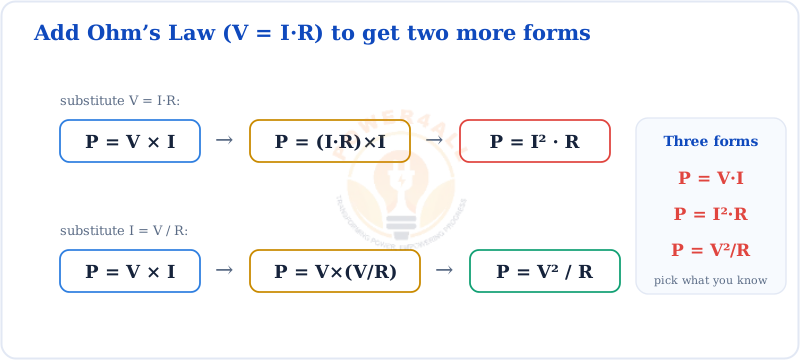
P = V × I = I² × R = V² / R
The three equivalent power formulas — pick the one using the two quantities you know
| You know… | Use this form | Example |
|---|---|---|
| Voltage & current | P = V × I | 12 V, 2 A → 24 W |
| Current & resistance | P = I² × R | 2 A, 10 Ω → 40 W |
| Voltage & resistance | P = V² / R | 12 V, 6 Ω → 24 W |
Same answer, different route
All three forms give identical power for a given circuit — they are just algebraic rearrangements. Choose whichever uses the values you already have.
The Power Wheel (12 Formulas)
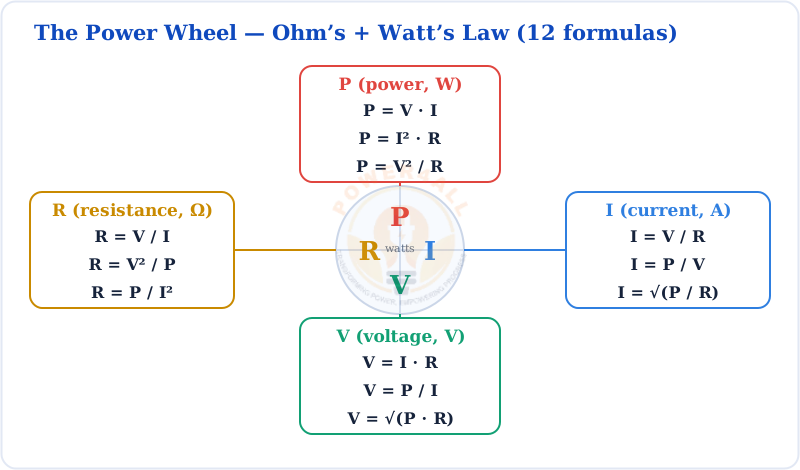
Combine Watt's Law with Ohm's Law and you get the famous power wheel — a single chart with twelve formulas for P, I, V and R. Know any two, and the wheel gives you the other two.
Power (P)
P = V·I = I²R = V²/R
Current (I)
I = V/R = P/V = √(P/R)
Voltage (V)
V = I·R = P/I = √(P·R)
Resistance (R)
R = V/I = V²/P = P/I²
Why Power Scales with the Square of Current
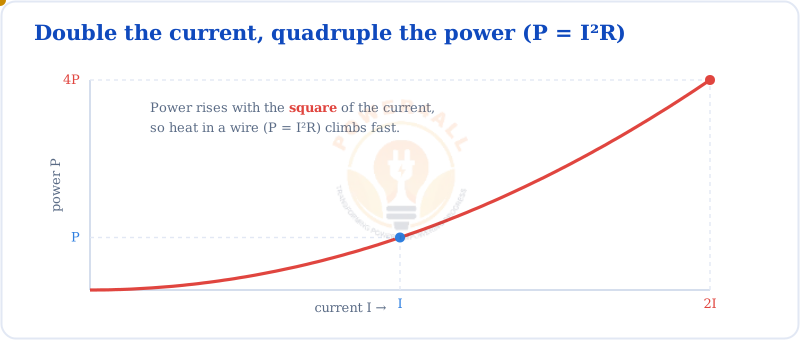
The form P = I²R hides an important warning: power grows with the square of current. Double the current and the power — and the heat — goes up four times.
Worked example — I²R heating in a cable
A cable of 0.5 Ω carries 4 A. The power lost as heat is:
P = I² × R = 4² × 0.5 = 8 W
Raise the current to 8 A and the loss jumps to 8² × 0.5 = 32 W — four times the heat for double the current.
This is why transmission uses high voltage
To deliver the same power at lower current, the grid uses very high voltage. Since losses are I²R, cutting the current is the most effective way to cut wasted heat in the lines.
Watt's Law vs Ohm's Law
They are two different laws that pair perfectly. Ohm's Law is about the relationship between voltage, current and resistance; Watt's Law is about power.
| Ohm's Law | Watt's Law | |
|---|---|---|
| Core formula | V = I × R | P = V × I |
| Relates | Voltage, current, resistance | Power, voltage, current |
| Answers | How much current flows? | How much power is used? |
| Unit of result | Volt / amp / ohm | Watt |
Together they make the power wheel
Neither law alone gives all combinations. Substitute one into the other and you get P = I²R, P = V²/R and the whole 12-formula wheel above.
Where Watt's Law is Used
Watt's Law is behind almost every everyday electrical decision — from choosing a fuse to reading an energy bill.
Appliance ratings
A device's wattage tells you the current it draws (I = P/V) — used to pick fuses, cables and sockets.
Resistor power rating
Use P = I²R to check a resistor won't overheat — see the Resistor Power Rating Calculator.
I²R line losses
Power companies minimise I²R losses in cables by transmitting at high voltage and low current.
Energy & bills
Power in watts × time gives energy in watt-hours — exactly what your meter charges for.
Try the calculators
Put Watt's Law to work with the Power Dissipation Calculator, the Power Triangle Calculator, and the Resistor Power Rating Calculator.
Key Terms at a Glance
The essential Watt's Law vocabulary students and engineers search for.
Watt's Law
P = V × I — the power law.
Watt (W)
Unit of power; 1 W = 1 V × 1 A = 1 J/s.
P = I²R
Power from current and resistance.
P = V²/R
Power from voltage and resistance.
Power triangle
Memory aid for P, V, I.
Power wheel
12 Ohm's + Watt's law formulas.
Frequently Asked Questions
Quick, expert answers to the questions people ask most about Watt's Law.
What is Watt's Law?
Watt's Law, or the power law, states that electrical power equals voltage times current: P = V × I. Power is in watts, so one watt is one volt multiplied by one amp. Combined with Ohm's law it also gives P = I²R and P = V²/R.
What is the formula for Watt's Law?
The basic formula is P = V × I. Using Ohm's law V = I × R, it rewrites as P = I² × R or P = V² / R, so you can find power from any two of voltage, current and resistance.
What is the difference between Watt's Law and Ohm's Law?
Ohm's law relates voltage, current and resistance (V = I × R). Watt's law relates power to voltage and current (P = V × I). They are separate laws, but combining them produces the full set of power formulas and the power wheel.
What are the three forms of the power formula?
P = V × I, P = I² × R, and P = V² / R. The first is Watt's law directly; the other two come from substituting Ohm's law. Pick whichever form uses the two quantities you already know.
How do you calculate power from current and resistance?
Use P = I² × R: square the current in amps and multiply by the resistance in ohms. For example, 2 A through 10 Ω dissipates P = 2² × 10 = 40 W.
Why does power increase with the square of the current?
Because P = I²R. Doubling the current quadruples the power, since the current term is squared. This is why heating in wires and resistors (I²R losses) rises so quickly and why high-current circuits need thicker conductors.
What is the power triangle and power wheel?
The power triangle puts P over V and I; cover the quantity you want to read its formula. The power wheel is bigger — it combines Ohm's and Watt's laws into twelve formulas around a central P, I, V, R hub for every combination.
What unit is Watt's Law power measured in?
Power is measured in watts (W). One watt equals one joule per second and equals one volt times one amp. Larger values use kilowatts (kW) and megawatts (MW).
Conclusion & Key Takeaways
Watt's Law — P = V × I — is the power half of circuit analysis. With Ohm's law it expands into P = I²R and P = V²/R and the full power wheel, letting you find any quantity from any two.
P = V × I
Power = voltage × current.
Measured in watts
1 W = 1 V × 1 A = 1 J/s.
Three forms
VI, I²R, V²/R.
Power wheel
12 formulas with Ohm's law.
Square law
2× current = 4× power.
Everywhere
Ratings, fuses, losses, bills.