B-H Curve & Magnetic Hysteresis
The complete guide to the B-H curve — how a magnetic material responds to a magnetizing force. From the magnetization curve and saturation to the full hysteresis loop, retentivity and coercivity, permeability μ = B/H, hysteresis & core loss, and soft vs hard magnetic materials.
Complete Learning Path — B-H Curve & Hysteresis
From the magnetization curve and the hysteresis loop, to retentivity, coercivity, permeability, core loss, material types and domain theory
What is the B-H Curve?
The B-H curve (or magnetization curve) plots the magnetic flux density B produced inside a material against the magnetizing force H applied to it. It shows, at a glance, how easily — and how far — a material can be magnetized.
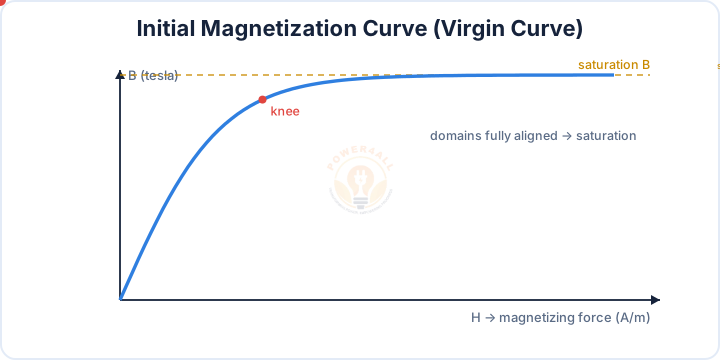
Start from an unmagnetized sample and slowly raise H: B climbs steeply, bends over at the knee, and finally flattens at saturation, where almost all the material's magnetic domains are aligned. This first path is the initial or virgin magnetization curve.
B vs H — keep them straight
H is the cause — the magnetizing force you apply (from current in a coil, H = NI/l), measured in A/m. B is the effect — the resulting flux density inside the material, measured in tesla. Their ratio is the permeability.
The Hysteresis Loop
Now cycle H up and down. Because the material remembers its magnetization, B lags behind H and traces a different path each way — a closed hysteresis loop. “Hysteresis” literally means “lagging behind.”
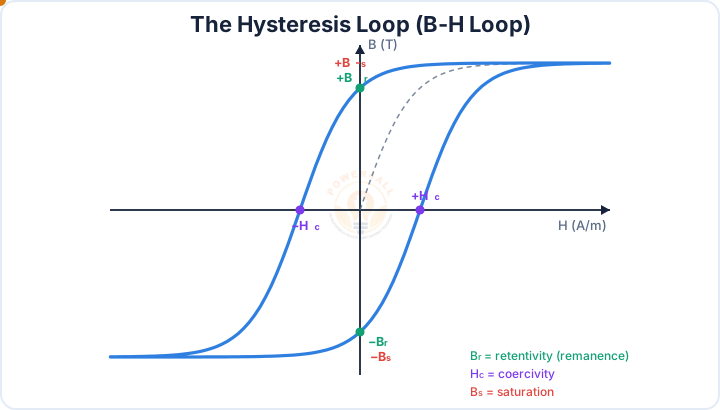
Follow it round: raise H to saturate at +Bs; reduce H to zero and B only falls to +Br (residual magnetism); reverse H to −Hc to force B to zero; drive on to −Bs, and back. That lag is hysteresis.
Retentivity, Coercivity & Saturation
Three points on the loop tell you almost everything about a magnetic material.
Retentivity (Br)
The flux density left over when H returns to zero — the remanence or residual magnetism. It is why permanent magnets stay magnetized.
Coercivity (Hc)
The reverse H needed to push B back to zero — how strongly the material resists being demagnetized.
Saturation (Bs)
The maximum flux density; beyond it, raising H barely raises B because the domains are fully aligned.
Retentivity vs coercivity
They answer different questions. Retentivity: “how much magnetism remains?” (a B value). Coercivity: “how hard is it to remove?” (an H value). A good permanent magnet needs both high.
Permeability μ = B / H
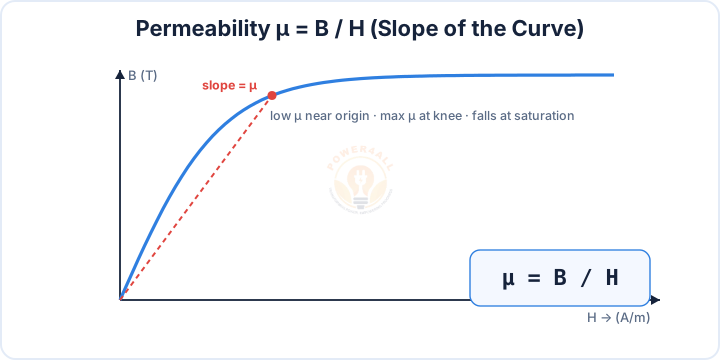
Permeability is the slope of the B-H curve — how much flux density you get for a given magnetizing force. On a curve it is not constant: it changes as the material approaches saturation.
μ = B / H μr = μ / μ0
Absolute permeability and relative permeability (μ0 = 4π×10−7 H/m)
High-permeability materials (soft iron, silicon steel, ferrite) reach a large B for a small H — ideal for concentrating flux in cores. See reluctance & permeance for the magnetic-circuit view.
Hysteresis Loss & Core Loss
Every trip around the loop wastes energy as heat. The energy lost per cycle, per unit volume, equals the area enclosed by the hysteresis loop.
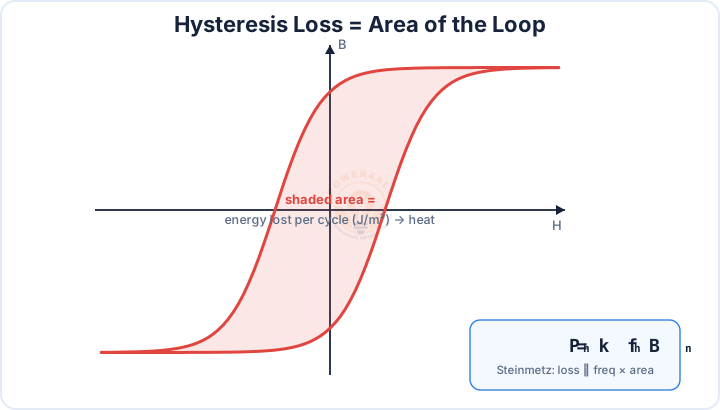
Ph = kh · f · Bmaxn
Steinmetz equation: hysteresis loss rises with frequency f and peak flux density (n ≈ 1.6–2)
Core loss = hysteresis + eddy currents
Total core (iron) loss is hysteresis loss plus eddy-current loss. Hysteresis loss is cut by using low-coercivity materials; eddy-current loss is cut by laminating the core. Both matter in transformers and inductors.
Soft vs Hard Magnetic Materials
The shape of the loop decides what a material is good for — and it splits magnetic materials into two great families.
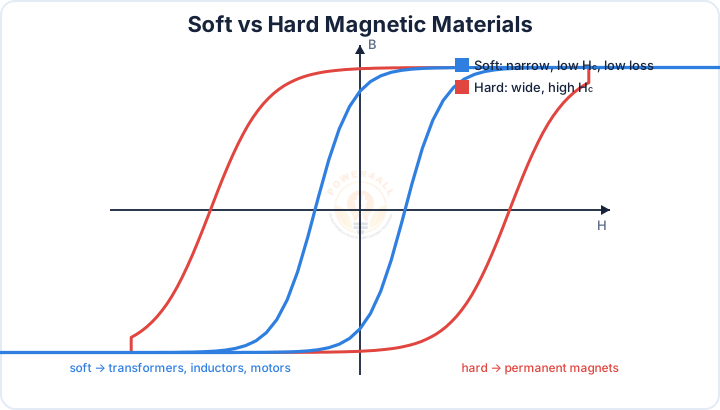
| Property | Soft magnetic | Hard magnetic |
|---|---|---|
| Loop | Narrow, tall | Wide, fat |
| Coercivity Hc | Low | High |
| Hysteresis loss | Low | High |
| Magnetized/demagnetized | Easily | With difficulty |
| Examples | Silicon steel, soft iron, ferrite | Alnico, ferrite magnets, NdFeB |
| Used for | Transformer/inductor/motor cores | Permanent magnets, loudspeakers |
Why It Happens: Magnetic Domains
A ferromagnetic material is divided into tiny regions called domains, each already magnetized. Un-magnetized, they point every which way and cancel out.
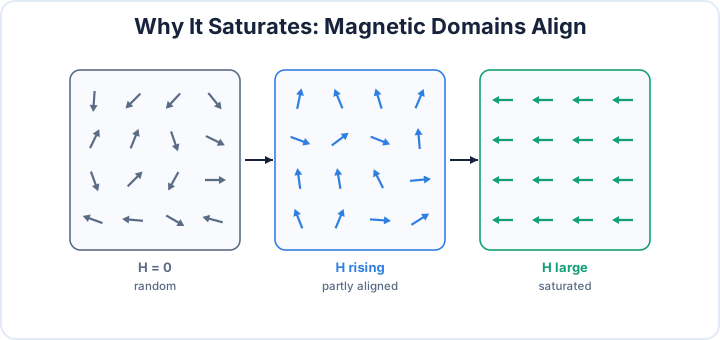
Applying H makes domains grow and rotate to line up with the field, raising B. At saturation almost all are aligned. When H is removed, some stay put — that “stuck” alignment is the retentivity, and the energy spent forcing domains back and forth each cycle is the hysteresis loss.
Where the B-H Curve Matters
The B-H curve is the single most important chart for choosing and using magnetic materials in power engineering.
Transformer & inductor cores
Pick a soft, high-μ, low-loss material and keep B below saturation to avoid distortion and overheating.
Permanent magnets
Choose hard materials with high Br and Hc so they hold their field for motors, speakers and sensors.
Power electronics
Core loss and saturation set the size, efficiency and switching limits of high-frequency magnetics.
Data storage
Magnetic recording relies on retentivity to store bits and coercivity to keep them stable.
Key Terms at a Glance
The essential B-H and hysteresis vocabulary students and engineers search for.
B-H curve
Flux density B vs magnetizing force H.
Hysteresis loop
Closed B-H path when H is cycled.
Retentivity (Br)
Residual B at H = 0.
Coercivity (Hc)
Reverse H to make B = 0.
Saturation (Bs)
Maximum attainable flux density.
Permeability (μ)
Slope B/H of the curve.
Frequently Asked Questions
Quick, expert answers to the questions people ask most about the B-H curve and hysteresis.
What is a B-H curve in simple words?
It is a graph showing how much magnetism (flux density B) a material gains as you apply a magnetizing force H. It rises from zero, curves over at the knee, and flattens at saturation where the material can't be magnetized much further.
What is magnetic hysteresis?
Hysteresis is the lag of B behind H when H is cycled. The material “remembers” its previous state, so B follows a different path up than down, tracing a closed hysteresis loop. The word means “lagging behind.”
What is retentivity (remanence)?
Retentivity, or remanence, is the flux density Br that stays in the material after the magnetizing force is removed (H = 0). It is the residual magnetism that keeps a permanent magnet magnetized.
What is coercivity?
Coercivity Hc is the reverse magnetizing force needed to bring B back to zero. High coercivity means the material strongly resists demagnetization — exactly what a permanent magnet needs.
How do you calculate hysteresis loss?
The loss per cycle per unit volume equals the area of the hysteresis loop. Over time it follows the Steinmetz equation Ph = kh f Bmaxn, so it rises with frequency and peak flux density (n ≈ 1.6–2).
What is the difference between soft and hard magnetic materials?
Soft materials (silicon steel, ferrite) have a narrow loop, low coercivity and low loss — used for transformer and inductor cores. Hard materials have a wide loop and high coercivity — used for permanent magnets.
What is permeability on the B-H curve?
Permeability μ = B/H is the slope of the curve. It is low near the origin, greatest at the knee, and falls towards saturation. High permeability means the material magnetizes easily.
Why does the B-H curve saturate?
The material is made of magnetic domains. As H rises, more domains align with the field, raising B. Once almost all are aligned there are none left to contribute, so B levels off at saturation even as H keeps increasing.
Conclusion & Key Takeaways
The B-H curve and its hysteresis loop capture everything about a magnetic material — how it magnetizes, what it remembers, and how much energy it wastes.
B vs H
Flux density vs magnetizing force.
Hysteresis loop
B lags H when cycled.
Br & Hc
Retentivity & coercivity.
μ = B/H
Permeability is the slope.
Loop area = loss
Hysteresis heat per cycle.
Soft vs hard
Cores vs permanent magnets.